
fbpx Skip to content
Named Best Museum 2022 by Miami New Times

The Miami Herald Spelling Bee always brings back a rush of memories for me, memories of a spelling bee 75 years ago, when, in 1942, at age 15, I soared to the finals representing the Gesu School in downtown Miami, only to miss the word “metamorphosis,” resulting in a third-place finish. I’ve never misspelled it since then!

In fact, “metamorphosis” is entirely appropriate when describing the many careers I’ve had since then. These experiences have included Broadway, television and the cinema, production of an all-night radio show for WOR radio, a powerhouse station in New York City, a position as radio/television director for a large New York City public relations firm, inventor, and author of over 1,000 wisdom word adages found in my book, “James Yoham’s Wisdom Words.”

But let’s look at my world before all of the above. I am the oldest of nine children. In 1938, as the Great Depression was ebbing, all 11 of us piled into our car, along with all of our belongings, and headed from Tell City, Indiana, to Miami with the hope that opportunities for a better life awaited us there. I and my brothers and sister attended the Gesu School (and later the Sts. Peter & Paul School), a large Catholic school run by the Sisters of St. Joseph in downtown Miami, when that quarter was seemingly the center of everything, both good and bad. The school, which stretched from grades one through 12, drew Catholic students from many parts of the county. Throughout the 1940s, I and my siblings engaged in a full range of activities there, including sports. In fact, my late brother Skippy Yoham was a champion boxer, winning many of his matches in the boxing ring standing atop the five-story Gesu school building. Later, he died in a tragic roller coaster accident in Palisades Park, New Jersey.

We were a large happy family, though somewhat challenged financially, which made it a necessity for each of us, as we reached our teenage years, to find employment as newsboys, stock boys in grocery stores, and in other positions, while continuing to attend school. We lived in a few different places in the old, cozy Riverside neighborhood, known today as East Little Havana, north of West Flagler Street and across the Miami River from downtown Miami. It was a neighborhood filled with coconut palm trees and tall Australian pine trees. One of our residences was a large two-story house we built on Northwest Eighth Avenue.

We would often walk to the nearby Miami River and watch the busy boating activity there. We enjoyed playing sports at Riverside Park, which was a few blocks south of us on Southwest Eighth Avenue. We got to know a lot of the kids who attended Ada Merritt Junior High School, which was located just east of the park.

In the last phases of World War II, while still a teenager, I left the warm ambiance of Miami and joined the Navy. However, I was in Miami for the glorious V-J Day celebration, Aug. 15, 1945, in downtown Miami. A photo in the Miami Daily News captured several sailors, bedecked in uniforms, celebrating the end of the war, a celebration that continued into the wee hours of the morning. I was included in that joyous photograph.

After leaving the military service in the late 1940s, I went to Hollywood to study acting at the Geller Theater Workshop under the GI Bill. By the early 1950s, my creative and entrepreneurial interests were on display as I invented a pair of shoes that lit up on the toes. At the same time, I authored a song, “It’s Enough to Make a Preacher Cuss,” which was recorded on Mercury Records by Tiny Hill, an orchestra leader from that era.

In 1953, I moved to New York City and demonstrated my shoes to Russell Markert, choreographer of the Rockettes at Radio City Music Hall. Soon after, I was off to Cleveland working with actor Dom DeLuise as an assistant stage manager; I also had a part in the musical “Carousel.” I really got a hankering for the live stage through this experience, leading me, in 1956, to the Ethel Barrymore Theater on Broadway and the Theater Guild production of “Affair of Honor” with Dennis King, Betsy Palmer and William Prince.

I also worked with actor James Cagney in the 1950s, and on television’s Robert Montgomery show, as well as with Jerry Lewis on his NBC television show. What I enjoyed over all else were my sketches with another comedian, Ernie Kovacs, on his television show in 1956, as well as the piano-playing member of Kovacs’ famous Nairobi Trio.

My career went in a new direction in the early 1960s, as I became a talent coordinator and scheduled guests for Dr. Joyce Brothers’ NBC radio show. Brothers was a psychologist who gained fame from her success on the 1950s television blockbuster, “The $64,000 question.” I was connected by 1964 with another television personality, Dave Garroway, the original host of the “Today” show on NBC.

The 1960s remained a very fruitful time for me. In 1965, I produced “The Amazing Randi Show,” an all-night program for WOR radio. My guests included Garroway; Guy Lombardo, the famed band leader; a young comedian, Dick Cavett; Pearl Buck, who wrote “The GoodEarth;” and Broadway producer Alexander Cohen. In that busy year, I created 250 subjects for discussion and booked 1,500 guests.

In the following year, looking for a change of pace, I became radio/television director of Howard Rubenstein, one of New York City’s premier public relations firms. In my new role, I helped launched the Weight Watchers program, which became wildly successful. As part of our promotion of the program, I was able to plant one story about it with The New York Times and two others in the New York Daily News, as well as bring it to both the “Today” and “Tonight” shows as a topic of discussion. I also did numerous sketches between 1962 and 1968 with Johnny Carson on his popular “Tonight” show.

My career continued into the 1970s and 1980s, and, again, it veered in different directions. In 1979, for instance, I helped begin the field of dental implants with pioneering Dr. Leonard Linkow, arranging for him to appear on national television shows, in newspaper stories, including one appearing in the Miami Herald, and in radio interviews. In the following decade, I worked with Jack Nicholson in the acclaimed film, “Ironweed.” Since then, I have devoted myself to writing and have produced since the mid-1990s more than 1,000 wisdom word adages for upcoming books.

Even with my many peregrinations, I never forgot Miami. Every winter I spend a few months in the Magic City with my large family and friends, many of whom go back to my youth. And even though Miami has changed 180 degrees since then, it still represents home to me. I especially love the large Christmas parties our extended family enjoys at one of my siblings’ homes in greater Miami each year. These parties now draw four generations of Yohams among the scores of family members who attend it. I thought a great deal about Miami and the lucky life I’ve had there and elsewhere when on April 11, 2017, I celebrated my 90th birthday.
We are all aware that Fidel Castro passed away on Nov. 25, 2016, over the Thanksgiving weekend.

We may see photographs and videos of Fidel Castro for decades to come, but we will not see him any longer. I have seen news clips of Cuban-Americans dancing in the streets with great joy on their faces, as well they should.

My parents were from “The Greatest Generation,” as Tom Brokaw describes those who were born in the early part of the 20th century, living through the Great Depression and World War II. My parents married later in life and had children in the baby boomer era.

Long before World War II, my father’s mother died suddenly, right after the Great Depression began. This left my father with no mother and no brothers or sisters. My grandfather left dad in a boarding home to fend for himself, except for meals, by mid-1930. This was a challenging life, but my grandfather stopped in on occasion.

Dad was moved to new schools a number of times, which he described as very challenging. At times, in a new school, the bully would find him.

In general, however, Dad developed an ease in making friends wherever he went. Not only did he make friends, he generally kept them.

Dad was drafted during World War II before the Pearl Harbor attack on Dec. 7, 1941. He was in Louisiana, and was eventually called home to care for his very ill father, and his single aunt, then in a care facility. She passed some time later, and Dad was drafted again. This time he was sent to MacDill Air Force Base in Tampa.

He was in the Army Air Corps, and worked as a mechanic on planes going east. Dad had plenty of stories to tell from his war days.

When he left the service, he had to hitchhike his way home. When I heard that as an adult, I will admit that I was not happy with Uncle Sam leaving Dad sort of stranded. Couldn’t they afford a train ticket? Thankfully, he got home safely.

Dad was trained as an electrician with the help of the GI Bill. (Okay, thank you, Uncle Sam.) He didn’t date my mother until late 1949 or very early 1950, as they had to save from scratch before they married.

My parents were living in their second house by 1957. My father felt a great urgency in 1962, based on the nightly news, to build a bomb shelter in our basement. Recently, I heard from a prior neighbor who was 8 years old when I was approaching 4. She heard about our bomb shelter, and asked her father, a World War II vet with higher ranking, why they weren’t building one.

Word got out in our Chicago neighborhood. This project, unlike others my father took up, became known as “Jim’s White Elephant.” He continued building it until he was satisfied that this one room had enough space for us, and just enough concrete to give fall-out protection.

Despite the neighbors’ label of this project, a new trend developed in the fall of 1962. On Sept. 4, 1962, President John F. Kennedy issued a public warning against weapons in Cuba. By October, the tensions between the United States and the Soviet Union were heating up. Reconnaissance showed bombs stored in Cuba.

As the neighbors started talking more and more about the bombs being so close to home, and the frightening disposition of a young Fidel Castro as seen on the news, their tune was changing.

Neighbors started to “stop by” our home, one family at a time. People summarized their unexpected visit by asking if their family, please, could benefit from our bomb shelter as well. As I have heard it told, Dad didn’t turn anyone down.

Our house was sold almost 20 years ago. I have no doubt that the well-known bomb shelter bit the concrete dust.

Dad, here’s to dancing with our Cuban-American neighbors, whether in Chicago, in Miami, or anywhere they can be found.

I remember the summer night that challenged me to find peace within myself and serenity in my neighborhood.

It was the summer of 2015, 2:00 a.m., Kendrick Lamar’s album “To Pimp a Butterfly” was playing, and I was just getting off from working the night shift at the Worldwide Marriott call center in Doral. After sitting in traffic for almost two hours on the southbound turnpike due to the endless construction road closures every night, I finally arrived in Goulds with a sigh of relief, only to find that the streets were hot and the air was filled with smoke. I came to the intersection that leads me home, but not before I was approached at the stop sign by a prostitute who in his very deep voice and yellow mini dress said, “Hello there.” I drove off to continue home, pulled into my driveway, and knocked on my parents’ bedroom door to assure them that I made it home safely. 

I sat on the couch with the echoing sounds of gun shots from a couple blocks over, and I told myself there has to be more to Goulds than poverty, violence, drugs, and prostitution.

The next day I recall talking to my younger sister, Quiana, and telling her that I wanted to begin a photo series that will acknowledge the positives of our community. So the journey began and we drove around the entire neighborhood, stumbling across dilapidated buildings that once housed community entrepreneurs. We sat by peaceful parks that had crystal blue waters, and for once I remember feeling calm as if we were on a secret oasis. I thought this was the end of my journey, but I remember feeling that I had to do more – I had to speak with my community members and help them understand the beautiful culture that our neighborhood holds. But how?

Driving home from working the night shift again, I traveled past an empty lot that had a cloud of smoke surrounding it. It’s a BBQ vendor. I turned the corner and recognize another empty lot that has one bright light peeking through a similar cloud of smoke. It is a BBQ vendor. I made it home to repeat my nightly ritual of knocking on the door to tell my parents I’m home and then sitting on the couch, but this time was different. This time I had an epiphany. Every night as I drive home from work I see these BBQ vendors, religiously set up to work the night shift on their undeclared vacant lots.

I’d found the answer to my question.

We will showcase the beautiful culture in Goulds by documenting a photo series of these inspiring BBQ entrepreneurs and displaying their impact on our neighborhood at a community BBQ extravaganza and photo gallery.

Quiana and I set out to talk to the BBQ vendors in hopes that they would want to participate in this photo series. To our surprise we were greeted with open arms, warm conversation, sweet iced tea, and mouth-watering rib sandwiches. 

Being able to capture images on the first night of meeting these BBQ vendors allowed for raw and authentic artistry and conversation.

The first conversation was with Mama Dukes over sweet iced tea. It was very humbling as she explained to us that she began barbecuing as a way to raise funds to help pay for her daughter’s wedding and eventually fell in love with serving the community by selling her food. Our relationship with the BBQ vendors grew rapidly and the camera soon became invisible as if it were only an extension of my eye. 

Engaging with complete strangers who share the same culture and community as I do has sparked a light in my heart that I want the rest of Miami to be able to feel. Look at Mr. Sam, who has been grilling for over 20 years. One night while we were taking photos and interviewing him, he was completely unbothered by the active crime scene nearby, and felt compelled to tell me about his first experience of barbecuing at a family event.  That is when he knew that this is what he was supposed to be doing because he is so confidently good at it.

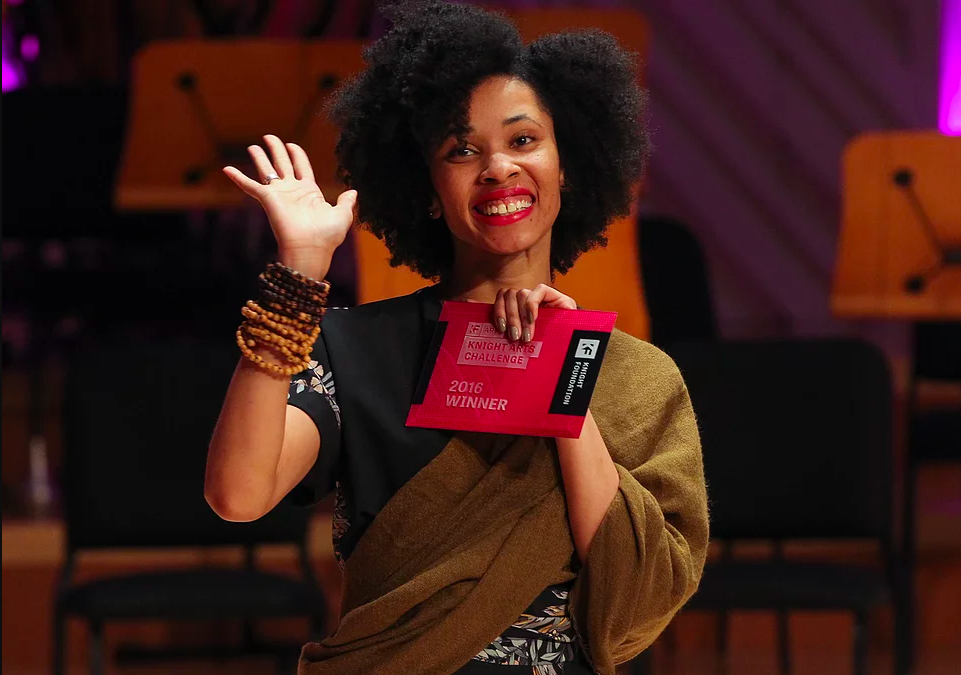
The audacious personalities of these vendors are what have inspired me to work even harder to find peace within myself and showcase the cultivating community that we have here in Goulds. My next challenge has been figuring out how to come up with the funds to actually make this event possible, because my weekly paycheck wouldn’t remotely cover the cost. One day at my goodbye luncheon for my internship at MDC Live Arts, my sister encouraged a conversation about what we had been working on. I was in awe that someone whom I consider to be a mentor convinced me that the story was good enough to apply for a grant. And so I did just that with only six hours before the Knights Art Challenge deadline. I poured my heart out about this photo series, not knowing that my project, entitled “The Unvoiced Community: BBQ Men & Women of Goulds,” would become a finalist and later a recipient of the grant. Because it is a matching grant I am now working tirelessly to raise the rest of the funds to make this initiative a success, not only for my community but for those who may also be searching for serenity in their neighborhoods.

Not only did I find peace through BBQ, I also found my voice in the community, and I encourage you to eat BBQ and unlock your peace.

My Miami story begins in the late 1940s with my birth at Christian Hospital in Overtown. Six years later, my identical twin brothers were born at Mount Sinai Hospital. Things do change. The twins have always called me “Doll.” They couldn’t pronounce my name. Since I had so many dolls, that name made sense.

I can remember when a milkman would deliver milk to your home. Before my time, an iceman delivered ice for the ice box (refrigerator). Recently, my 10-year-old grandson asked me, “Grandma, what is a telephone?” He knows phone, but he was clueless about a telephone!

Unlike my two daughters’ experience growing up in Miami, all four of my grandparents were alive until my maternal grandfather passed away in 1959. I even knew one great-grandparent. My maternal grandfather, Amaziah Melvin Cohen was one of the 162 black men who stood for the incorporation of the city of Miami on July 28, 1896. There were less than 500 white men in Miami, so Henry Flagler “used” his black railroad workers to fill the gap. Shortly thereafter, they were disenfranchised. Not even Julia Tuttle, who founded the city, could be an incorporator. Women did not get the right to vote until 1920.

My grandfather, A.M. Cohen, was born in Sumter County, South Carolina. Black men traveled south through Indian territory in search of the work — building a railroad. Many of them walked to get here! I call this a reverse migration, blacks traveling to the South, rather than north or to the Midwest (Chicago, Detroit, etc.) or west to California, as they did during the Great Migration (1915-70).

My fondest memory of my grandfather was riding around with him. I let him know that there was a Royal Castle hamburger joint just around the next corner. I loved Royal Castle hamburgers and he made sure I got as many as I wanted.

My maternal grandmother, Mamie Evans, arrived in Miami by horse and buggy from Americus, Georgia, at the age of 8. Her mother, Missouri Evans, sent Mamie to Miami with the family of Parker Henderson. He was Miami’s seventh mayor. However, Missouri made it very clear that Mamie was coming to be educated and not become a live-in maid.

When the railroad building ended, A.M. Cohen worked at the Henderson Lumber Company. He and Mamie were married in 1910 and had 15 children — 10 boys and five girls. Mamie never got educated but she made sure their children did. Their professions included police officer, truant officer, school principal, librarian, dentist, beautician, barber, architect, nurse, veteran, businesswoman and minister.

Before my grandfather became a minister, he ran several ventures. He operated a jitney service from Colored Town (Overtown) to Homestead employing 20 people. He also had a gospel radio show and brought gospel singers from out of town to sing at the church — including Mahalia Jackson. However, my grandfather’s life work was the ministry. He was the highly respected bishop of the Miami Temple Church of God in Christ (C.O.G.I.C.) of Eastern Florida.

Overtown’s black entrepreneurs were plentiful. There were skilled tradesmen, medical professionals, barbers, beauticians, cleaners, and even Negro Improvement Associations. Florence Gaskins, a businesswoman, came from Jacksonville. Dana Albert Dorsey, Miami’s first black millionaire, was born in Quitman, Georgia. Kelsey Leroy Pharr, a mortician and an appointed consul for the Republic of Liberia, West Africa, was born in Chester, South Carolina.

My paternal grandparents lived on Charles Avenue in Coconut Grove, two doors down from Mariah Brown’s historic home. Since 1925 their home has been in my family and is still owned by my family. My paternal grandmother arrived in 1911 from Governor’s Harbor, Eleuthra, Bahamas. My paternal grandfather arrived in 1916 from Orlando. My great-grandmother, Zilpha Petty, came to live with them. I remember Great-grandma Petty because she sat by the kitchen door and would reach out to grab you when you walked by her. I would scream and run from her.

Getting back to my story, my parents, Eddie Birmingham Bunyan Jr. and Florence Cohen Bunyan, were the biggest influence in my life. Both graduated from Florida A&M College (now University). My father spent his entire working career with Dade County Public Schools and my mother was a smart and zany businesswoman.

When my parents talked to their children, we listened and we followed their advice with few complaints and no rebellion. All three of us still live in South Florida. As an adult, I have lived in Atlanta, San Francisco and Washington, D.C. However, I chose to come back to Miami in 1974. I truly love this city and the incredibly diverse people. My unfulfilled wish is to see Black Miami truly be a genuine part of Miami’s economic mainstream.

I was born in New Jersey in the wonderful year of 1958. I was raised in Jersey City, and there on the Jersey shore is where my child-rearing and life-saving career began.

I was in New Jersey through my formative years in high school and going to college. During the summer, I started working as a lifeguard at a pool and then stepped up to working on the beach, which is a whole different atmosphere.

I came to Miami Beach in 1993, which gives me a little over 23 years working for the Miami Beach Fire Department’s Ocean Rescue division.

Originally, my plan out of college was to teach during the school year so I could be a lifeguard during the summer, but coming from New Jersey that was only a summer seasonal job, and the call of the ocean was so strong that I came to Florida in hopes of getting a job as a lifeguard here.

I had a teaching degree in health and physical education, recreation and dance, which I thought would make a good degree for a career as a lifeguard. New Jersey had some inclement and snowy weather though, so I wanted to find a place that was sunny 365 days of the year.

A moment that influenced me was when I worked at my first pool job and I saved someone’s life. It may sound overdramatic, but had I not been there it could have been much worse. And that was the rush. That was a draw for me to lifeguarding, being able to have an impact on a person’s life (or death), and that followed me through college where I worked during the summers as a lifeguard.

I then became interested in ocean rescue and lifeguarding on the beach, which is different from working at a pool or a water park. The confines of the pool can be limiting, but the wide range of the ocean is a challenge.

The job of any lifeguard is to ensure that anybody who enters a body of water, large or small, does not drown. At the ocean, we deal with additional factors like the weather that can change very quickly and drastically. The ocean is very different than a pool, and there are deep and shallow spots all over the ocean and also waves.

We want new lifeguards to understand how the beach is a unique environment and what he or she needs to know about their job on the beach. Miami Beach is a wonderful place; we joke about it and say that it’s “surf, sun and sex.” It’s an area with various cultures, ethnicities and different kinds of people out on the beach, which can be distracting for new lifeguards and the public. We want our lifeguards to stay focused.

There have been unfortunate medical issues and fatalities where someone died, and we want to keep this from happening as much as possible. Cardiac arrest on the beach is often fatal. It’s sometimes treatable, but out in the water it can be very dangerous. Our goal is to make sure that nobody drowns, and we are good at it. But there are situations that are beyond our control.

To this day I still am occasionally stumped. After 30 years on the beach, there are always new things that I see and need to know how to address.

Here’s a funny story: There was a group of young men who were out swimming, and as they were returning one of them was having trouble, doing what we call the “tip-toe dance” on the bottom of the ocean. He started to cramp up from bouncing up and down in the ocean, and once the group made it back to shore his friends all tried to help him treat the cramp in his calf. He started howling in pain, and his friends didn’t know that they should help him massage the cramp so it would heal. Instead they thought that they should pull all of the hair out of his leg where he was cramping.

They start pulling handfuls of hairs from his leg, and now he was screaming from that and the leg cramp. We had to explain to his friends that ripping the hair out of his leg wasn’t going to help him, and we helped him recover from his cramp. This is one of the weird things that happen on the beach.

There’s no other place comparable to Miami Beach or South Florida in the United States other than the Hawaiian Islands, where there are warmer waters.

People here are also more scantily dressed; they don’t have to worry about their winter outfits. Here in Miami it’s a very outdoors-oriented and physical experience on the beach. In beach culture in general, you see people enjoying the weather, the water, and the sun. For much of the coastal United States, it’s a different feel in those communities and cities than in the rest of the country, and I think it’s because of the beach access. It’s a beautiful thing. I have a sign on my wall at home that says, “The ocean fixes everything.” It’s a great place to live and work while other people are here to enjoy their vacation.

I’m not going to complain about living here, but personally I have issues when my family members visit and they want to go to the beach, obviously, and I want to go elsewhere. I also notice that when I’m at the beach, I’m never off-duty. A lot of times I’ll have to turn my chair around so I’m not looking at the ocean, but I always carry the lifeguarding duty with me.

A job is job, but a job working at the beach beats anything. It’s a great place to be.

This story was transcribed from an interview between Gerry Falconer, a Miami Beach lifeguard, and the HistoryMiami South Florida Folklife Center as part of a research project exploring the question “What Makes Miami Miami?” The Florida Folklife Program, a component of the Florida Department of State’s Division of Historical Resources, directed the project.

This story was transcribed from an interview during the opening night of HistoryMiami Museum’s ‘Hurricane Andrew: 25 Years Later’ exhibit. It was recorded in the Miami Stories booth, a partnership between WLRN and the HistoryMiami Museum.

I grew up in Miami so I’ve been through a lot of hurricanes. I remember in high school just watching the storm from my screened-in back porch. It was always a mess to clean up after but it was no big deal. But Andrew was unlike any other hurricane I’ve ever experienced.

I have a lot of glass doors on either side of my living room area and during the storm I literally had to get up and nail my front door shut because it kept blowing open. My living room was full of leaves. It was just amazing to me that so much stuff could come into the house even with the doors closed. It just tells you what the force of those winds were. I was with my then-husband, who was British and had no concept of hurricanes.

I had a lanai outside my bathroom and it was built around a sea grape tree. I realized the storm was going to take the sea grape tree and the lanai with it, so I ran and grabbed the iron bird cage I had out there and brought it inside in the middle of the storm. But you do what you have to do and thank God we were safe and uninjured, although I can’t say the same for our yard.

We had huge ficus trees that were knocked over. I couldn’t even get to my garage for three days. We had to cut a hole through the trees to be able to get the car out of the garage. My whole yard was shaded before Andrew and that all changed after the storm. It was unbelievable.

Of course, we also lost power, and when we lose power we lose water in my house. Back then I was still on well water. We didn’t get power back for several weeks. We had to go out and get a generator so we could pump some water, at least occasionally.

It took us months just to get gas in our car. Nobody had electricity to pump gas and we also needed gas for the chainsaws we used to cut through trees. I had stored just enough to use for the chainsaws and to drive to North Miami to fill up my car.

Sadly, my cat was a casualty of the storm’s aftermath. The kids came home from school one day and found her right by a pile of dirt and debris. It was traumatic for them. She kind of blended in with all the dead leaves and I think she must have gotten hit by a car. All the fish in my pond also died because pine needles fell in. I guess the toxins in that just killed them. I never expected that to happen.

I really saw first-hand the effects the storm had on wildlife. One of my ficus trees must’ve had a nest of squirrels in it because all these squirrels would come up to the back door. After the storm, they would come and crawl up my leg looking for peanuts in my pockets.

One day about a month after the storm, I was in my house, which was open since we didn’t have any air conditioning. I was sitting at the table having some lunch and a squirrel came in to have lunch with me.

It actually got up on the table and kept trying to drink some of the Coke I was having with my sandwich. I thought, “Oh the poor thing is thirsty.” So I got a little ramekin, put some water in it and put it down.

I fixed it a plate of some sunflower seeds and pears and other things and it sat there right beside me at the table eating its lunch.

But it still kept trying to get my Coke. So I poured out the water and poured in a little Coke in the ramekin. The squirrel drank it right away. And then it was looking for more. It was so funny. I guess the squirrel liked sugar. Maybe they were just traumatized, too.

I was a member of the Master Chorale and I couldn’t go to my choir rehearsal because people were not allowed to be out at night. We meet in Fort Lauderdale and the members up there didn’t understand why the Miami members couldn’t come up. The storm was nothing to people just literally up the road. That was very strange. They had no idea what the devastation was.

And we were the lucky ones. It was years before a lot of places got rebuilt and some never did. About two years later, I went down to a fishing store off U.S. 1 and about [Southwest] 136th Street. I walked up to it to open the door and realized there was no roof. It was just the front of this whole shopping area. It looked perfectly normal from the street, but there was no roof on the building and nobody inside.

Hurricane Andrew impacted this city so deeply. I can’t believe it’s been 25 years and that so much has been rebuilt. I just hope we’re more prepared in the future. I know I am. I have city water now. No well.

I’m Lance Scott O’Brian and I was born at North Miami General, which no longer exists. I grew up in Coconut Grove and South Miami.

I’m a hippie baby who grew up with a hippie mom. Mom didn’t have it easy. Dad died when I was almost 5. I was the oldest so you can imagine what the other two brothers were like. But I give her a lot of credit. We all had a strong bond.

My two biggest loves in life that aren’t people are surfing and reggae. They were both introduced to me by my mother’s brother, my Uncle Robbie. I can remember surfing with him as young as 4 years old.

But this being Florida, the only times we could catch great waves was during hurricanes. Hurricane Sandy (in 2012) brought some of the best waves I’ve ever surfed in Florida. We didn’t get the full effects of the hurricane but we got the optimal effects as far as the waves. There were probably waves in excess of 20 feet, bigger than a two-story building. It was like nothing I’d ever seen.

It takes a level of bravery to surf during hurricanes. I think Florida as a whole creates hardcore surfers. We constantly have that feeling of wanting what we can’t have. And when you get some, you just want more. That’s the kind of surfer that’s been bred in South Florida. The 11-time world surfing champion is from Florida, of all places. It’s one of the worst in the world for consistently good surf. But we produce hardcore surfers.

We have to be very dedicated, plus we need to have courage and maybe a little ignorance and stupidity. But you also learn when it’s good and when it’s bad.

I remember this one hurricane where they were saying the offshore winds were over 100 mph. I drove my car right up to the beach to check the waves. I had a little car at the time and it was shaking. It almost felt like it was elevating. The winds were so good that I surfed for three hours by myself.

During Andrew (in 1992) they evacuated the beach but I stayed, and with my friend Oscar we spent the night at my place on West Avenue. At the time I was living on the second floor and they said storm surge would be as high as 20 feet initially. So being on the second floor wasn’t even high enough. Then they lowered it to 10, maybe 12, feet.

Oscar and I couldn’t sleep because the wind was blowing so hard it was rattling the windows. At 3 a.m., we heard a loud crash. One of the back windows had broken in the bedroom. The two buildings to the east of me created a wind tunnel, so the sound was amplified. What happened was a pebble went through one of my windows and it was so incredibly noisy.

We tied one of our surfboard leashes around the door handle because it wouldn’t stay shut tight. We had a battery powered radio and were listening to (meteorologist) Bryan Norcross on the radio. Oscar even called him up.

Bryan said, We got Oscar in Miami Beach. What are you doing in Miami Beach? You’re not supposed to be out there.” We told him we’re on the second floor and that we planned to go surf and jump off the second floor into the water. He called us crazy, so that was funny.

We ended up falling asleep a little bit after it calmed down, probably 5 o’clock in the morning. I think we slept for maybe two hours. I remember being all hot and sweaty and we jumped in the car, grabbed the boat as we went to the beach and it was horrible. There were waves but they were so weak and breaking on the shore. I kept thinking about how I made all these sacrifices for this. I was so bummed.

But it’s always a gamble. When I moved up to the Panhandle we went through Hurricane Eloise (in 1975). It wiped out Panama City. Then we went to Mobile, Alabama, where seven tornadoes touched down. Then I went to North Carolina for college and in my first year there were eight hurricanes that hit southern North Carolina.

So I’ve been through a lot of hurricanes. They don’t faze me. I know what they can do. I know when they’re most dangerous. They’re unpredictable, so you have to be very cautious and on alert. I think I would probably be a better judge than most because I’ve had a lot of experience. But at the same time you don’t want to be stupid.

I’ve definitely taken some risks to surf, when most people are probably getting out of town. I remember driving down Ocean Drive and all the hotels were boarded up.

What surfing does for me is a lot. It’s that whole spiritual, emotional and physical element that it brings to my life. That’s why I love it so much. Nothing else has brought to me what surfing does.

I was born at Victoria Hospital in Miami, which is still there.

When I was a kid in the 1930s we didn’t wear shoes, no matter how hot the streets were. I think the bottoms of our feet turned into something else. We would race from one patch of grass to the next. We couldn’t afford to wear shoes because nobody had any money.

My family was living in an apartment in downtown Miami when the great hurricane of 1926 struck. After that my father decided we needed a house and bought one in what is now Little Havana.

My bedroom was in the back of the house and under my windows my father made a beautiful pool and put in koi fish so I could look out and see something pretty. And then, when he saw I was making friends in high school, he made a barbecue out in the back so I could have friends over.

My father had a jewelry store in downtown Miami in the Capital building. We had a fox terrier that would walk from our house in Little Havana all the way to my father’s store downtown. It would cross the bridge and everything. We had no idea that little dog could take that walk all the way downtown until he was sitting by the door waiting for somebody to let him in.

During World War II my father kept two things: a gun and land he had in Tampa. I knew if something happened in Miami he would be putting us in his car and heading for Tampa. And I was really frightened because I think he would have killed us all before he’d let them take us. We were Jewish and the Nazis wanted to get rid of all the Jews in the whole world. Luckily nothing like what had happened in Europe ever made its way to Miami.

For fun we used to go watch movies or go to Bayfront Park to watch the boats come in. The Orange Bowl was right by my house. Celebrities came in all the time. All the kids in the neighborhood would stand there looking pitiful and they would let you in.

We saw some very important people and movie stars. I remember going to see Sonja Henie ice skate there once. I went with my brother, but he didn’t stay with me to make sure that I got in and I was left behind there alone at night. I went home crying all the way and my brother was in deep trouble.

I loved my neighborhood. And it was near a good school, Citrus Grove. I just loved it there. The teachers would use me as a second teacher in the room. In the second grade I used to read to the class when the teacher had to go to the bathroom.

I had been called names by some of the kids, but the teachers made it clear that they loved me. They would also buy groceries for the children who couldn’t afford food. It made all the difference for me. So I wanted to be an elementary school teacher when I grew up, and I was.

I went to high school at Miami High and then went to Florida State, which was an all-girls school then. The men had to come up from Gainesville to date us.

I was later pushed into a marriage. The only good thing about it was my two children. I got divorced from my husband in the early 1970s.

When Norman, a man I dated in college who became an attorney, found out about my divorce, he contacted me, we dated and got married. He was a second father to my children and we were married for 35 years until he died five years ago.

I got my master’s back home at the University of Miami. They didn’t have many buildings back then and they were all wooden. And it was so hot because there was no air conditioning.

My first teaching job was at St. Thomas Episcopal, where I was treated like family, despite my being of another faith.

But they paid next to nothing, so I finally decided if I was going to be a teacher I might as well be in the public school system. I went to Whispering Pines in Cutler Ridge. I was there for about 25 years, from the 1960s into the ’80s. Then a friend of mine asked me to teach with her at Avocado Elementary School in Homestead.

I loved teaching. We had the children who really wanted to learn and I always thought teaching was fun.

I was also teaching children who didn’t speak English and were learning the language. I taught the children in my class to be helpful to these new children. I never had a problem with it because the kids liked each other and they were proud to teach and learn from each other.

The school system changed so much throughout my time as a teacher. They never thought you had to do anything different for a child who had a really high IQ.

A lot of the children that I got would be labeled as “rowdy” and “lazy.” The truth was they were bored to death. So when they sent them to me they thought they’d been dropped into heaven because I realized they needed to be challenged.

My oldest teaching partner was Allie the alligator.

It was my daughter’s puppet that I brought into class one day to play with the kids. He suddenly became very important to my lesson plan. I think children learn a little bit more when they’re also having fun. Also, an alligator is something they’re likely to see outside of the classroom.

So that connects them, in a way, to where they are, Miami, Florida. The place that’s given me everything.

Saturday at 4:30 a.m. If you don’t have trouble getting up, you’re probably a runner. Weekdays are fun runs, under four miles. Saturdays are exciting. Saturdays are long runs! Toe socks, water belt, jelly beans, light clip — it is with a respectful sense of ceremony that I put on my running shoes. I step outside and feel the palm trees smiling at me in the dark. I am ready to conquer the city. My city. Miami.

About five-and-a-half million people call Miami home. And it’s easy to feel at home, whether you are into salsa, jazz, tennis, vintage biking, sushi or pho. Many of us grew up somewhere else — for me it was Guayaquil, Ecuador — and we dreamed of a Miami vacation. Fate was good to us; vacation is only a half-hour from our beds.

#MyMiami is quiet and peaceful. #MyMiami whispers to me on Saturday mornings: “Be the first one to see the new day Cynthia, and nail those miles. You can do this girl!”

The stretching begins at 5:15. Then the different pace groups set off, the fastest first. We head east on Sunset Drive. The trees send us a dark embrace. The sidewalk is uneven, studded with roots. Still, we fight our urge to ignore our pace, for we know very well we need to save energy for the last mile.

We turn left onto beautiful, moon-bathed Maynada Street, which gifts us with a wide, smooth concrete sidewalk. Runner’s paradise. Past the little bridge over the canal, we turn right at the traffic circle onto Hardee Road.

We stop at the water station at Coco Plum Circle. The two-mile warming is done. After the Circle, the run will get real. We all take pictures and encourage one another while the group is still together (we will split around mile 7). It’s still dark. The palm trees, tall and beautiful, smile approvingly at us, next to yachts and houses with guest quarters.

“OK, guys, let’s do this!” says Betty, our pace leader. “Enjoy!” says one of the bikers. “We will!” we respond. The biker means it. We mean it too. Complete exhaustion is such joy.

We go onto Edgewater Drive and hit the Mile 3 mark before turning onto Douglas Road.

We turn onto Douglas Road, past Vanguard School onto Main Highway. There is no sidewalk; the road is narrow and the traffic is heavier. Main Highway is long and dark and curvy. We know every curve, especially the last one, for after that, CocoWalk.

CocoWalk is best when empty. I know, we usually go to, well, walk, and see people. But there’s a certain intimacy between the empty cafes and the runners. We will see dawn in CocoWalk — but first, the towel angels!

We are almost at Mile 5 when this heavenly vision appears at St. Stephens Church: Angels with ice-cold wet towels!

People and their dogs are beginning to show up at the park in front of the marina. They greet us with, “Great job!” We continue down CocoWalk back to Main Highway. As we enter into Main Highway, we chat and giggle, and check on the ones behind. The groups will split at Mile 7.

A little bit before Douglas Road, our perspectives begin to change. We need to focus more, we need to lift up our knees more, we need to want it more. Somewhere down Douglas Road, the groups are regrouped because our paces need to be adjusted.

Motivation comes from all sources. More people, more dogs, more bikes, more cars. Each step is a thought process now, the running technique needs to be applied according to your strife. They may say it becomes natural, but I still have to think about it past Mile 7. On the way to Coco Walk, I see every house, every balcony, every garden; but on the way back I need to concentrate on my steps. “Knees up, land flat on your feet, knees up, land flat on your feet.”

My grandma used to say: “If life overwhelms you, try wearing a pair of shoes one size too small for a day.” Same concept with running. Mile 9 is the point where you let go of your heartbreaks and conflicts, for at this point nothing hurts more than every muscle of your body. You find strength in your pain. Lift up your knees.

Maynada Street. One more mile. The last mile is the toughest mile. Everything is possible if you believe.

Sunset Drive. It is a mental fight now. Your legs will do what your mind commands. Your heart will obey your will. Sunset Place is two blocks away. No stopping until we reach the traffic light across from Barnes & Noble. There is life in the cafes of SoMi. We clap and high-five each other. Our self-esteem is up in the clouds, and Miami, as always, is at our feet.

I was born in Cuba. My name “Karelia” has an interesting background. The name is not of Hispanic origin but Russian. There is a region known as the Russian Republic of Karelia, and “Karelia Suite, Op. 11,” was written by Jean Sibelius in 1893.

My family immigrated to the United States when I was 5 years old. We arrived as refugees at the historic Freedom Tower in Miami and were welcomed with food and clothes. We stayed with relatives in Miami until we settled in New York. I was 13 when we moved to Fort Lauderdale, where I graduated from Westminster Academy. After high school, my family moved once again, this time to a 1940s Art Deco gem on De Soto Boulevard in Coral Gables. It was designated historic in the early 2000s. I have lived in Coral Gables ever since — drawn to the panoply of distinct architecture in this city founded by George Merrick 90 years ago.

In 1980, shortly before my family’s move to Coral Gables, I met my future husband, Marino, in Fort Lauderdale at the legendary but now defunct Pete & Lenny’s club. It was at the height of disco fever and Marino was a dancer in a disco contest.

Three years later, on May 29, 1983, we traveled from Coral Gables to New York City for our wedding ceremony at the historic St. Patrick’s Cathedral. On our return to Coral Gables as newlyweds, we rented a quaint coral rock home on Columbus Boulevard. Our son, Brenden Marino, was born there in 1985. In 1986, we bought our first and only home — an Old Spanish beauty with good bones, large French windows, cathedral ceiling, pinewood floors, pecky cypress ceiling in the sitting room, and a coral rock fireplace. The outside facade was painted pink and embellished with tall pines that stood as decorative statuettes. That year, the city of Coral Gables recognized our home with a beautification award.

We have been happily married for 34 years — happily living in Coral Gables.

My husband also came to this country from Cuba as a young boy. Today, no longer a disco dancer, he is a private practitioner, a licensed and certified psychotherapist. His credentials include a doctorate in child and youth studies from Nova Southeastern University’s Fischler Graduate School of Education.

We are proud parents of a handsome son who is “an officer and a gentleman” and the pride of the family. Brenden grew up in Coral Gables attending St. Philip’s Episcopal School and Ransom Everglades School. He majored in ethics, politics, and economics at Yale University and continued his studies at the University of Pennsylvania School of Law. Upon his passing the New York bar, Brenden decided to serve his country as a commissioned U.S. Air Force JAG (judge advocate general).

As for me, I hold a doctorate in public administration with a concentration on nonprofit management from Nova Southeastern University.

For me, it is an honor to have the opportunity to serve my community as a nonprofit professional. I am especially drawn to the smaller charitable organizations trying to do so much good with so little. From facilitating an organization to reach its million-dollar milestone to setting in place the tools and structure for sustainability — I am honored to offer my expertise. Many small nonprofits just need a bit of professional guidance in order to attain financial viability.

At present, I am an independent fundraising and communications consultant after many years employed in the not-for-profit independent school sector. I headed the alumni office at Ransom Everglades School and before that as development director at Carrollton School of the Sacred Heart. As a consultant, I have worked with St. Thomas Episcopal School and St. Stephen’s Episcopal Day School.

I continue to love my City Beautiful and give back as much as possible.

I call myself an “accidental preservationist.” I basically stumbled into serving on the Historic Preservation Association of Coral Gables (HPACG) board back in 2012. Lured to join the organization by long-time preservationist and founding HPACG member Ellen Uguccioni, I find myself gradually becoming more drawn to the protection of historical patrimony and an ardent protector of all things “old” here in the city of Coral Gables and beyond.

One of HPACG’s signature preservation projects has been years in the making and has required perseverance and deep dedication. Our group’s focus has been advocating the historical importance and preservation of the last remaining landmarked streetlights in Coral Gables known as the “1926 White Way Lights.” One of the barriers to the preservation project has been a convoluted contractual relationship between the city of Coral Gables and the Florida Power & Light. The barrier impedes the city in forging ahead with much-needed restoration. Hopefully, a satisfactory outcome will soon pave the way for Coral Gables and HPACG to begin restoring the remaining 45 of the 500 original streetlights.

Beside historic preservation, my other passions include art and travel. I enjoy art in all its forms — from paint to performance to everything in between. The world is our oyster, as the saying goes. As a family we have traveled to more than 30 countries to date. In 2016, my husband and I made several emotionally laden trips that included visiting our native Cuba for the first time since our childhoods; joining parishioners of the Church of Little Flower in Coral Gables on a pilgrimage to Lourdes, Normandy, Liseaux, and Paris in celebration of the church’s 90th anniversary; and traveling with Miami Archbishop Thomas Wenski to Rome for a private visit to the Vatican and an audience with Pope Francis.

Yet all roads lead back home. Our sense of place is in Coral Gables. Our historic home is our haven.

Translate »