
fbpx Skip to content
Named Best Museum 2022 by Miami New Times

I call Little Haiti home. Though I don’t physically live there, it’s part of what I refer to as “My Miami,” and a big part of what makes this city so cool. Over the past seven years living in South Florida, I’ve had many moments reflecting on the similarities between Harlem, the place I was born and raised, and Haiti, the country where my spirit flies to every night as I dream.

Just like Harlem, Little Haiti has been viewed negatively; it’s perceived as a tough ghetto. Drugs, gang violence and abandonment have overshadowed the positive cultural contributions. But the truth is that Little Haiti is a place like any other, where people work and spend time with family and friends, fall in love, make great art. Viter Juste, known as the “Father of Little Haiti,” led the community in renaming the neighborhood, from historic Lemon City, which was one of the oldest black neighborhoods in Miami, to Little Haiti, because of the mass exodus of Haitians who settled in the area due to the political instability in Haiti in the 1970s. But this settlement of Haitians in Miami, and the subsequent renaming of the area, exacerbated the divide between Haitians, African Americans and other black Caribbean communities. Something similar happened in Harlem, too. As a kid, this divide led me to hide my identity because of the teasing and hazing most Haitians received in school. It was a tough time and easier to pass as African American than to acknowledge being Haitian.

Little Haiti was not the most attractive place for my family, the typical pseudo-Haitian bourgeoisie. They were able to achieve slight opportunity and stayed far away from Black Harlem and the Haitian community in NYC. And like most South Florida Haitians who tasted a bit of the American dream, they left Little Haiti and invested their modest earnings in other communities in Florida, such as Kendall or Broward County.

Regardless of the economic hardships and disparities and lack of government investment in Little Haiti, the people of the community, many of them so-called “boat people,” persisted despite prejudice and discrimination, and they opened businesses, bought homes, worked multiple jobs to try to get to their piece of the dream, and created one of the most culturally relevant communities in Florida.

I fell in love with Little Haiti when I screened my documentary film, “Harlem’s Mart 125: The American Dream,” at the Little Haiti Cultural Center back in 2010. It was a pretty new facility at the time, and I began to meet fascinating people. I loved to eat at Leela’s Restaurant, grab a book on Haiti at Libreri Mapou, stop by the Little Haiti Thrift Store to sift through their “made in Haiti” jewelry and get my dance on at Big Night in Little Haiti (now called Sounds of Little Haiti), a free Haitian music concert every third Friday of the month at the Cultural Complex. The center began to attract all kinds of amazing programming, and as years went by, the cultural activities began to grow. Under Sandy Dorsainvil, the former director of the Cultural Complex, and groups like NEP2, the Haitian Cultural Alliance and others, in just a matter of three years, Little Haiti became what is now one of the hottest cultural enclaves in the city of Miami.

It’s been attractive to politicians, too. In just one year, I’ve seen Hillary Clinton, Donald Trump, former mayor of NYC Rudolph Giuliani, Bernie Sanders, and a slew of other world leaders and celebrities visit the center. Little Haiti has landed on the global stage.

Just like Harlem is a Mecca for black civil liberties activists and others, Little Haiti has always been the place where activists gather to discuss and take action when politics are affecting the Haitian diaspora community. It warms my heart to meet them and help. Lately, I’ve volunteered with political activist Marleine Bastien who is working on issues dealing with the gentrification of Little Haiti. As three huge developers come into the community, just like what happened in Harlem, many residents feel like they are at a crossroads.

I plan to be there, waving my Haitian flag, on Friday when when international pop star Wyclef Jean was set to perform May 19 at The Sounds of Little Haiti fundraiser. Another event that makes me proud and hopeful is the Little Haiti Book Festival created by Jan Mapou of Sosyete Koukuy in partnership with the Miami Book Fair. It will take place on Saturday evening, May 27, and all day Sunday, May 28. Authors from Haiti and the diaspora will be in conversation (with simultaneous translation into English), there will be free books for children, workshops for writers and delicious food, music and dance — a Voudou ceremony will close out the night. I will be there too, waving my books by Haitian authors and celebrating our rich, intellectual heritage. I will also screen a film based on a novel by one of Haiti’s most important authors, Dany Laferrière.

I celebrate the courage of the people who came here for a better life, and I will work to make sure that these courageous people can stay here for decades to come, always maintaining love for their homeland of Haiti and their home, Little Haiti.

Rachelle Salnave is an Emmy-nominated filmmaker, creator of Ayiti Images Film Series and Adjunct Film Professor at Miami Dade College. Her film, La Belle Vie: The Good Life, re-airs on WPBT2, Monday, June 19th at 10 p.m. 
As a city girl from the Bronx, the only strawberries I had picked were at the corner supermarket. Oftentimes on weekend trips with my husband we would be driving through strawberry fields on the way to an Islamorada Keys getaway. Today, I live in an East Kendall townhome built on top of former farmland.

But how did I wind up in this beautiful place?

Our family had occasionally vacationed during the winter in Miami Beach. We would travel on the Orange Blossom Special train from New York. Miami was still a very small town back then and very clearly “South” not “North.” I remember asking my mother about the odd sign I saw in a supermarket water fountain on one of our trips: “Colored Water.”

My father’s respiratory issues grew worse from the brutal New York City winters, so the choice was to move to either South Florida or Arizona. Being that there weren’t too many kosher butchers or delicatessens in Phoenix, my parents chose Miami, and in October 1950 made the move south. They settled in an apartment north of Coral Gables, just in time for a late season hurricane to hit and blow the roof off the building! My parents later bought a house in Coral Gate and my brother, Seymour, went to Miami High and then on to graduate from the University of Miami. I initially stayed behind and decided to work part-time in Manhattan. However, I soon followed the family and in 1951 found myself, at 20 years old, in the Magic City.

I started working and participating in singles functions at the Coral Gables Jewish Center, and it was there that I met my first husband, Murray Levine, who was living on the Beach and had just started a concrete business with his younger brother. Our second date was in October 1951 and by December, we were married in the chapel of the beautiful Temple Emanu-El in South Beach.

While Murray was building his concrete business with his brother Sam, I raised our growing family. We built a house “way out” on Miller Road — 10 blocks west of the University of Miami. Three of my four children were born at Doctors Hospital on the university campus. There were no traffic lights in our neighborhood; it was still a quiet part of town. On the occasional cold winter morning, I’d find a sheriff’s deputy on his motorcycle sitting in our garage waiting to catch someone running the stop sign. We left our doors unlocked, and I would feel comfortable in the house leaving my baby daughter on the porch in her carriage with only our German shepherd watching over her. It was a simpler time in Southwest Dade.

As our children grew during the 1950s and ‘60s, so did the city. All of my husband’s brothers and sisters lived within a few miles of us, so we were always together with the extended family on weekends. There were picnics at Matheson Hammock, trips to the Zoo and Seaquarium on Key Biscayne, movies at the Tropicaire Drive-In, or dinner at Shorty’s on U.S. 1. The air-raid siren on top of Riviera Theatre would go off precisely at 1 p.m. on Saturdays. We could smell the bread baking across the street at the Holsum Bakery.

My parents still lived in the Gables where they were very active in Temple Zamora. Most of their brothers and sisters made the move from New York, as well, and they settled on Miami Beach. Dinners with them would be at restaurants such as the Glorified Delicatessen or The Pub in the Gables, or Junior’s Deli or Embers on the Beach. Later on, my mother would enjoy Freddie’s great onion soup at The Studio on 32nd Avenue just south of Coral Way.

When I wasn’t doing the bookkeeping for the latest company project, or volunteering at PTA or attending a Hadassah meeting, I would be carpooling one of the kids. Mondays, however, was bowling in the B’nai B’rith league at The Coliseum Lanes. Weekend trips could include a drive to Key West, a Pan Am flight to Havana or Nassau, or an Eastern flight to San Juan. On our last trip to Havana, one of the floors of our hotel had been commandeered by a young military officer named Fidel Castro.

My husband’s company, Samson Concrete, supplied much of the infrastructure of South Dade, from an initial plant on Coral Way to a second plant in Homestead. My two brothers-in-law, Barney Landers and Sidney Falk, started a building supply company called Banner Supply, initially located on Dixie Highway next to the Royal Palm Ice Company.

As my children grew up, so did Miami. Traffic lights replaced stop signs and new schools were built. Publix was closed on Sundays, and for kosher food you still had to go the local butcher. Drive-Ins became shopping centers and Tropical Park racetrack became a beautiful park with tennis courts and baseball diamonds.

I lost my husband Murray prematurely in 1968, but a few years later found a great soulmate in Emmanuel “Manny” Seitlin, whose family had even deeper roots in Miami. Manny was born and grew up in Coconut Grove. Their family home’s roof was lost in the Labor Day hurricane of 1935. He would tell me stories of watching the Pan Am seaplanes landing at Dinner Key, where Miami City Hall is now. His family founded many local businesses, including Seitlin Insurance. We were married in 1972 as the city was just about to enter its next major growth spurt.

The pace of life in southwest Miami in the 1970s started increasing along with the population. South Miami High opened up — with its “Cobra” mascot on the roof relocated from the old Serpentarium. Waves of new residents and citizens, largely from Cuba, joined our schools and neighborhoods, and arroz con pollowas added to the local menus of hamburgers and fries and lox and bagels.

By the early 1980s, my youngest son was off to college in Gainesville and the house became a little empty. But in a few years, my children would start getting married and soon the house would be filled with grandchildren and holiday parties. My daughter and sons stayed in South Florida as their careers and families grew.

In the 1990s it was time for me to downsize the original family home. I moved to Kendall where I still remain quite active in Hadassah as past president of Naomi Chapter and past advisor to the Greater Miami region. My kids have moved a bit north to Plantation and Aventura, with only my eldest son in Pinecrest. Shabbat dinners now often involve an overnight bag. I have 12 grandchildren and five great-grandchildren. Unfortunately, most of them live up north in Washington, D.C., Philadelphia, Georgia and Colorado, so I don’t see them as often as I would like. How ironic that the family is moving north — just wait for a couple more winters like 2014 and perhaps they’ll see the same thing I saw in warm, magical Miami!

I am an immigrant.

Freedom has never been just a concept, but my reality. I give because giving was instilled in me by my family and education. I serve because I stand on the shoulders of giants, and it is my obligation. This is my story, and I am better for it: My father and mother fled Haiti under persecution, leaving years of hard work and a wealth of relationships, only to encounter the racism and prejudices of the 1960s in the United States.

The struggles my father endured affirmed his long-held beliefs in the importance of a vigilant press and the value of an education. As a businessman and community leader, he fought for social justice and served his community at every turn. We moved to Miami from NYC, and he worked hard to build bridges between Cuban, Haitian, Anglo, and African-American communities.

I became a photojournalist to be able to tell the amazing stories that were unfolding right at my front door. Born to both Cuban and Haitian parents, I understood at an early age the importance of diversity and common cause. In our home, a new Miami emerged as local political leaders, men of faith, long-time Miamians and new immigrants all came to seek my father’s counsel. He coined the name for this dynamic emerging community, “Little Haiti.” Many Haitians refer to him simply as “Pere (Father) Juste” because of the love he gave to everyone who walked through our door, and for the ways in which he helped this culturally rich emerging community grow and thrive. I work to build community in his honor.

As a Miami Herald photojournalist for the past 27 years, I have worked diligently to speak truth to power. I have used my experiences and knowledge to make images that bridge the gap between opposing views, or bridge gaps of understanding. It is about starting small conversations that yield a greater understanding among our local, national, and international readers. It is about highlighting our shared humanity. I believe my presence in the newsroom has helped to bring my community’s diverse voices and truths into the light. The work I do every day reaffirms the value in our community and shows the people of our community that they are valued and deserving of validation.

I am currently working on the book and accompanying exhibition, “Havana and Haiti: Two Cultures, One Community,” a Knight Foundation Arts Challenge winner, and hope to use the BMe funds toward the match I must raise. This project concentrates on the common narratives of both Cuban and Haitians through essays and photography, highlighting our two communities’ shared experiences.

Miami through its very name, unites Cubans and Haitians, two immigrant groups in our community who have sometimes found themselves at odds. (”Mi,” is “my” in Spanish, and “Ami,” is friend in French.) These two immigrant communities have made Miami one of the greatest cities in the world. I hope my experiences, and the documentation of these communities in my project, can help shape a better understanding of why we need to celebrate both our differences and similarities, and why we need to unite as immigrants and people of color, to continue shaping the greater American narrative.

The air was, by season, fragrant with tiny white citrus blossoms; or pungent with fallen mangos, swollen with grey squalls; or heavy with the stink of seaweed that floated in from Biscayne Bay and stagnated in the canal. I woke into a world where rain thrummed on the fans of palm fronds. Mockingbirds sang operettas from the treetops and bees built massive hives that hung from poinciana branches like the dewlaps on Brahmin cows. I had no idea my first steps were taken in a paradise. It was the only world I knew; and that world was my great-grandfather’s garden.

My first four years were spent on The Kampong, the estate my great-grandfather David Fairchild bought and planted for horticultural research. My parents and I lived in one of the buildings on that expansive property. It was a tiny efficiency with one common space that served as half living room, half art and architectural studio. There was also a sleeping area and a galley kitchen. Beyond that uncluttered, unwired, and uncomplicated shelter was a playground of sun-dappled growing things.

Avocados came in a variety of shapes and densities, from light and lemony to oily and nutty. I learned to swim in a dark un-chlorinated pool festooned with sweet ylang-ylang flowers that dropped from trees above. Tiny red ants built mounded homes in the soft earth and carpenter ants swarmed up the trunks of banyans. The roads were completely covered with the occasional undulating carpet of blue crabs. A gardener from the Bahamas, working the trees with fingers the same size but darker than the cigars he smoked, used to joke with me. With the flash of his star-shaped tooth cap he’d say, “I’m gonna marry you some day, little girl.” I can remember thinking “Okay.” Because his gentle and knowing way with trees already had won him the respect of my entire family, we belonged together in that garden.

Somewhere inside, there should be, there must be, the memory of my great-grandmother’s arms. I have a faded Kodacolor print of her gazing down on my 4-month-old wrinkled little face that manages to appear,amusingly, older than hers; like a balding little old man. In the entrance to the main property, I also have a (scandalous nowadays, no doubt) snap of me playing naked in the fountain at the entrance to the main house. The expression on my face is one of sheer joy.

But every paradise has its provisos. There were sandburs that dug into the soft flesh of your toes, and ants that surrounded your ankles before their coordinated attack. There was a rabid raccoon once, and the occasional rotten something you stepped in, and several heavy hurricanes that darkened the world and mangled the garden. There were plants that were poisonous and penalties for picking every last one of your parents’ orchid collection for a bouquet. These were simply part of the balance of things.

After four years, I moved closer to the Grove. I grew up walking to school through the psychedelic hippie culture of shops hawking black lights, waterbeds, cheap incense and Indian print clothing. I daydreamed through school; staring out the windows of historic 1911 Coconut Grove Elementary, where my grandmother had also gone.

In those days I could walk home by myself, dawdling to explore the scents of handmade leather sandals and head shops comfortably juxtaposed to the camphor and candy-tinged air-conditioned interiors of the pharmacy and the Five & Dime. Before heading out into the world at large, I worked in the box office at The Coconut Grove Playhouse and in a health food store. I watched the gentrification and glitz of a new era nibble away at the greenery and vibe that made the Grove so wonderful.

I didn’t stay to fight for it, so I can hardly complain about the developmental damage my hometown went through. Instead, I skipped off in search of damage, as it were. I thought that grime and dumpsters and burnt brick facades soaring upward, the packed and excessively loud cells of cement on cement and person on person, and even (don’t laugh) cities in snow were the things which real writers needed to experience. Almost everywhere I went, however, I noticed trees, or the lack of them. When they were part of the urban landscape at all, it was as afterthoughts inside wire enclosures, spindly urban pit stops for dogs or places to chain your bike. Always in the back of my mind was the garden.

I now live in Japan, thousands of miles from The Kampong. My great-grandfather actually visited Japan twice by boat, and he fell in love with the flowering cherry trees here. They are blooming as I write this. Fairchild imported and planted Japanese cherry trees on his estate in Maryland, vigorously promoting them as the perfect candidates to beautify the Potomac area of Washington D.C. Through his efforts, and the generosity of many others, Japan and the U.S. share gifts of seedlings back and forth to this day; a trade agreement of flowers.

Like those trees going back and forth, I come back to my childhood home every year because, to a large degree, it still exists. Thankfully The Kampong has not become a Disney-like pseudo-garden attraction. Today, I am a poet who specializes in haiku, a highly condensed Japanese poetic form. As children, we learn that haiku has a 5-7-5 format, but (sorry) this is not a good place to start teaching the form. The most crucial part of haiku is that it situates the poet’s existence within the cycles of nature. In haiku, human passions, desires, constructs, and ego are not meant to be the poem’s main subject. The position of the poet is meant to be on a par with, say, an ant, heron, or cloud, observant of nature and involved with it, but not its constant brutal master. I come back to the garden to remember what that looks like.

My immediate family consisted of my mother, father, three brothers and two sisters. My father, Bishop Henry Curtis, came to Miami in 1910 from Port Howe, Cat Island, Bahamas. My father had been a farmer in the Bahamas. Since he had no land to farm in Miami, he used his knowledge of farming to become a gardener. He was fortunate to work for wealthy white people in Miami Beach. The pay was good. He was also a minister. My mother, Lenora Clark Curtis, was from Exuma, Bahamas. She was a maid.

My father’s employers only stayed in Miami during the winter. They required my father to live on their premises while they lived up north during the summer. I was born in Overtown in the house my parents owned at 1827 N.W. Fifth Court; my brother was born on Miami Beach at 4609 Pine Tree Dr., where my parents worked and lived in the servants’ quarters. The Bureau of Vital Statistics, however, refused to put Miami Beach on his birth certificate because he was black. Likewise, my brother and I were not allowed to live with our parents in Miami Beach. This meant that my grandmother, Melvina Clark, and her daughter, my aunt Beulah Clark, had to move to our home in Overtown so we could have adult supervision and attend Dunbar Elementary School.

My parents were proud of their Bahamian heritage and brought us up in Bahamian traditions and culture. They were not interested in becoming American citizens until they found out that they could get a tax exemption as citizens. They took citizenship classes and passed the test to become American citizens.

My father studied the United States Constitution and was quick to share his knowledge. One night when we were driving home from church on State Road 9, the police stopped us for driving with bright lights. One of the policemen ordered my father out of the car and to take off his hat. My father asked the policeman what law he was violating by keeping his hat on. Incensed by the question, the officer slapped my father, knocking his hat off! My father stooped down, picked up his hat, put it back on his head, and told the policeman, “I’m the last black man you’re ever going to slap.”

Shocked by my father’s response, the officer turned to my poor mother and persuaded her to calm my father down, but she couldn’t. The policeman said he would have to arrest my father because of his lack of respect for an officer, and they took him away, leaving us on State Road 9 not knowing how we were going to get home. My father told the officers that he knew he had the right to make one telephone call and he wanted to call his boss. Rather than going through the trouble, they brought him back to where they left us, and my father drove us home.

Our lives centered on church, school, neighborhood and family. We attended the Church of God of Prophecy on a regular basis and participated in all activities in the church including Sunday school and youth group activities. At Booker T. Washington High School, I participated in plays and organizations. My brother, Isreal, played football and sang in the school chorus. I served as president of the student council during my senior year, which gave me the opportunity to meet and greet celebrities such as Bill “Bojangles” Robinson and boxer Joe Louis. I was even asked to participate in a Brotherhood Week radio broadcast with white students from other communities.

Afterward, I was mentioned in an article that came out in the Miami Herald about a cross burning in front of the house of one of the white students in Coral Gables who had invited me to speak.

My family and friends feared for my safety and said I should stop following Ms. Marie Roberts, my civics teacher, who frequently attended integrated meetings despite segregation and Jim Crow. My father refused to be intimidated and did not stop me from going with Ms. Roberts. His courage and fortitude for justice continues to live within me and motivates much of what I do today.

My parents had strong values and expectations for their children, but the sustaining elements in our home were always love and pride. We were told that we were special because we were a Curtis, and our name became a source of pride and belonging for my brother and me. Our name represented the best within us and we had to live up to it. This meant that we had to finish high school and further our education.

After high school, my brother went to the Air Force. He received an honorable discharge and began working for the Miami Herald, where he was the first black pressman. I went on to study social science at Talladega College in Alabama, earning a bachelor of arts degree. I returned to Miami and became a teacher at Dorsey Junior High and a counselor at Edison Senior High School. I earned a Master of Science degree in guidance and counseling from Barry University and became assistant principal at South Miami Junior High School, where I retired in 1991.

I served as a board member and the first African-American president of both Dade Heritage Trust and Natives of Dade and Pioneers of Miami. As a dedicated historic preservationist, I uncovered research showing that African Americans were buried at the City of Miami Cemetery, and I led efforts to preserve the Miami Circle, the Historic Hampton House Motel, the Lemon City Cemetery, and a unit of Liberty Square, one of the nation’s oldest public housing complexes. I have been awarded honorary Doctorate of Humane Letters degrees from St. Thomas University and Talladega College.

Above all, I credit my achievements to my parents and the example they set with their strong values, commitment to family, and involvement in church and community activities. I am married to Frank Pinkney.

“En San Jose, Nohemí Alarcón, Noticias 14.” I wouldn’t go to sleep until I heard those words. That was Moder’s signature signoff.

Moder was my nickname for her, if you were to pronounce the word “mother” with a Hispanic accent. I was her biggest fan! She was a reporter at Univision’s local affiliate in San Jose, California, a job she got just months after graduating with a degree in mass communications from Santa Clara University. After three years in that role, she wanted a bigger challenge and a bigger audience. She set her sights on Miami, “the capital of Latin America,” the perfect place to move her burgeoning career forward.

In 1996, my father, mother and I made the transnational move to the Magic City.

The move was difficult. The challenges, unexpected. As welcoming as Miami was for so many, the same could not be said of the city’s media market. The airwaves had a Cuban stronghold and she was a Venezuelan newcomer with no insider connections. Let’s just say the job offers were not trickling in.

Only one thing guided my mother, though, and that was her vocation for communicating on behalf of her community. If that passion didn’t find a place in Miami, she would find it elsewhere. That unstoppable drive led her to a gig with The Weather Channel in Atlanta. I worried about our future. I was happy in Miami, just starting second grade, making new friends. Would we have to move again?

But we didn’t give up on Miami and Miami didn’t give up on us.

After that year of uncertainty, my mother got her big break and started working at el Nuevo Herald. She was a general assignment reporter and had a weekly column dedicated to issues relevant to the Venezuelan diaspora. She also became the public face of el Nuevo Herald with her own segment on Telemundo 51 and then Univision 23, where she would give a rundown of the most important stories folks could find in the next edition of the paper.

That was just the beginning. Bien tempranito, bright and early, her new signature signoff, was more than a tagline — it became a way of life. She was up bright and early dashing all over Miami, finding the story that had to be told. Her talent was finally being recognized and opportunities came pouring in. She started her day on the radio with Cuban journalist Agustin Acosta on WQBA 1140-AM with a morning show appropriately titled, “Good Morning, Miami!” From there she would head to the Herald and end the day at the TV station. She was covering stories she had only dreamed of, including interviewing Fidel Castro and Hugo Chávez. And most important for her, she was a voice for Miami’s growing Venezuelan community.

It was all happening! And I was along for the ride! I grew up in Miami’s newsrooms as Moder’s most trusted production assistant. Between homework and book reports I helped her research her stories, practice her script, and of course, choose her outfits. Layered between the bustle of the news world were my most important life lessons. Moder always said the most rewarding aspect of her career was being able to convey the stories of all kinds of people, from presidents to homeless families, sometimes all in one day. And she treated each with the same respect and dignity.

Those values are what made her such a beloved figure in our community. Everywhere she went, from the ventanita in Hialeah to the supermarket in Miami Lakes, someone had a kind word for her. Her charisma was infectious, her journalism chops, among the best. What folks did not see on screen or read between her lines were the pains of a difficult divorce from my father, who eventually became estranged, the struggle of raising me alone while her whole family was back in Venezuela, and the challenge of advancing a career in journalism as newspapers were in rapid decline.

Eventually, Moder left journalism, but never Miami. In 2006 she became the regional director for community relations at Aetna, serving our city by providing grants and resources to organizations advancing health and wellness in the Magic City.

Ironically, after surviving a battle with cancer, post-surgical health complications took Moder’s life too soon.

Since her passing in 2013, the Miami Herald building on Biscayne Bay has been torn down and local news viewership is not what it used to be, but the mark she made on both will never be forgotten.

Before she was Nohemí Alarcón, she was Nohemí Torrealba. Hailing from Altagracia de Orituco, a small town in the plains of Venezuela, she was the fourth child and only daughter of Dora Lopez and Amador Torrealba. After 23 years growing up in Caracas, she married Federico Alarcón and followed him to the United States, mostly for love, but also led by the dream of going to an American university to study what she loved the most, journalism. The rest, as they say, is history.

As I look back at her life I cannot help but make so many parallels to my own. Two years ago my then-fiancé and I decided to leave our exciting life in Washington, D.C., to move back home. Like my family’s trajectory, our move to Miami also didn’t go according to plan.

But as fate would have it, we’re proud residents of “Doralzuela,” living not even a mile away from my first home in Miami, from John I. Smith Elementary, my first school in Florida, and from that same Univision station where I grew up. In so many ways I am my mother’s daughter.

Today would have been Moder’s 51st birthday. The best birthday gift I can give her is remembering her Miami story, our Miami story, and renewing that pledge we made over two decades ago to never give up on Miami just as it continues to not give up on us.

Happy Birthday, Moder. I hope to keep making you proud.

I was born on Nov. 5, 1956, in Long Island, New York, to a family of seven kids. My dad is an ex-New York Giant and ex-military from West Point.

We came down to Miami originally in 1975. My first job was at the Castaways as a bellhop. It was up on 163rd Street and Collins Avenue.

I just kind of knocked around Florida for a while and wound up going to culinary school at Florida International University’s school of hospitality here in South Florida. When I came back down for school in late November, I saw Santa Claus in Bermuda shorts and realized I’m not going back up north. I stayed ever since.

Now I’m the general manager of Joe’s Stone Crab restaurant here in Miami Beach, although the Miami Herald once printed my job title as “chief cook and bottle washer.” They printed it, so it’s got to be true.

I started in 1980 as a waiter. In 1982 I was on the door as a seating captain and I was the youngest seating captain ever put on the door. Then I proceeded to be the relief maitre d’. I did the job for a while.

I did leave for two years to take a job running a restaurant in New York City at Rockefeller Center. But I decided I wanted to come back. So when I returned, I started off again as a waiter, then captain, then relief maitre d’. Then I also became a part-time manager. And then, approximately 19 years ago, took on the job as general manager.

Over the years Joe’s has grown. The best way I can explain it is when I first started in 1980, there were 92 employees and we now employ about 400. The operation itself really does get quite busy during season, especially for stone crabs. Stone crab season runs from Oct. 15 to May 15. During the summer months we close the market. And on the restaurant side we do dinner only. This allows our chef and sous chef to play with the menu and be creative with certain food products that are only available fresh during the summer. Our guests and our locals are then able to have something besides crabs and realize Joe’s is not just crabs.

We also have multiple languages spoken on the floor. That’s important, especially in Miami. It’s such a melting pot.

During season I’ve got about three staffers who speak Russian, two who speak Chinese and two who speak Japanese. One of them is a short Italian guy who speaks perfect Japanese. It’s great. Of course we also have a bunch of staff that speak Portuguese, Spanish, German and French. It puts the guests at ease and gives them a better experience.

You need the diversity in this day and age, and in Miami especially because there are so many different nationalities now. Many years ago it was just Spanish. It’s not just Spanish anymore. It’s everything.

The best example I can give of diversity is from a trip I took to Italy eight years ago where I went looking for wine. As I was leaving, I stopped at a gas station going into Florence.

The guy at the station turned around and asked me where I was from in the U.S. I told him Miami Beach, and he goes, “Oh, Joe Stone Crab! South Beach!” The guy said those two words and I was blown away. This was south of Florence in Italy!

There are people who come here that remember coming here with their grandparents. It’s just one of those things that a lot of people identify with Miami Beach. Joe’s is even a year older than Miami Beach. I will see people coming in the door who say they haven’t been here in 40 years.

So we’ve been around here for a little while, and if everything goes right Joe’s will be here for another 100 years.

Miami of years prior was extremely transient. People would come and go. I don’t see that happening anymore. They’re staying planted longer. Miami has grown into more of a business hub. I’m seeing more international business here than I’ve ever seen before, which I think is a great thing.

People come in who don’t really speak English but they’re able to get through it, and they’re enjoying it. That’s what Miami’s about. You’re here to enjoy it.

This story was transcribed from an interview between Brian Johnson, general manager of Joe’s Stone Crab in South Beach and the HistoryMiami South Florida Folklife Center as part of a research project exploring the question “What Makes Miami Miami?” The Florida Folklife Program, a component of the Florida Department of State’s Division of Historical Resources, directed the project.

I was born in Miami in 1966 and raised in Hialeah. When I got older I moved down to Kendall, where I live now.

My mother and my father came from Cuba when they were young, 8 and 12 years old. They were born in Cuba but their parents were from Puerto Rico, so I have both places in my heritage.

Growing up, salsa was a huge part of my life. When my parents would have parties at home, they and my grandparents always played salsa music and it was something that was always heard and liked. I love disco and I love the freestyle music, but salsa had a flavor to it that I liked. My mother, my sister and my dad before he passed away were all great dancers. But I’m the one that took it to the next level.

I got involved in salsa music and salsa dancing when I was about 24 years old.

I was looking for a part-time job to go to college and I opened up a newspaper and saw they were asking for salsa instructors at a ballroom studio called Dance City. I applied, and through that I got into salsa and other dances.

After I started taking classes in the ballroom studio, I learned that to teach dancing you need structure. It’s not something you could just teach off the street. When I started doing the ballroom dancing is when I noticed that the instructors really break down the steps.

So then I started breaking down all the salsa steps and creating my own syllabus for salsa. Soon enough, I had a little group of salsa students and they followed me from venue to venue.

I left the ballroom studio and started teaching on the side. Then it just kept growing and growing and growing, and one day I said I’m going to give it a name, Salsa Lovers. And now it’s been 22 years.

I first noticed the Casino Rueda-style of salsa when I walked into a club called Club Mystique in 1992 and saw them dancing salsa in a circle and was blown away.

Casino Rueda is something that came in strong in Miami in the1980s during the Mariel boatlift. That’s when all these good dancers started coming in to Miami. But then people like myself took it and we structured it. I cleaned it up so people could learn fast and that’s what we do today.

There is a Cuban style and a Miami style. If you go to Cuba, it’s a little bit more street, what we call a little bit more raw. In Miami, it’s become a little bit more flashy. Here we created more turns and gave it a disco look so it looks more freestyle.

The differences are noticed in the way the girl places her arms; the turn patterns look a little more disco-like compared to all over the place.

The men in Cuba, like my dad, tend to bend over and get down and dirty in it, whereas a male dancer in Miami holds his chest up. It’s a cleaner feel.

A lot of those old disco dancers influenced the Casino Rueda today. You’ll see it in the turn patterns that look a little disco and flashier. But the Cuban doesn’t care for that. They’re more about doing more patterns in the casino and getting more creative with the circle.

In Miami, you’ll see a lot of parties and a lot of clubs doing salsa nights. But there are not as many as people would think. Many people come to Miami and think they’ll get off the plane and start dancing salsa right away. But it’s not like that. I had a client from Canada who asked me if there was anywhere to go dance on a Sunday, Monday or Tuesday. I couldn’t recommend a place.

There are little hotspots here and there but not many. One place I like to host parties at is Yuca (Young Urban Cuban American) on Lincoln Road. We get salsa DJs and people just start showing up.

When I first opened up shop, Casino Rueda was a fad, but since then I’ve been fortunate enough to come up with a teaching structure that keeps business alive and well.

A majority of my customers are recently divorced. Some people are married for many years and they need a new activity in their life. They come here to find some excitement. Some people just come because they go to Ball & Chain or Blue Martini and they see us dancing. Some of them are in their 20s and realize the dancers their same age are doing amazing things and they get inspired.

Now I mostly produce events. I produce with the Adrienne Arsht Center and I also produce the Salsa Congress, a big event in Miami Beach with over 5,000 people in attendance. That’s my new favorite role, but I do still love to teach when I can. My daughter is almost 3 years old and I’ve been teaching her how to salsa since she could walk.

I think salsa is never going to die. My grandparents danced salsa and I’m 50 now and it’s still going strong. It’s in my Latin roots.

When I was raised in Hialeah it was all Anglos at that time. Now it’s little Cuba. Miami was built on this Cuban culture and when you think of Cuba you think of salsa. So I think salsa just fits perfectly into Miami. That’s why I would not leave.

Twenty years ago, Calle Ocho in Miami was where you went to get mugged. Now you walk along there and see restaurants and clubs. When I tell people about Miami, I always talk about the nightlife. We’re like the little New York, the town that never sleeps. And we really don’t sleep. It’s such a cultural city and I love it. This is where I was raised and I’m going to die here.

This story was transcribed from an interview between Rene Gueits, founder of Salsa Lovers dance studio and the HistoryMiami South Florida Folklife Center, as part of a research project exploring the question “What Makes Miami Miami?” The Florida Folklife Program, a component of the Florida Department of State’s Division of Historical Resources, directed the project.

Salsa Lovers is located at 1405 SW 107th Ave., #201D, Miami. The studio and Miami Salsa Scene are sponsoring Bachateando Dance Festival March 29 to April 2 at the Deauville Beach Resort in Miami Beach.

My name is Alvin Lee, but my nephews call me Uncle Al, and my mom always called me Big Al growing up. I was born in Miami, Florida, on Nov. 25, 1966, and raised in a little sub-city called Richmond Heights.

I have seven brothers and sisters. We were introduced to music as a family with my father and my mother. My father was a minister at the House of God Church in Perrine. All my parents did was music. My father sang jubilee songs in the church, played the guitar, piano and trombone.

But what I remember most was him playing the steel guitar.

The sacred tradition was part of our family, all our lives. We grew up in a church and the steel guitar was the focal instrument. He played it every time we went to church. It was a traditional style of music that became a part of us.

He had three girls and five boys. The girls were older, so our older sisters were like second moms. Out of his boys, he wanted to know who wanted to play the steel guitar. That was a tradition — he was taught by my Uncle Lorenzo.

He gave my older brothers, Robert Jr. and Keith, the steels, but they just were not interested. Keith really wanted to sing. Glenn and I were the middle kids, and we were the ones who were interested in guitar lessons. I played bass and Glenn played the guitar. That’s kind of where our musical introduction got started from.

Glenn had such a good ear. He actually was known for bringing the pedal steel to our church. We both took lessons and learned how to read music, but it just kind of went from there to the next level.

The Lee Boys get their name from Lee boy No. 1, my father. My dad used to always say, “Come on my Lee boys, come on” in broken English.

My brother who passed early, Robert Jr., was Lee boy No. 2. Keith was 3, I was 4, and so on.

Then the nephews came from my sisters. And they started giving themselves numbers. And then the boys had boys. So my sons had a number and so we gave them the rest of the numbers down. It became this tradition that we did. So my father gave us the name and when I started the music, I just said we had to be named The Lee Boys.

Growing up, Miami had about eight House of God churches. Not all of them had prominent steel bands. There was this other guy that played with a church in Florida City. His name was Elder Rump, Reverend Rump I think at that time. And man, we got so much stuff from him. We loved to watch this guy play.

We had two churches in Liberty City with some very great steel players, as well.

There were a lot of steel players who played here. You know that you move in the rankings when you get to play a state assembly. Sacred steel came from House of God churches. The bigger gigs at state and national level were sacred steel assemblies and festivals that were taking place outside of the church, since the music had taken off. Now you really know you’re going up when you get to play in Nashville. That’s where all the churches within the organization meet once a year.

Way back in the ’80s, my father convinced the head Florida guy to get us to play. We were like 12. We got our chance cause we were so young, and we rocked it. The next time we got to play on the stage, then we moved to nationals. Then Glenn became a minister of music over the state of Florida. Afterward, he became one of the ministers of music over the national assembly.

He was able to open the door for the rest of us to form a band. I played bass. And my brothers played drums, guitar and everything. We would all switch around, too, and it was real fun.

What I play in band is the guitar, but I grew up playing the bass. I played drums all throughout high school. I was the percussion section leader in Miami Killian High School.

Glenn and I were both in Killian marching band. He played the saxophone.

There, we met a lot of people outside of what was considered a traditional gospel music scene. Some of their music influenced our music, especially a lot of the Spanish influence. Growing up, we had a lot of Cuban friends. There were also a lot of Jewish people. They were all our closest friends. A lot of the elements of the music we use today are intertwined with theirs. The mix of people really helped shape the influence of what we did. It all came from the Miami population.

From this church in Perrine, we were able to shed light on this style of music that’s always been a part of Miami. We grew up here, went to school here. It’s just that now the tradition of what we did is coming out. We’ve helped shape a big scene now.

We’ve all spread out a little now, but we still keep our Miami roots. A lot of us play around here at different churches and concerts. That’s how The Lee Boys give back to Miami after getting so much from the city. It’s a lot of different worlds within one small city.

In February of 2000 my father passed, then we lost Glenn in October of 2000.

Our church audience is one of the hardest audiences to play for. A lot of them look at this music as a tradition. But when we took our music out of the church, a lot of people seemed like they appreciated it more. This one guy came up to us after a gig at a bar and said, “Man, you don’t know what you are doing for my soul. When I heard that music, I felt like turning my whole life over.”

And that’s what I want. I think we can reach so many more people by not trying to throw up a particular situation at them and just letting them enjoy music, which is all the healing you need.

In all honesty, I do what I do to help fill a void of my brother and father. Music was such a big part of our lives. A lot of your biggest influences come at the tender age, like between 8 and 18. We got that at an early age. A lot of kids were playing outside, but we were in the room practicing, studying tapes and building our own creativity.

We have to move on with life, but I was fortunate enough to be able to keep a little part of work that connects me to my family and my city.

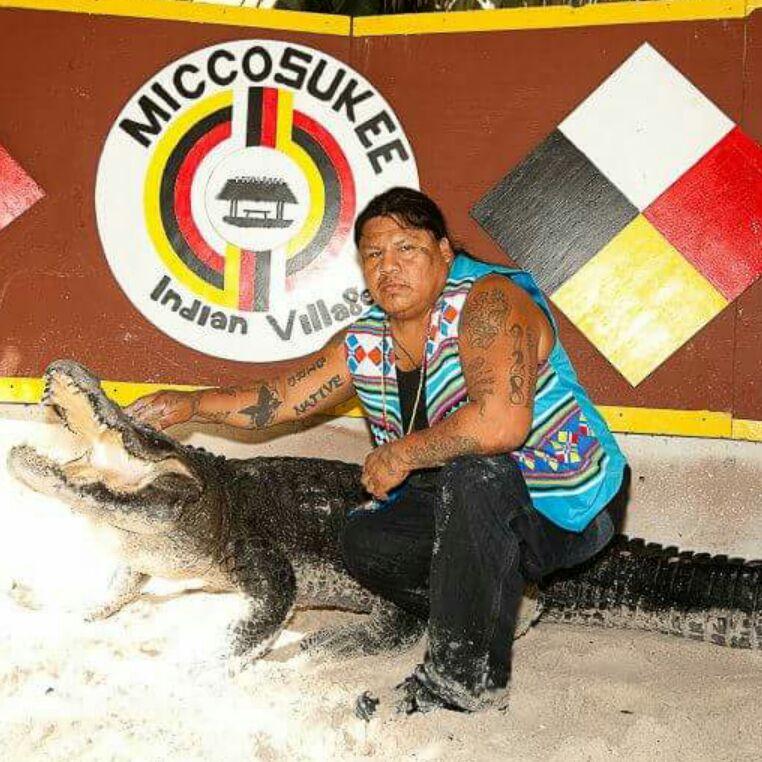
My name is Rocky Jim Jr. and I was born in Miami on July 23, 1971. I grew up on the Miccosukee reservation in Miami for about 95 percent of my life.

Around five years ago, I left because I needed a little change. Up until then, I was an alligator wrestler at the reservation.

The first time I worked with an alligator I was about 13. I was fishing with my late dad and I saw him moving gators around with his bare hands. I was kind of surprised when he asked me whether I wanted to do it. I hesitated and said no. But the next time he did it I just told myself “OK, I’m gonna do it.”

So I jumped in the canal and moved that gator. I just pushed him away and jumped out of the water real quick.

At first it was not something I was ready for, but [my dad] calmed me down by telling me that they wouldn’t do anything to me.

So I just kept doing it with smaller ones until I got used to it. My dad’s advice was simply “Don’t get bit.”

He taught me a few other things, like how to stay away from the alligator’s head.

He told me to just go under the water, look at the gator and grab it from the tail softly and slowly. Then, just pull it and go under its neck, hold it and push it away. That’s it.

The reason my dad told me to go underwater was to look at the way the gator’s positioned. Part of what I do is looking at its body language.

I never really asked how my dad learned how to do this. I’m assuming he learned from his dad.

I know my dad did it for a long time, and he did it mostly when he was fishing.

I looked up to other wrestlers like my late grandpa and my uncles. My grandpa’s name was Bobby Tiger. He worked at the reservation for a long while. Every time I got a chance, I’d go over there and see the way he wrestled alligators.

There were alligator wrestlers on both sides of my family.

Before I got into it myself, I played other sports, like basketball, football and baseball.

One of the most challenging things about wrestling is that you’ve got to have a lot of patience with the gators. They’ve got a mind of their own and pretty smart brains. So they’re stubborn.

We also have to try to work with them instead of hurting them. It’s called “wrestling” but we try not to be aggressive with them. It’s more like a conversation than a fight.

You’ve got to position yourself in a good angle with enough separation, or they’ll hiss and try to bite you. The reason I retired from wrestling was because I was bit one too many times.

They can’t see in front of them or behind them. But when I first approach one from the front and try to go to the back, the gator would be able to see me and follow me around. So I had to learn to move slowly. If I moved real quick, they’d react real quick. I used to move around slowly so don’t they wouldn’t be threatened by my movements.

I grabbed gators from the front, usually under their jaw so I can lift their head up. When their head’s up, they’re kind of almost paralyzed.

Most gators, if I grabbed them by the under the jaw, they’d shake around and let loose. But that’s where the patience comes in. So if it didn’t shake, I’d move them up and close their eyes. When I close their eyes, it kind of relaxes them. And when they can’t see me, they aren’t gonna move. Then I closed my legs around their back so they wouldn’t try to move.

Obviously the mouth is the most dangerous part, but their tails are strong too. It’s kind of like a muscle.

If it hit me real good on the leg, it could break my leg or shatter my bones.

Plus, the tip of the tail is like getting slapped with a leather belt. Their scales can also leave a mark on my sides. They’re kind of sharp, but some of them are kind of rounded.

Common injuries are hits from the tail, bites and fingers getting jammed on the gator’s head. There’s also their claws, which they normally use for digging. Those can hurt, as well.

I started doing shows at the reservation because we were short of workers. A friend of mine was doing it but he had to leave. So he asked me if I wanted to do it and I said nope. I was working in maintenance at the time. Nobody knew I could even alligator wrestle.

But he said, “Come on, help us out!”

I did it. Everyone was kind of surprised that I could do it, and it kinda stuck with me ever since.

Most of the shows go the same. I’ve gotten used to how to do it, especially working with the same gators. We tried different things with different gators, but that’s about as different as we got.

We did travel with the gators. We got to do shows at different parks like the Fruit and Spice Park in Homestead and in schools around the city.

It’s one of the ways I would see the city when I was on the reservation. I also liked seeing the people who live in the city and would come and see us.

I don’t really feel like the reservation is separate from the city of Miami. Since we’re on Tamiami Trail, I think a lot of people have access to us and come and visit. But I see why they would feel like tourists when they go to the reservation. I also sometimes feel like a tourist going into a McDonald’s or Burger King. Especially when I’m in the Miami traffic trying to get there.

Translate »