
To accompany HistoryMiami Museum’s exhibit: National Archives Freedom Plane National Tour
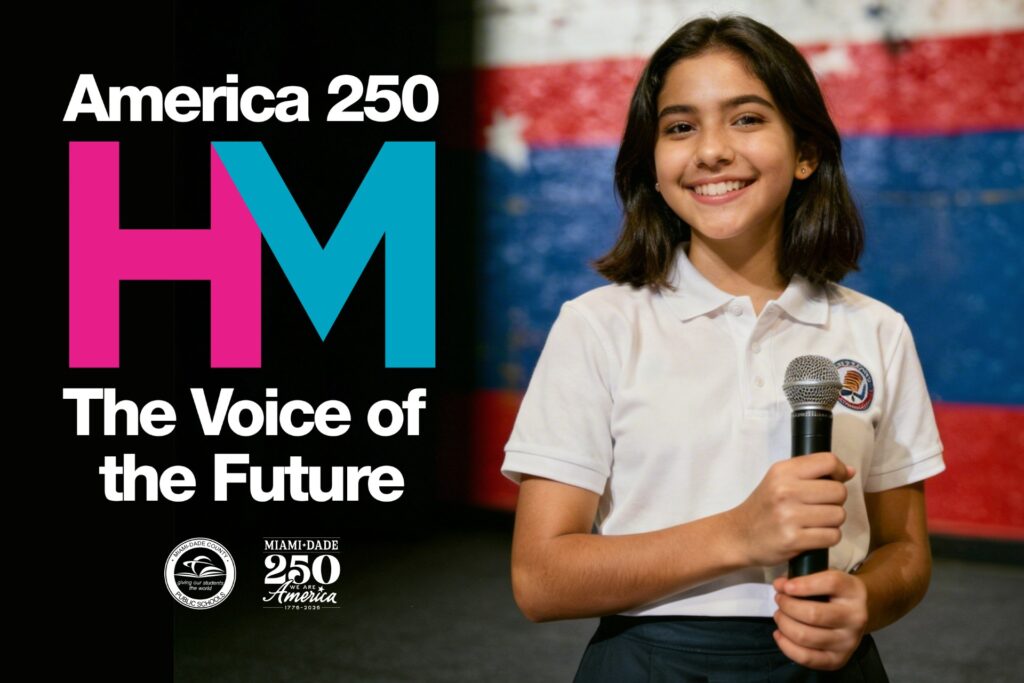
To celebrate the Semiquincentennial of the United States, HistoryMiami Museum is proud to announce a premier youth oratorical competition. This is a unique opportunity for Miami’s young leaders to bridge the gap between our nation’s founding documents and our future. The competition is presented in partnership with Miami-Dade County Public Schools and Miami-Dade County’s America 250 initiative.
To learn more about HistoryMiami Museum’s exhibit: National Archives- Freedom Plan National Tour, see the link below:
HistoryMiami Museum’s National Archives Freedom Plane National Tour
HistoryMiami Museum’s High School Oratorical Competition in support of celebratory efforts for the United States of America’s upcoming semiquincentennial: July 4, 1776 – July 4, 2026.
As we approach July 4, 2026, the United States marks 250 years of an ongoing experiment in democracy. To honor this milestone, HistoryMiami Museum invites high school students to reflect on our shared history, the power of the written and spoken word, and what it means to be “We the People” in 2026.
About the Competition
The Oratorical Competition: The Voice of the Future
Write and record a 4-minute speech that addresses the following (minimum submission 2 minutes and 30 seconds, and the maximum length of the speech is 4 minutes).
- Reflection: How do you feel about the U.S. turning 250? What does this milestone mean for you and for your generation?
- Primary Sources: You must reference at least three primary source documents (e.g., The Declaration of Independence, The Treaty of Paris, George Washington’s Oath of Allegiance, or the U.S. Constitution). Additional documents are acceptable form the list found below based on the documents that are part of the exhibit..
- The “Why”: Explain why preserving these physical documents is essential and what specific “messages” we learn today by analyzing the original intent of the founders versus or as compared to our modern reality.
- Beyond the Textbook: We are not just looking for a history lesson. We want to hear your critical analysis of historical evidence and how the process of learning from primary source documents shapes how you feel about your future and your generation’s future.
- The Big Idea: History is not just a collection of dates; it is the heartbeat of our present. Use your voice to tell us how that heart beats for you.
The Oratorical Competition: The Voice of the Future- Logistics
Eligibility: Open to ALL High School students (public or private) in Miami-Dade County who will be in either grade 9, 10, 11, or 12 for the 2026-2027 school year (This refers to grades 8-11 for the 2025-2026 school year).
Format – Video recording MP4
Length – Maximum 4 minutes; Minimum 2 minutes and 30 seconds
Deadline – Submissions must be uploaded by May 8, 2026.
Primary Sources – Speeches must explicitly name and quote from at least three (3) of the six (6) historical documents from the list of primary sources that will be on display in the exhibit.
Prizes
The winning student will:
- Receive a $3000 scholarship
- Be “County Mayor for the day.”
- Be given the opportunity to deliver their speech live at the HistoryMiami Museum’s July 4 celebration.
- The winning speech will be added to the Museum’s permanent collection.
Scholarship funds in support of students’ post high school educational plans will be awarded as follows:
- First place: $3,000
- Second place: $2,000
- Third place: $1,000
- Fourth place: $500
- Fifth, sixth, seventh, eighth, ninth, and tenth (6 awards) $250 each.
The top ten winners will also receive complimentary admission pass(es) for area attractions:
- HistoryMiami Museum
- ZooMiami
- FROST Science Museum
- Fairchild Tropical Gardens
- Perez Art Museum
Student scholarships and awards are made possible through the generous support of David Lawrence Jr. and The Children’s Movement of Florida, Discovery Education, EdFed Credit Union, McGraw Hill, and Savvas.
An overview of what you need to do
- You will be analyzing 6 primary source documents.
- You will be thinking, writing, and speaking like a historian and with your own unique perspective.
- You will select 3 of the 6 primary sources that resonate most with you.
- You will analyze the 3 primary sources you have selected by doing more research and reflection.
- You will take note of information and ideas that spark an interest in you to include in your speech.
- Write out Your Speech: As if you were writing an essay, but with the idea of engaging an audience, write out your speech before you record.
- Practice Your Speech: Before recording, practice delivering your speech several times.
- Record: Film yourself delivering the speech (ensure clear audio and a professional background).
- Submit: Upload your video and a copy of your transcript here on the HistoryMiami America 250 Portal.
America 250: The Voice of the Future
SUBMIT HEREAmerica 250: The Voice of the Future
Step 1: THINK ABOUT YOU- Your “Pulse” Check
Before you look at the documents, check in with your own perspective.
- The Milestone: In July 2026, the U.S. turns 250. Does this feel like a “celebration,” a “commemoration,” or a “call to action” to you? Why?
- The Miami Lens: How does living in a global “gateway city” like Miami change how you view American history compared to someone living in Philadelphia, Washington D.C., or another major urban area of the country?
- The Future: What is one thing about America today that you hope is different by the time we hit 300 years? What are some things that you hope remain the same or consistent?
Step 2: Research and Learn: Use the student tools found in the next pages to learn about the 6 different primary resources that will be on display in the exhibit.
The following section provides guidelines for students to analyze the six (6) primary source documents/artifacts that will be on display from the National Archives.
Step 2: Research and Learn
Getting Started- Research and Learn!
The following links and resource suggestions can assist participating students in developing the necessary background knowledge and skills to “Think Like Historians” and “Speak Like Historians.” It is highly suggested that students conduct research, take notes, and draft a plan prior to writing out their speech and recording their entry for submission. Remember: Historians reflect on their analysis of primary source documents and artifacts in order to think, write, and speak about history based on credible evidence.
- Press Release from the National Archives: Freedom Plane National Tour.
- Brief Description of primary sources to be on exhibit at HistoryMiami Museum’s National Archives Freedom Plane National Tour:
- Original Engraving of the Declaration of Independence, 1823: One of only about 50 known engraved copies of the Declaration of Independence, printed from a copperplate of the original. Commissioned by John Quincy Adams and made by engraver William J. Stone, the engraving captured the size, text, lettering, and signatures of the original document (on loan from David M. Rubenstein).
- Articles of Association, 1774: Signed by all 53 delegates, the Articles of Association urged colonists to boycott British goods and was the Continental Congress’s first major unified act of resistance against Britain.
- George Washington’s, Alexander Hamilton’s, and Aaron Burr’s Oaths of Allegiance, 1778: Oaths of Allegiance that all officers of the Continental Army signed during the Revolutionary War.
- Treaty of Paris, 1783: Signed by John Adams, Benjamin Franklin, and John Jay, this Treaty with Great Britain formally recognized the United States as an independent nation.
- Secret Printing of the Constitution in Draft Form, 1787: A rare copy of the U.S. Constitution in draft form, with the delegate’s handwritten notes made during the Constitutional Convention in 1787.
- Tally of Votes Approving the Constitution, 1787: The voting records of the Constitutional Convention reflecting the debates, resolutions, and eventual vote on the final text that would become the Constitution.
- See additional details about these primary sources in The National Archives’ Freedom Plan National Tour Press Kit.
- See the following research and analysis tools to assist you in interpreting the documents.
Step 2: Research and Learn
Student Research Tool: Making Sense of Primary Sources
Primary sources are not just old pieces of paper—they are “time machines” that capture the tension, uncertainty, and high stakes of their era. To help you move beyond just reading the words and into understanding the meaning behind these National Archives treasures, follow this framework.
The “4-C” Analysis Framework
Use these four steps for every document in the collection to uncover its deeper significance.
1. Contextualize: What was the “Vibe” of the Document?
Before reading, place the document on a timeline. What was happening just before this was written?
- For example:
- The Articles of Association (1774): This was not a country yet; it was a protest. Look for the “why.” They were not fighting for independence yet—they were trying to get Britain’s attention via their wallets (boycotts).
- Treaty of Paris (1783): Contrast this with the 1774 document. How did the tone shift from “angry protesters” to “sovereign nation”?
2. Corroborate: Look for the Gaps
Compare the documents to see how the story evolves or where voices might be missing.
- For example:
- The Oaths of Allegiance (1778): Why did Washington, Hamilton, and Burr have to sign these? In 1778, the war was going poorly (Valley Forge). These oaths weren’t just formal paperwork; they were “all-in” bets against being hanged for treason.
3. Close Read: Look for the “Drafting Scars”
Pay attention to the physical changes or specific word choices.
- For example:
- Secret Printing of the Constitution (1787): Focus on the handwritten notes. Notes in the margins are where the real arguments live. Does a note suggest a compromise? Does it cross out a word that changed the entire power of the government?
4. Consider the Audience: Who was it for?
- For example:
- Engraving of the Declaration (1823): Why make a high-quality copy 47 years after the revolution? By 1823, the Founders were dying off. This engraving wasn’t just for news; it was for legacy. It was meant to turn a “treasonous memo” into a “sacred relic
Step 2: Research and Learn
Resource-Specific Guiding Questions
Understanding At-a-Glance
Document
Key Question for Analysis
Original Engraving of the Declaration of Independence, 1823
The engraving was commissioned by John Quincy Adams (son of founding father John Adams). What does fact reveal about John Adams’ son and his opinion of the Declaration of Independence?
Articles of Association
Look at the list of 53 names. What does “unified act” mean when these people represented very different colonies (e.g., Georgia vs. Massachusetts)?
Oaths of Allegiance
Compare the signatures. Is there a difference in the “weight” or style of Washington’s vs. Burr’s? What does the act of swearing an oath mean in a time of war?
Treaty of Paris
This is a legal contract. What did the US have to give up or promise to Britain in exchange for independence? (It was not a one-way street).
Secret Printing of the Constitution in Draft Form, 1787
Observe and reflect on the handwritten notes found in this draft. What do the notes reveal about the process of formulating the U.S. Constitution?
Tally of Votes (1787)
Look at the “No” votes or the split delegations. What do these disagreements tell us about how fragile the “United” States was at the start?
Step 2: Research and Learn
Student Research Tool: Deeper Dive into the Declaration of Independence Engraving (1823)
1. OBSERVE: Describe the visual style of the lettering and the signatures. Since this is a copperplate engraving, how does its appearance differ from a standard handwritten letter?
_______________________________________________________________________________________________________________________________________________________________________________________________________________________________________________________________________________________________________________________________________________________________________________________________________________________________________________________________________________________________________________________________________________________________________________________________________________________________________________________________________________________________________
2. CONTEXT: This was created in 1823, almost 50 years after 1776. Why would Americans in the 1820s want “official” copies of this document?
_______________________________________________________________________________________________________________________________________________________________________________________________________________________________________________________________________________________________________________________________________________________________________________________________________________________________________________________________________________________________________________________________________________________________________________________________________________________________________________________________________________________________________
3. INFER: John Quincy Adams commissioned this. What does this suggest about his goals for national identity and history?
_______________________________________________________________________________________________________________________________________________________________________________________________________________________________________________________________________________________________________________________________________________________________________________________________________________________________________________________________________________________________________________________________________________________________________________________________________________________________________________________________________________________________________
4. MEANING: How does turning a political document into a piece of art (an engraving) change how people treat it?
_______________________________________________________________________________________________________________________________________________________________________________________________________________________________________________________________________________________________________________________________________________________________________________________________________________________________________________________________________________________________________________________________________________________________________________________________________________________________________________________________________________________________________
Reflection/Notes: Think about your speech and write some notes about this document to assist you in developing your speech).
_______________________________________________________________________________________________________________________________________________________________________________________________________________________________________________________________________________________________________________________________________________________________________________________________________________________________________________________________________________________________________________________________________________________________________________________________________________________________________________________________________________________________________________________________________________________________________________________________________
Step 2: Research and Learn
Student Research Tool: Deeper Dive into the Articles of Association (1774)
1. OBSERVE: Look at the number of signatures (53). What does the physical presence of so many names communicate?
_______________________________________________________________________________________________________________________________________________________________________________________________________________________________________________________________________________________________________________________________________________________________________________________________________________________________________________________________________________________________________________________________________________________________________________________________________________________________________________________________________________________________________
2. CONTEXT: This was the Continental Congress’s “first major unified act.” What were the colonies specifically protesting?
_______________________________________________________________________________________________________________________________________________________________________________________________________________________________________________________________________________________________________________________________________________________________________________________________________________________________________________________________________________________________________________________________________________________________________________________________________________________________________________________________________________________________________
3. INFER The document urged a boycott of British goods. Why is an economic boycott a powerful tool for resistance compared to other methods?
_______________________________________________________________________________________________________________________________________________________________________________________________________________________________________________________________________________________________________________________________________________________________________________________________________________________________________________________________________________________________________________________________________________________________________________________________________________________________________________________________________________________________________
4. MEANING: This document happened before the Declaration of Independence. How does it show the transition from “loyal subjects” to “rebels”?
_______________________________________________________________________________________________________________________________________________________________________________________________________________________________________________________________________________________________________________________________________________________________________________________________________________________________________________________________________________________________________________________________________________________________________________________________________________________________________________________________________________________________________
Reflection/Notes: Think about your speech and write some notes about this document to assist you in developing your speech).
________________________________________________________________________________________________________________________________________________________________________________________________________________________________________________________________________________________________________________________________________________________________________________________________________________________________________________________________________________________________________________________________________________________________________________________________________________________________________________________________________________________________________________________________________________________________________________________________________
Step 2: Research and Learn
Student Research Tool: Deeper Dive into the Oaths of Allegiance
1. OBSERVE: Examine the signatures of Washington, Hamilton, and Burr. What does their handwriting reveal about the formality of this military requirement?
_______________________________________________________________________________________________________________________________________________________________________________________________________________________________________________________________________________________________________________________________________________________________________________________________________________________________________________________________________________________________________________________________________________________________________________________________________________________________________________________________________________________________________
2. CONTEXT: 1778 was a difficult year for the Continental Army (think Valley Forge). Why was a formal “Oath of Allegiance” necessary at this specific moment?
_______________________________________________________________________________________________________________________________________________________________________________________________________________________________________________________________________________________________________________________________________________________________________________________________________________________________________________________________________________________________________________________________________________________________________________________________________________________________________________________________________________________________________
3. INFER y signing this, these men were technically committing treason against the British Crown. What were the personal stakes for these officers?
_______________________________________________________________________________________________________________________________________________________________________________________________________________________________________________________________________________________________________________________________________________________________________________________________________________________________________________________________________________________________________________________________________________________________________________________________________________________________________________________________________________________________________
4. MEANING: Why does a modern military still require an oath of allegiance today? How does this 1778 version set that precedent?
_______________________________________________________________________________________________________________________________________________________________________________________________________________________________________________________________________________________________________________________________________________________________________________________________________________________________________________________________________________________________________________________________________________________________________________________________________________________________________________________________________________________________________
Reflection/Notes: Think about your speech and write some notes about this document to assist you in developing your speech).
_______________________________________________________________________________________________________________________________________________________________________________________________________________________________________________________________________________________________________________________________________________________________________________________________________________________________________________________________________________________________________________________________________________________________________________________________________________________________________________________________________________________________________________________________________________________________________________________________________
Step 2: Research and Learn
Student Research Tool: Deeper Dive into the Treaty of Paris (1783)
1. OBSERVE This is a legal agreement between two nations. What visual cues tell you this is a high-level diplomatic document??
_______________________________________________________________________________________________________________________________________________________________________________________________________________________________________________________________________________________________________________________________________________________________________________________________________________________________________________________________________________________________________________________________________________________________________________________________________________________________________________________________________________________________________
2. CONTEXT: The war had effectively ended at Yorktown in 1781, but this wasn’t signed until 1783. Why does the formal “recognition” of independence take so long?
_______________________________________________________________________________________________________________________________________________________________________________________________________________________________________________________________________________________________________________________________________________________________________________________________________________________________________________________________________________________________________________________________________________________________________________________________________________________________________________________________________________________________________
3. INFER: Benjamin Franklin, John Adams, and John Jay were the negotiators. What qualities did they need to convince Great Britain to sign this?
_______________________________________________________________________________________________________________________________________________________________________________________________________________________________________________________________________________________________________________________________________________________________________________________________________________________________________________________________________________________________________________________________________________________________________________________________________________________________________________________________________________________________________
4. MEANING: Without this document, would the Declaration of Independence have mattered? Explain the relationship between “declaring” independence and “securing” it.
_______________________________________________________________________________________________________________________________________________________________________________________________________________________________________________________________________________________________________________________________________________________________________________________________________________________________________________________________________________________________________________________________________________________________________________________________________________________________________________________________________________________________________
Reflection/Notes: Think about your speech and write some notes about this document to assist you in developing your speech).
_______________________________________________________________________________________________________________________________________________________________________________________________________________________________________________________________________________________________________________________________________________________________________________________________________________________________________________________________________________________________________________________________________________________________________________________________________________________________________________________________________________________________________________________________________________________________________________________________________
Step 2: Research and Learn
Student Research Tool: Deeper Dive into the Original Engraving of the Declaration of Independence, 1823
Think Like a Historian: Now that you have had experience in observing, contextualizing, inferring, and extracting meaning using guiding questions provided, create your own guiding questions/statements for the primary source: Original Engraving of the Declaration of Independence, 1823.
1. OBSERVE: My Guiding Question(s)/Statement(s)- ___________________________________________________
________________________________________________________________________________________________________________________________________________________________________________________________________________________________________________________________________________________________________________________________________________________________________________________________________________________________________________________________________________________________________________________________________________________________________________________________________________________________________________________________________________________________
2. CONTEXT: My Guiding Question(s)/Statement(s)-___________________________________________________
________________________________________________________________________________________________________________________________________________________________________________________________________________________________________________________________________________________________________________________________________________________________________________________________________________________________________________________________________________________________________________________________________________________________________________________________________________________________________________________________________________________________
3. INFER: My Guiding Question(s)/Statement(s)- ______________________________________________________
________________________________________________________________________________________________________________________________________________________________________________________________________________________________________________________________________________________________________________________________________________________________________________________________________________________________________________________________________________________________________________________________________________________________________________________________________________________________________________________________________________________________
4. MEANING: My Guiding Question(s)/Statement(s)- ___________________________________________________
________________________________________________________________________________________________________________________________________________________________________________________________________________________________________________________________________________________________________________________________________________________________________________________________________________________________________________________________________________________________________________________________________________________________________________________________________________________________________________________________________________________________
Reflection/Notes: Think about your speech and write some notes about this document to assist you in developing your speech).
_______________________________________________________________________________________________________________________________________________________________________________________________________________________________________________________________________________________________________________________________________________________________________________________________________________________________________________________________________________________________________________________________________________________________________________________________________________________________________________________________________________________________________________________________________________________________________________________________________
Step 2: Research and Learn
Student Research Tool: Deeper Dive into the Tally of Votes (1787)
Think Like a Historian: Now that you have had experience in observing, contextualizing, inferring, and extracting meaning using guiding questions provided, create your own guiding questions/statements for the primary source: Tally of Votes (1787).
1. OBSERVE: My Guiding Question(s)/Statement(s)- ___________________________________________________
________________________________________________________________________________________________________________________________________________________________________________________________________________________________________________________________________________________________________________________________________________________________________________________________________________________________________________________________________________________________________________________________________________________________________________________________________________________________________________________________________________________________
2. CONTEXT: My Guiding Question(s)/Statement(s)-___________________________________________________
_______________________________________________________________________________________________________________________________________________________________________________________________________________________________________________________________________________________________________________________________________________________________________________________________________________________________________________________________________________________________________________________________________________________________________________________________________________________________________________________________________________________________________
3. INFER: My Guiding Question(s)/Statement(s)- ______________________________________________________
________________________________________________________________________________________________________________________________________________________________________________________________________________________________________________________________________________________________________________________________________________________________________________________________________________________________________________________________________________________________________________________________________________________________________________________________________________________________________________________________________________________________
4. MEANING: My Guiding Question(s)/Statement(s)- ___________________________________________________
________________________________________________________________________________________________________________________________________________________________________________________________________________________________________________________________________________________________________________________________________________________________________________________________________________________________________________________________________________________________________________________________________________________________________________________________________________________________________________________________________________________________
Reflection/Notes: Think about your speech and write some notes about this document to assist you in developing your speech).
________________________________________________________________________________________________________________________________________________________________________________________________________________________________________________________________________________________________________________________________________________________________________________________________________________________________________________________________________________________________________________________________________________________________________________________________________________________________________________________________________________________________________________________________________________________________________________________________________________
Step 2: Research and Learn
Step 3: Select Your 3 Primary Sources
Primary Source “Cheat Sheet”
Remember, you must choose three from this list for your analysis to develop your speech.
The information found in the chart below provides additional ideas to think about related to each primary source. Use this to assist you in finalizing the 3 primary sources you will use.
Document
The “Hidden” Story/Message
Articles of Association (1774)
Unity through Sacrifice: Before the war, colonies agreed to boycott British goods. It shows that the first step to liberty was economic solidarity and community discipline.
Alexander Hamilton’s Oath of Allegiance
The Immigrant’s Promise: Unlike Washington, Hamilton was “foreign-born.” His signed oath represents the intentional choice to belong to a new nation.
Secret Printing of the U.S. Constitution
The Work in Progress: This “confidential” draft shows the delegates’ early ideas before they were polished. It reminds us that democracy is a designed, debated product.
State Delegations Final Vote
The Final Tally: This document captures the tension of the moment the Constitution was officially ratified. It highlights the regional differences that have always defined America.
Senate Markup: Bill of Rights
The Power of the Edit: Seeing the crossed-out words and margin notes shows that our “fundamental” rights were the result of intense negotiation and compromise.
The Declaration of Independence
The Moral Compass: The foundational claim of unalienable rights and the start of the American experiment.
The Treaty of Paris
Global Recognition: The moment the world’s superpowers acknowledged America’s right to exist.
Step 4: Research and Learn (AGAIN!)
Deep Dive into My 3 Primary Sources
Historians, like scientists, conduct their “experiments” (or analysis of history) multiple times in order to develop solid conclusions. The following pages provides you with additional points to analyze and consider now that you have a well-developed understanding of the primary sources in question.
Think about the following ideas when analyzing the primary sources, you have selected. This guide helps students move beyond reading the text to analyzing the physical evidence of history.
How to Read Between the Lines
When selecting documents like the Senate Markup of the Bill of Rights or the Secret Printing of the Constitution, look for the following:
- The Power of the Strike-Through: In the Senate Markup, look at what was deleted. If a right was edited out, ask yourself: Why were they afraid of that word? How would our lives be different if that sentence had stayed?
- The Evolution of “We”: Compare the Articles of Association (1774) to the final Constitution. Notice how the language shifts from a collection of “Colonies” to a single “Union.” This shows the struggle to find a unified identity.
- The Weight of the Pen: Analyze Alexander Hamilton’s Oath of Allegiance. It isn’t just a signature; it’s a legal risk. At 250 years, we can learn that citizenship is an active choice, not just a passive status.
- The “Secret” Element: Why was the Constitution printed in secret? Analyzing the Secret Printing helps us understand that history is full of tension, debate, and the fear of failure.
Step 4: Research and Learn (AGAIN!)
My 3 Primary Sources: The Human Element
The Document
What was the emotion behind this? (Fear, Hope, Secrecy, Bravery?)
How does this document affect your life in 2026?
Example: Senate Markup
Anxious debate; trying to get the words “just right.”
It reminds me that my right to speak was negotiated and isn’t accidental.
My Primary Source # 1:
My Primary Source #2:
My Primary Source #3:
Step 5: Building Your “Hook”
A 4-minute speech needs a powerful opening. Try one of these prompts to start your draft:
- The “Discovery” Hook: “If you walked into the National Archives today and looked at [Document Name], you would not just see a piece of paper. You would see…”
- The “Miami” Hook: “From the streets of Little Havana to the shores of Biscayne Bay, the America of 2026 looks very different than the America of 1776. And yet, when I read [Document Name] …”
- The “Draft” Hook: “Most people think the Constitution was written in one go. But the Secret Printing tells a different story—a story of a country that was ‘work in progress’ from day one.”
Step 6: Explain! We all Need to know WHY?
HistoryMiami wants to know why we preserve these physical items. Use these questions to finalize your conclusion:
- Why not just a PDF? What is lost if we only have the digital text one of the primary sources you have selected but lose the physical document with all of its imperfections, has anything been lost?
- The Message: If you could leave a “Primary Source” from 2026 for a student to find in the year 2276, what would it be? How does that link back to one of the primary sources you selected?
Step 7: Based on all your research, write out your first draft of your speech.
Step 8: Step away from this process for a day to let your ideas percolate!
Step 9: Edit your written out speech as needed.
Step 10: Practice saying your speech before recording (several times).
Step 11: Use the tools below to assist in recording your speech to submit it to the oratorical competition.
Before You Hit Record: Think about the Following Logistics
Technical Setup
- Framing: Is the camera at eye level? (Avoid looking down at a laptop or up at a phone). Ensure you are framed from the chest up.
- Lighting: Is your main light source in front of you? (Avoid sitting with a window behind you, which creates a silhouette).
- Audio: Have you done a 10-second sound check? Ensure there is no background noise (fans, traffic, or family members).
- Background: Is your setting clean and professional? (Bonus points for filming in front of a bookshelf, a historical map, or a clean neutral wall).
Content & Script
- The “Three-Doc” Rule: Did you explicitly name and analyze at least three documents? (e.g., “When we look at the strike-throughs in the Senate Markup of the Bill of Rights…”)
- The Clock: Is your speech between 3 minutes 45 seconds and 4 minutes? (Being too short can lack depth; going over 4 minutes may lead to disqualification).
- The “Why”: Did you explain the importance of preserving physical archives?
- Personal Voice: Does the speech sound like you, or does it sound like a Wikipedia entry? Ensure your feelings about the U.S. at 250 are front and center.
Performance & Delivery
- Eye Contact: Are you looking at the camera lens (the “audience”) and not at your script?
- Pacing: Are you speaking slowly enough for the judges to digest your analysis of the Secret Printing or the Treaty of Paris?
- Energy: Are you showing passion for the subject? Remember, the winner will deliver this live at the National Archive exhibit opening—the judges are looking for stage presence!
- Visual Aids: If you are holding up a facsimile or pointing to an image of a document, is it clearly visible to the camera?
Pro-Tip for the Video Submission:
- When you record your 4-minute video, try to have a printed copy or an image of your chosen documents nearby. Referring to them physically on camera shows the judges that you recognize these as real objects, not just ideas from a screen.
Submission Final Steps
- File Name: Is your video saved correctly? (e.g., Lastname_Firstname_America250.mp4).
- Format: Is the file an MP4
- Transcript: Do you have a typed PDF copy of your speech ready to upload alongside your video?
- Deadline: May 8, 2026 (Don’t wait until 11:59 PM!)
Contest Rubric (4-Minute Format)