
fbpx Skip to content
Named Best Museum 2022 by Miami New Times

By William D. Slicker

My very dear Jewish friend, Steve Simone, had the chutzpah to die recently. In his memory, I went to Sarasota for a Jewish food festival and ate a homemade apple strudel. Steve would have liked that. While at the food festival, I read a Jewish newspaper. In the newspaper I saw an ad for Wolfie’s Restaurant in Sarasota. That brought back memories of the Wolfie’s restaurants that were popular in Florida many years ago. Those who are old enough to have lived in Florida back when Wolfie’s Restaurants were here, remember the great deli fare: a basket of fresh rolls, chicken soup, dill pickles, reubens, and thick pastrami or corned beef sandwiches.

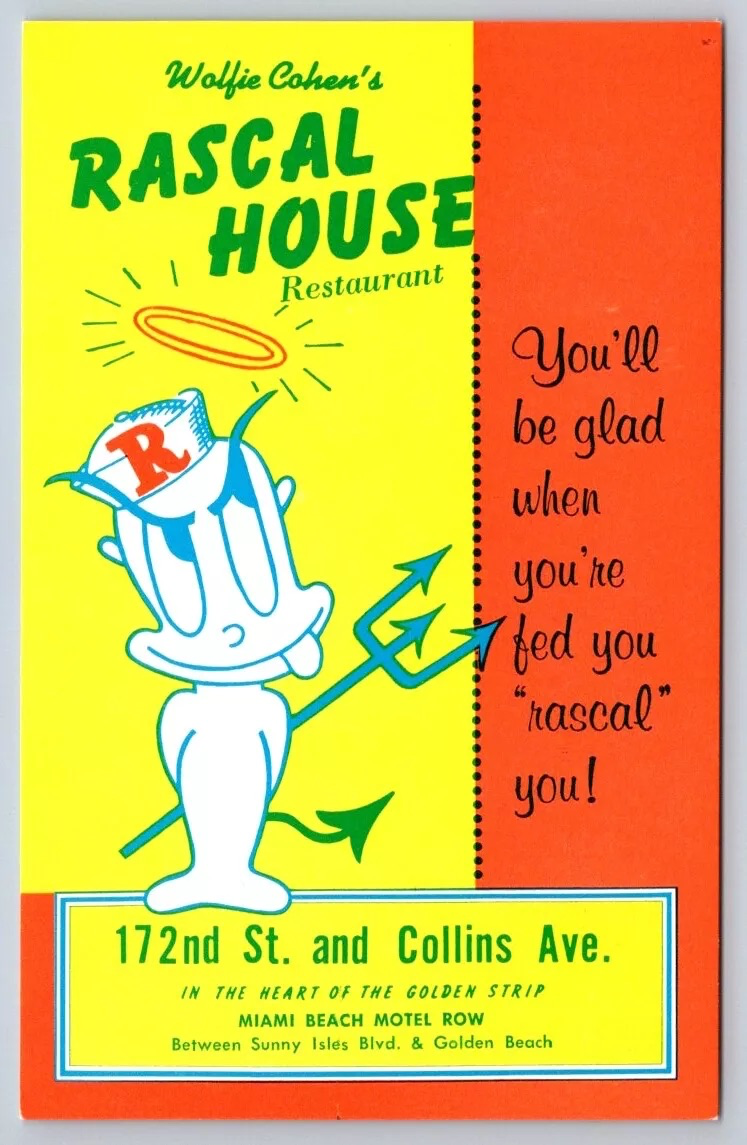
Wilfred “Wolfie” Cohen also known as The Rascal started his restaurant career as a busboy in the Catskills. He then learned the restaurant business.[1]

 In 1947, he moved to Miami, home of the largest Jewish diaspora community in the United States outside of New York City, and opened Wolfie’s restaurant on Collins and 21st Street, Miami Beach. He also opened a second Wolfie’s at Collins and Lincoln.[2]

In 1954, he opened The Rascal House on Collins and 172nd Street, North Miami Beach. It was shown in the opening street scene of the Bee Gee’s 1977 video “Night Fever.”[3] Its great food brought in the great stars. It was visited by Frank Sinatra, Jackie Gleason, Judy Garland, Clark Gable, Katherin Hepburn, and other movie and TV stars. It was also a favorite of mafia gangland financier Meyer Lanskey.[4]

For a time, several branch Wolfie’s were open. One location was in St. Petersburg in the plaza at 3200 Central Avenue.[5] Another location was Ft. Lauderdale at 2501 East Sunrise Blvd. A third was located in Cocoa Beach at 900 N. Atlantic Avenue.[6] A fourth was in Jacksonville at New Beach Blvd at Southgate Plaza.[7]

The Cocoa Beach Wolfie’s was featured in the movie Fly Me to the Moon in which Apollo engineers were shown eating there.[8]

Wolfie Cohen died in 1986. Only one of his restaurants survived him. His daughter operated The Rascal House for 10 years and then sold it. It closed in 2008.[9]

There was a short term rebirth of Wolfie Cohen’s tradition on the east coast of Florida. In 1998, Jerry’s Famous Deli opened a Rascal House at 2006 Executive Center Drive, Boca Raton, but it closed shortly afterwards[10]. Then in 2024, a Wolfie’s was opened at 251 South US 1, Suite 1, Jupiter Beach, but it is now called the SaltBird Kitchen.[11]

There is a present rebirth of Wolfie Cohen’s tradition on the West Coast of Florida. JFD Parent LLC’s CEO Jonathan Mitchell opened a Wolfie’s at 1420 Boulevard of the Arts in Sarasota in 2023 and a Wolfie’s Bakery and Take Out at 5318 Paylor Lane, Lakewood Ranch in 2024.[12]

Now with new Wolfie’s open in Florida, a new generation has the opportunity to enjoy the flavors of the Jewish deli food that made Wolfie’s famous. Steve Simone would like that.


[1] Wolfie’s and Rascal House Miami Designed Preservation League, 2022 .https://mdpl.org/archives/2020/04/wolfies-and-rascal-house/; Ingall, Marjorie, The Greatest Floridian Restaurant In the World, Tablet Magazine, (Apr. 14, 2017) https://www.tabletmag.com/sections/news/articles/the-greatest-floridian-restaurant-in-the-world

[2] Ibid

[3] Wolfie Cohen’s Rascal House, Miami Beach 1970’s Vintage Menu Art -https://vintagemenuart.com/products/wolfies-rascal-house-miami-beach-1970s?srsltid=AfmBOopp1AqLP66BBSxI2Dq2WFItMXC8KAW3GrelWAfOzBqTSr00HTWf; Kiddle Encyclopedia, Wolfie Cohen’s Rascal House Facts for Kids (Oct. 17, 2025) https://kids.kiddle.co/Wolfie_Cohen%27s_Rascal_House

[4] Wolfie’s and Rascal House, supra.

[5] Wolfie’s Restaurant Opening Set for Early December at Plaza, St. Petersburg Time (Nov. 18, 1953); Wolfie’s Restaurant https://www.flickr.com/photos/hollywoodplace/5479345908

[6] Flickr https://www.flickr.com/photos/edge_and_corner_wear/5561571826

[7] Whitaker, Jan, Famous in its Day, Wolfie’s, Restaurant-ing Through History (Mar. 27, 2011) https://restaurant-ingthroughhistory.com/2011/03/27/famous-in-its-day-wolfies/

[8] Swrup, Aahana, Fly Me To The Moon: Are Satellite Motel and Wolfie’s Restaurant Real Places, The Cinemaholic, (Aug. 15, 2024) https://thecinemaholic.com/fly-me-to-the-moon-satellite-motel-wolfies-restaurant/

[9] Wolfie’s and Rascal House, supra.

[10] Karetneck, Jan, Worth the Wait, Broward Palm Beach New Times, (Aug, 13, 1998), https://www.browardpalmbeach.com/food-drink/worth-the-wait-6336771/; Yelp, Rascal House Restaurant, Boca Raton, Florida https://www.yelp.com/biz/rascal-house-restaurant-boca-raton.

[11] Yelp, Wolfie’s-Jupiter-Florida, https://www.yelp.com/biz/wolfies-jupiter; Metrodesk Media, Jupiter Restaurant “Saltbird” Opens with Comfort, Creativity, Boca News Now (2026) https://bocanewsnow.com/new-restaurants/jupiter-restaurant-salt-bird-opens-with-comfort-creativity/

[12] The Original Wolfie’s Restaurant ,About Us https://originalwolfies.com/story; The Original Wolfie’s and Wolfie Cohen’s Rascal House, Jerry’s Deli, https://www.jerrysdeli.com; Robinson, a Taste of Tradition, Edible Sarasota, Nov. 8, 2024, https://ediblesarasota.ediblecommunities.com/about-us; Gordon, Mark,, Famous New York-Style Deli Brand Plans Big Sarasota Opening Weekend, Business Obverser, (Oct. 30, 2023) https://www.businessobserverfl.com/news/2023/oct/30/famous-new-york-style-deli-brand-plans-big-sarasota-opening-weekend/.
This entry is part of the Miami Migration Short Essay Contest. The program, created by Cátedra Vargas Llosa, was designed to engage young people in South Florida in the art of writing while reflecting on their migration experiences.

When people talk about migration, it usually sounds like something distant, something that happens to other people. For me, it’s not just a story, it’s the foundation of my life.

I was too young to understand what was really happening, absorbing the shift only through the hurried packing, the hushed adult voices, and the strange, quiet finality of the closing door. Everything changed the moment we left. I didn’t register the geopolitical reasons, only the feeling of a sudden, rootless transition. What started as something simple ended up shaping everything I grew up to know, leaving me with a unique sense of belonging that is always half here and half somewhere else.

I didn’t really understand what was happening when we left. I was eight, my sister was five, and all I cared about was the fact that I could only bring one plushie with me, my favorite bear, the one my grandpa had given me. This bear became the tiny, tangible weight of everything I was leaving behind. I thought we were going on some long vacation, maybe just a trip somewhere nice, because that’s what my parents had gently, perhaps heartbreakingly, told us. About a week before, we had gone to Ciudad Zulia to say goodbye to my grandparents on my mom’s side, and to most of her family. I didn’t question it too much back then; I just thought it was something families did before going away, a big, celebratory farewell. We packed a few clothes, said some quiet goodbyes, and got on a plane like it was nothing, our parents insisting on keeping a smile on their faces that looked a little too wide, a little too fixed. I remember posing for pictures at the connecting airports, smiling wide, clutching that bear in my arms, genuinely excited for the ‘adventure’ ahead. It was a perfect lie that my childhood self believed completely. It never crossed my mind that I wouldn’t be going back, that the simple act of boarding that plane was actually the single biggest decision of our lives.

Adjusting to life in a new country was a lot more complicated than I expected. I didn’t know the language, not really. The only background I had was a handful of songs I could mimic the sounds of and a few TV shows I half-understood. For a while, we lived with my godfather, which made everything feel even less like it was real or permanent, as if we were just squatting in someone else’s settled life, waiting for a signal to pack up again. I remember my first Christmas there being strange but warm, everything familiar and unfamiliar at the same time. Then came school, three of them, in just two years. Every time I started to get used to one, we moved again. Each move was a reset button, forcing me to learn a new bus route, a new set of faces, and a slightly different way to hide my confusion. People thought I was Mexican until not too long ago, and at first, I didn’t even know how to correct them. Somewhere in all that moving and trying to keep up, I started losing little pieces of my culture without even noticing; the language of my home became fainter as the sound of the pavement under my feet changed yet again.

I didn’t find out the real reason we left until years later. For most of my life, I just accepted the story of it being a trip that turned permanent. One day, I asked my mom why we really left, and she told me that things in Venezuela weren’t stable at the time. At first, I thought she meant the apagones, the constant power cuts, or maybe just the general instability that I’d overheard adults whispering about when they thought I wasn’t listening.

But when I pressed a little more, she finally said that some dangerous people had gotten involved with my dad’s company and that our family had started receiving death threats. She told me in such a quiet, careful voice, like she was handing me something fragile. I could tell it wasn’t something she liked remembering. I didn’t really know what to say, part of me felt like I should’ve known, and another part of me was relieved I didn’t. In that instant, the silence of my childhood wasn’t a gap; it was a wall, built by my parents to keep the darkness out. It was strange, realizing that what I’d always thought was just a move for better opportunities had actually been about survival. It made everything, every bag we packed, every goodbye, every flight connection, suddenly feel heavier, tainted with the invisible shadow of a threat I was never supposed to know existed. That smiling picture of eight-year-old me in the airport became less about adventure and more about escape.

Looking back, everything makes a little more sense now. I understand why things happened the way they did, even if I didn’t back then. I’ve lost parts of my culture, picked up new ones along the way, and learned how to balance both without letting either disappear completely. It’s a strange kind of story to grow up with, but it’s mine, and it’s made me who I am.

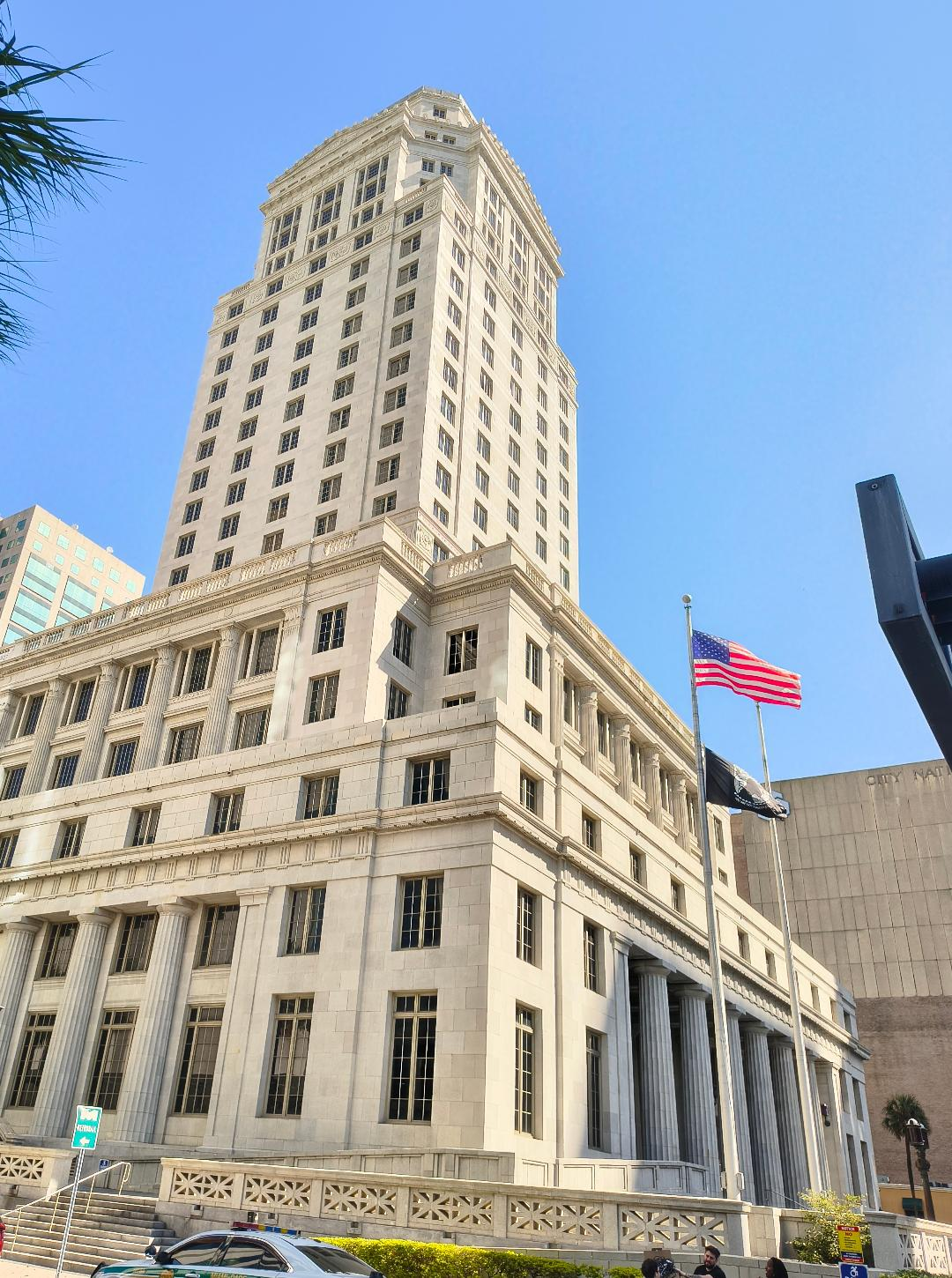
“The Miami Dade County Courthouse is scheduled to close soon,” the announcement read last August.  As a retired legal secretary and avid Miami history fan, I decided to visit there one last time.

Entering the Courthouse, at 73 West Flagler Street, I was flooded with memories.  Admiring its massive pillars, gold-plated elevators, checkerboard tile floors and shiny wooden benches, I took a “sentimental journey” to recall my Courthouse “duties,” which I performed from 1970s to the 21st century.

First, I visited the third floor Law Library, where I used to photocopy case law. Its glass-plated front doors were already closed to the public.  I could see stacks of packing boxes sealed and ready for moving. Next was the Clerk’s Office, where I used to file pleadings and have copies date-stamped. Aside from some evidence of the upcoming move, it looked much the same as ever.

As William Shakespeare once wrote, “All the world’s a stage and all the men and women merely players.” That is such an accurate portrayal of the Courthouse!  As we all know, there are the plaintiffs, defendants, judges, court reporters and bailiffs. But let’s not forget the other “players”  over the decades: the quadriplegic, sitting in his wheelchair at the foot of the Courthouse steps, selling caramels and bubble-gum; the double amputee, seated on a blanket on the sidewalk playing an accordion, singing “Take it to the Lord in prayer,” the elderly African-American shoe-shine man, the security guards screening and X-raying bags, and the Division of Blind Services food vendors? They, too, deserve to be remembered!

In December, 2025, the last “All rise” was exclaimed, the last gavel struck, the last jury verdict read and the Courthouse finally closed its doors to the public. (They’re still doing some packing and moving).  No one seems to know how this 100-year-old, historic building will be reincarnated: possibly a condo, or hotel or office building? Will the vultures still make their annual pilgrimage to circle the tower every winter?

But life goes on!  In January, 2026, a brand-new, gleaming Osvaldo V. Soto Miami-Dade County Courthouse, 600,000 square feet, 24 stories high, and with 46 juried courtrooms welcomed the arrival of its new tenants. Let’s pray that, in their new home, plaintiffs, defendants, judges and all other participants will be honest and fair and do what God knows is right and just.

This entry is part of the Miami Migration Short Essay Contest. The program, created by Cátedra Vargas Llosa, was designed to engage young people in South Florida in the art of writing while reflecting on their migration experiences.

The Price of a Breath

I am the final line of a story that began with a bomb. My existence is the culmination of a secret loan, a shattered bus, and a cleaver held by the hands of a scholar.

My father’s life almost ended on a Saturday morning in 1979. The air in El Salvador was thick with heat and woodsmoke. My grandfather, my grandmother, her body a vessel for my unborn father and his two young daughters squeezed onto a crowded bus. The vinyl seats were hot; the engine groaned, and the scent of warm pupusas mixed with the scent of diesel fumes. This weekly trip was their family tradition in a country being devoured by a civil war. That year, the Bloque Popular Revolucionario had begun its violent campaign, seizing churches and bombing public places to paralyze the nation with fear.

Suddenly, the bus jerked to a stop. The doors hissed open to reveal armed guerrillas. The comfortable morning sounds were replaced by sharp, terrified breaths and the words that would redefine our future, “They are going to bomb the bus.”

My grandfather did not hesitate. In a single, fluid motion born of instinct; he grabbed his daughters. His hand locked onto my grandmother’s, their grip an anchor, and he pulled them through the screaming chaos toward the light at the back. They spilled onto the dusty road, gravel sharp under their feet, and ran. They did not stop as the world behind them erupted into a fireball, their tradition erupting into a fireball of shrapnel. They ran up the mountain, my father’s heart beating a frantic, like a drum against his mother’s ribs his first lesson was that life is a sprint away from death.

That run was the final argument. To save them, my great grandmother Luisa walked into a bank in 1983. The cool, quiet air contrasted with the chaos they fled. She placed a loan against her house, the papers signing away her security for five plane tickets to Miami. She gambled her past for their future.

In Miami, another matriarch was building the foundation. My great grandmother, her hands roughened from cleaning rooms at the El Carillon hotel, her body tired from double shifts, and studying hairstyling. She wove a safety net with her exhaustion. She filed the papers, secured an apartment, and found my grandfather a job.

He arrived on a Friday, the scholar from the University of El Salvador. By Monday, he stood in the refrigerated air of Sedano’s. A butcher’s cleaver, heavy and cold, was placed in his hands. The man of numbers now earned $3.20 an hour. His net pay was five hundred and twelve dollars every two weeks to feed five souls. He would look at that number and quietly bury the dreamer inside himself forever. His silence was the price of their future.

This is what shaped my father. He saw the cleaver in his father’s scholar’s hands. He felt the absence of his sister, lost to kidney failure, a sorrow no change of country could cure. He learned that love is a silent, brutal, and beautiful sacrifice that spans generations.

The boy who learned that lesson now builds a secure world as a cybersecurity engineer. His success is not just his own. It is his family’s final, flourishing return. It is the answer to a question his father never asked.

When I look at my life, I see the bomb. I see the cleaver. I see two great grandmothers, one who gambled on her home, the other who built a new one from sweat and will. I am the last breath they fought for. And I will make it count.
This entry is part of the Miami Migration Short Essay Contest. The program, created by Cátedra Vargas Llosa, was designed to engage young people in South Florida in the art of writing while reflecting on their migration experiences.

My name is Nicole Aguiar and I am Cuban, but I was born and raised in Miami. My parents were the first people in my family who had the courage to search for a better life and immigrate to the U.S. I am grateful every day for the sacrifices that they made to give me a better life. I’ve grown up hearing the story of how my parents had to give up everything they had to escape communism. The story starts with my dad, who was a doctor in a small town called Limonar in Matanzas, Cuba.

My dad had always hated communism, he didn’t agree with the Cuban government and how they didn’t care for their citizens. He experienced it firsthand whenever he had to care for a really sick patient and he knew that he could save their life, but the hospital didn’t have the resources to do so. He would experience it when he had to care for malnourished babies, because there was no formula. He really realized how horrible communism was when my grandpa, (his father-in-law) became extremely sick with cancer, would have violent seizures, and there was nothing he could do to save him,
because the hospital could not give him the surgery he needed. My dad moved in with my mom after they got married and he always considered her family his own, especially since his own parents had passed away when he was younger.

My grandpa did eventually pass away, and life became a lot more difficult for my family. Just because my dad wasn’t a communist, they took away his job at the hospital. They also kicked my mom out of her job, because at the time she was a high school history teacher. My mom’s sister was the one that now had to support the family. My parents knew that they could not keep living like this, so they tried to escape Cuba on a motorboat in the middle of the night.

My dad was able to escape on his third try, but before that, the police had thrown rocks at him, and he got put in jail for 18 months just for trying to leave. My mom’s sister had to bail him out of jail. My mom tried to leave on a motorboat 17 times, but she would always get caught. My parents’ immigration story is also a love story, because they were separated for 3 years before my dad could make enough money to get my mom to the Mexican border. He would always send my mom money for food and necessities, tell her how much he loves her, and that they would be reunited soon.

My mom had to go on a 9-month long journey from Brazil, to Panama, to Mexico, where she eventually crossed the border. My parents were finally reunited, and they couldn’t be happier. A couple years later, I was born. My parents are my biggest inspiration. Every summer when I go to Limonar to visit the rest of my family, I hear stories about how my dad saved someone’s life, or how my mom welcomed people into their home, and just overall how much they helped their community. They truly have the most beautiful hearts, always helping everyone they can, whether its sending food or money to Cuba, or taking in a cousin that just immigrated from Cuba, they’re always happy to help. It was because of them that I learned the beauty of life, and that even when life gets hard, your family will always support you.


This entry is part of the Miami Migration Short Essay Contest. The program, created by Cátedra Vargas Llosa, was designed to engage young people in South Florida in the art of writing while reflecting on their migration experiences.

I’m Gabriela Alcala, a 15-year-old girl that wants to show the people that Moving to another country is not just about changing the place where you live. It’s about leaving behind your house, the history of your family, and everything you know. My story begins in Colombia, a beautiful country full of life and welcoming people, but also where my family and I live surrounded by violence and fear. Armed groups made life dangerous every day, and families like mine never felt safe.

In 2008, everything changed for us when my grandparents’ farm was burned down by a group of armed men. They threatened to kill my family, and from then on, life was never the same. We lost not only our land and the animals, but also our sense of peace. Over time, things only got worse. Relatives disappeared or were killed, and every day we felt insecure. After many years of living this way, we finally decided to leave. In 2022, we came to the United States. I was only 11 years old, excited but also nervous about what awaited me.

Starting school here was one of the most difficult parts. I sat in class without understanding a word on my first day in fifth grade. I felt ashamed and alone. That day I realized that learning English was my biggest challenge. At first, it seemed impossible, but gradually, I began to understand more. Every word I learned gave me confidence. Over time, I made friends, started participating in classes, and saw that new doors opened for me.

Adapting to life in the United States was not only about then language, but also about the culture. In Colombia, we were very close to the neighbors and family. Traditions and community meant everything. Here, life felt much faster, and people seemed more independent. At first, the difference made us feel out of place. But after, we learned to mix both cultures. We celebrate Colombian traditions at home while enjoying the American ones.

Although life here was not how you see it on television. It given us opportunities that we could never have had in Colombia. My parents were able to find better jobs, and we finally felt safe. Education became our new hope, and I understood that if I worked hard, I could build a better future.

Migration has been a journey full of challenges, but also full of lessons. I have learned to adapt to overcome difficult times, and how important the family unit is. Above all, it has shown me that even when life feels scary or uncertain, there is always an opportunity to start over.

I’m grateful for the opportunity to be here. God has always been there even in the worse moments. I know that the sacrifices my family made were not easy, but they gave me a new life full of hope and opportunities. The changed from Colombia to United States will always be part of who I am. It has made me someone stronger and inspires me to continue working hard for the future I want to build.

Wagon’s West Restaurant was an American western-style diner tucked into Suniland Plaza on South Dixie Highway, one of those local fixtures that felt like it had always existed, even before you were born. Living in Pinecrest meant you were technically part of Miami, but far enough removed that the skyscrapers of Brickell seemed like a distant civilization. Head thirty minutes north and you’d meet a skyline of steel and glass; drive just ten minutes south and the city’s glow dissolved into the quiet, almost enchanted darkness of Old Cutler Road, lit only by the moon and the occasional flicker of a stoplight.

By the time high school rolled around and I finally got my license, I became the designated driver by default, my car was the biggest. Those nights felt endless. We could’ve gone anywhere in Miami, yet somehow we never drifted far from Pinecrest. Our world was mapped by muscle memory: my house, your house, school, Publix, Suniland Plaza, Sunset Place, The Falls. We were all just 2 to 15 minutes apart, a small constellation of teenagers who thought we knew the whole universe.
And at the center of that universe was Wagon’s West.

It was only a twelve-minute drive from school. The place itself always smelled like coffee, toast, and griddle heat. The walls were crowded with Western memorabilia and decor that made absolutely no sense in humid, tropical Miami, yet somehow fit perfectly. The food was simple in the best way: pancakes, bacon, hash browns, and every breakfast staple you could want. A simple menu that never tried to reinvent itself because it was already perfect.

What made Wagon’s West truly special, though, was the atmosphere, the lived-in nostalgia of it. The clatter of plates. The low amber lighting. The worn-down booth cushions that dipped slightly in the middle from overuse. The tacky, lovable signs with jokes that made you roll your eyes and smile at the same time.

My father introduced me to the place long before it became a hangout with friends. I remember sitting on a barstool, stretching my neck to watch the cooks work the massive flat-top griddle. I remember the warmth of his hand patting my head just as a plate of sunny-side-up eggs landed in front of me. With every buttery bite, the smell of his black coffee drifted into my nose, weaving itself into the memory.

In high school, my friends and I would squeeze into a booth, tossing our keys into a messy pile in the center of the table like some kind of ritual offering. As we ate, we talked about everything and nothing; gossiping about classmates, family frustrations, and trivial drama. Wagon’s West was our refuge, a place overflowing with decorations that almost overstimulated the senses, and yet comforted us all the same.

When we graduated high school in 2021, we scattered as everyone moved away for college. But every school break, winter, summer, Thanksgiving, we returned as if on a pilgrimage. Wagon’s West wasn’t just a restaurant; it was the anchor point that made home feel like home.

The diner closed in 2023, before any of us finished college. Miami moved on, as it always does, but those mornings and afternoons remain suspended somewhere, untouched, intact, waiting for us in memory.

*The author requested to remain anonymous.

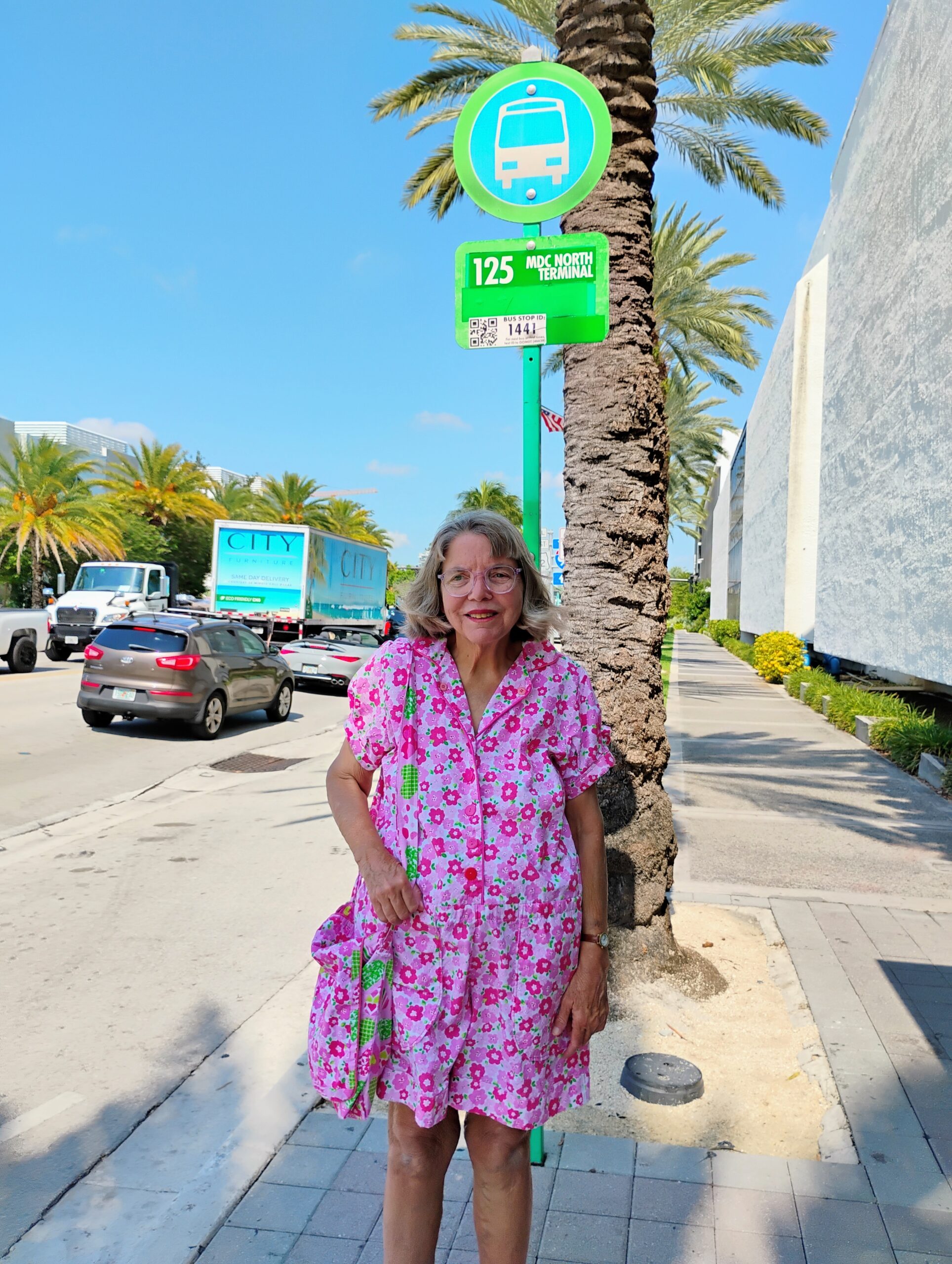
To quote the Grateful Dead, “What a long, strange trip it’s been.” That’s the way I feel about my 66 years of riding the bus in Miami. 

In other major urban hubs, like Chicago, New York, Washington and Atlanta, commuting is socially accepted and commonplace. But here in Miami, I’ve always felt there is a certain stigma to being a non-driver. I’ve felt this way since childhood. 

I began riding the bus at age 6 in 1959. My mother had me ride daily after school from Van E. Blanton Elementary to Little River Library where she worked. I was so small I had to stand on tiptoe to put my dime in the coin box. Bus fares for children were 10 cents and 27 cents for adults. The fare-coin boxes were illustrated with praying hands that read, “Lord – what wilt thou have me to do?” and “All colored move to the back of the bus.” To a tiny schoolgirl just learning to read, it seemed a mixed message. 

Even the bus advertisements reflected that discriminatory era, from the oppressive “Playtex Living Girdles make you look 5 pounds thinner” to “Be a Marlboro man!” 

Time brought change. The era of Rosa Parks, John F. Kennedy, Lyndon Johnson and the 1964 Civil Rights Act ended segregation of riders. Even the sexist culture of America was undergoing a “metamorphosis.” Fewer women felt the need to wear constricting girdles and smoking became less definitive of “manliness.” However, despite advances of equality regarding race and gender, I feel there has always been a culture of discrimination against non-drivers. But bus riders fought for their rights! Here are some examples in Miami’s history: 

In 1963, Little River’s government leaders proposed that all bus benches along 79th Street, from N.W. 7th Avenue to Biscayne Boulevard be eliminated “because they take away the prettiness of our thriving shopping district of department stores, dime stores, banks, drugstores and movie theaters.” Shoppers, workers and housewives, black and white, protested, saying, “After a long day’s work on our feet, we need to sit down when waiting for the bus!” City leaders hastily backed down. 

In 1969, bus fares had climbed to 35 cents for adults and 15 cents for students. The County proposed the student fare be applicable only on school days from 7:30 a.m. to 4:30 p.m. This meant students would be paying 20 cents more per ride during off hours. (20 cents might not sound like much today, but in perspective, a candy bar back then was a nickel, and a ticket to see the Doors concert was $6.00). Parents and students howled in protest and student fare stayed in place regardless of time of day. 

In 1985, the Miami-Dade County proposed “Network 86,” with massive bus cutbacks called “streamlining.” I became a “Network 86 Forum Participant,” encouraging fellow bus riders to attend a town meeting. Most of my neighbors and fellow passengers were white, elderly and Jewish, (in sharp contrast to North Dade’s current population, which is primarily Haitian and Creole speaking). Network 86 participants eagerly protested at North Miami City Hall, exclaiming “We lived through famines, World War II and the Holocaust! We won’t be swept under the rug by you young whippersnappers with cars!” We all calmed down, heard each other’s viewpoints and compromised. One agreement was that since Routes “10” and “12” were almost identical, the “12” was eliminated. There was even a pleasant surprise: we’d have a new route directly to Aventura Mall! All other North Dade buses remained intact and the proposed cuts were scrapped. 

In the 1980s, President Ronald Reagan cut federal transportation funds nationwide and singled out Miami’s Metrorail, saying it would have been “cheaper to buy everyone a limousine.” He, of course, had arrived in Miami in a chauffeured motorcade! 

In the summer of 2023, Miami-Dade County made their so-called “exciting” announcement: There’d be a “Better Bus Network,” with ‘more efficient, streamlined service.” 

However, seeing their new Route Map, I was shocked! Routes 2, 10, 16, 19, 93 and 297 had been cut. In addition, they curtailed Route 3 so it no longer serves a vast area of North Miami Beach. What does this mean for North Dade commuters? Without the routes listed above, only the 9 remains to travel between downtown and the 163rd Street Mall terminal. Most North Dade riders now have to walk as far as a mile to catch the one remaining 9. It is so crowded bus drivers often have to bypass people waiting at stops. I have heard similar cutbacks have also occurred in other parts of Miami Dade County. 

I will not give up hope that the voices of riders will be heard. A Facebook page, “Miamians Against the Better Bus Network,” has been created. There are now 465 members protesting the cutbacks. I hope that more Haitians will join in the protest, as they would be powerful allies. To date, the County has not reinstated the cut routes. 

What a long, hard road it has been. The journey continues! 

January 1st, 1959 was like any other in New York City, but one family was celebrating more than the arrival of the new year: aboard the Norwegian freighter M.V. Hoegh Cape were several passengers from the other side of the world. Among them were my mother, father, and me–an infant twenty-three days shy of my first birthday. Lacking the financial means to buy airplane tickets, my parents got a berth on the freighter (as many poor families did in that era) from Bombay, India, to return to the U.S., where they had met and gotten married. My mother had gone home to Madras to be with family so that I could be born with her mother and family nearby. Mom got a job as a music teacher in Dade County’s public school system. She was the only Indian teacher in Miami in 1959, and it’s possible my father was the only Swedish-American boat builder and sculptor. They rented a tiny cottage in Coconut Grove’s Ye Little Wood. By the mid-1960s, Dad’s copper sculpture became well-known around Miami, and several private collectors bought his graceful shorebirds, gulls, and various other unique works to display in their homes, from Coral Gables to Fort Myers. Dad’s astrological globe–partially rebuilt over the decades because of vandalism–still adorns the entrance to the Gables By The Sea community on Old Cutler Road. My father was deeply connected to the ocean, and we spent at least two days a week on his homemade sailboats, exploring Biscayne Bay and the Keys. We would spend overnights on long weekends, sailing down to Elliot and Sands Keys, cooking aboard, and snorkeling. During several summers, we sailed across the Florida Straits to the Bahamas, living aboard for weeks at a time in the Abacos and Berry Islands. As a 13 and 14-year old, these were the most memorable adventures of my life. We would stay until it was time to go back to school. Mom admirably ignored racism and got her Ph.D. from the University of Miami and rose to become a prominent principal and administrator with Dade County Schools. With my Swedish and Indian background, I was exposed to different cultures and foods at an early age. Still, my life as a young man in Miami was as American as any typical kid could be: I fell in love with football at age nine, but music was also a huge part of my life because of my mother’s classical influence. I played the cello at ten, taking lessons from one of the Miami Philharmonic’s premier cellists; Mom took me to countless concerts, when I wasn’t going to Miami Dolphin games with friends. I taught myself guitar at fourteen, and by fifteen was playing in rock bands around town. I attended Palmetto Junior High, then spent two years at Ransom School–then all-boys–for 8th and 9th grade before returning to public schools and graduating from Palmetto Senior in 1975.

I was a music major at Dade Community College (Now MDC) and later changed my major to Criminal Justice when the law enforcement bug hit me at nineteen years old. By twenty-one, I was in the police academy with the Opa-Locka Police Department. I later joined Metro Dade Police, and worked as a uniformed officer and homicide investigator for the next twenty-seven years, retiring in 2006. My mother had passed away from pancreatic cancer in 1996, and Dad became too old to sail after the third boat he built was wrecked by Hurricane Andrew. Dad passed away just before my retirement in 2005. I had since married and raised two sons, and in 2003, my then-wife and I adopted a baby girl from Russia. After retirement, I worked in real estate and later began teaching criminal justice at Coral Reef Senior High School. After four years of teaching, I left and worked in the security industry, returning to Ransom-Everglades for one year as their Director of Security before returning to Coral Reef to resume teaching. By that time, I had re-married to an aspiring teacher, an Indian divorcee with three children. Remarkably, she was hired by Ransom Everglades in 2005, and we moved north from Kendall to be closer to her job. Sadly, my Russian daughter died in a car accident at age 16. That was 2020, the year of COVID; the disease wasn’t much more than fleeting afterthought after the terrible loss of Linnea. We both still teach and enjoy our five children–and now, two grandchildren (who live in Boston). We are happy empty-nesters who enjoy life and we travel to India to visit my wife’s parents each summer. Miami, my upbringing, my young adventures on the water, and my law enforcement career, are all inextricably woven in a rich tapestry (to borrow from Carole King) that I have memorialized in a recently finished autobiography entitled “Badge, Tie, and Gun Life and Death Journeys of a Miami Detective.” This book is with a literary agent and we are currently pitching it to various major publishers. I continue to write, working on my second novel now. Miami is a remarkable and unique place. I have tried to capture its growth–as well as mine–in my book. The Miami I grew up in was a quiet, Southern town. It has grown into a vibrant and diverse cyclorama of Latin American culture and financial promise. I live across the street from a Metrorail station, and when I ride it, I look out the window and see my younger self at
almost every corner.

I grew up in Weston, a suburb outside of the Fort Lauderdale area. Growing up, I never really went into Miami, and drove to Fort Lauderdale or Naples to get to a city. Now, I am a student at the University of Miami, and currently live in Coral Gables. Miami has become a home to me, and I have realized that there really is no place like Miami. Miami is so unique, and is a place where culture, history, and people thrive. I feel like every day I experience something new, and connect with someone I would have never met if it weren’t for Miami. The people in Miami are what makes Miami so special, and sometimes, just having the city of Miami in common with someone allows you to relate to one another. I also feel as though there is a constant sense of Miami pride, inside and outside of the city. Often times I will see someone wearing UMiami gear in a different state, and throwing up the U will always spark up a conversation. Something that will always make me feel like a Miamian and give me a sense of Miami pride is when I drive on I-95 passing through Brickell and Downtown. I often make this drive coming US-1 on the way to either the University of Miami Medical school, the beach, or somewhere else downtown. There is nothing quite like this drive, or the view that comes with it. When you pass through Brickell and Downtown on I-95, you have a perfect view of all of the high rises and the ocean behind them. It is beautiful during the day and at night, with all the lights from the buildings shining through the dark. Whenever I make this drive, I get this indescribable feeling, and I am so grateful to be living in this beautiful city and get to experience it every day. I feel a sense of hope and contentment, knowing that this place is my home.

Translate »