
fbpx Skip to content
Named Best Museum 2022 by Miami New Times

I am Nelly Josefina Avila de Barriga and I was born on November 20, 1958, in Maracaibo. We are very regionalist, and refer to our city, Maracaibo, as the first city of Venezuela.

My first visit to Miami was as a tourist, and it seemed very pretty to me here. It reminded me a lot of Maracaibo – the city is on a flat plane like Miami, it has a lot of beaches and the climate is similar to Miami. I told my family that when I was in Miami I felt like I was in Maracaibo. Of course Miami is a bit more organized than Maracaibo, but also very pretty like Maracaibo.

After raising a family and growing a career in Maracaibo, my daughter had the idea to move here to Miami to live. It was because of the things that were happening in Venezuela at that time. My oldest daughter came here with her husband, but my second daughter is a journalist and she had to stay and cover the Venezuelan government.

I worked with children there and I didn’t want to leave it to come to Miami. My roots were there. My schools, my kids, my profession, everything was there. It cost me the world to leave and come here. But for the love of my daughters and grandchildren, I came to Miami.

I don’t regret the decision, and I have been well received here. I’ve found my group here, and now I am working with children, giving them music lessons. I am doing a part of what I did in Venezuela, thanks be to God.

In Venezuela I started with music when I was 11 years old. At that time there was a priest who really liked music and sports, so he created a project with children. He saw that there were many music groups in the region where I lived, Zulia, but they were groups of adults. He decided to make a music group of children and see what came out of it. Then we gained attention. All of the children in Maracaibo wanted to participate in this group because of the importance it had.

He dedicated himself to teaching us music, but he educated us in other ways, as well. He taught us a lot of discipline. From then on, everyone who integrated into the conjunto all went on to become teachers. We taught music and we taught primary education.

At age 16, I went to a female group. When I finally joined the men’s professional music group, I was the only woman among 18-20 men. I was a principal member of this group. I have also been in big groups like Los Tucusones, Enrico Morales, Amor y Gaita, and others.

Later on, I met my husband and we formed our own group. My father was being difficult at that time, saying that since I have a boyfriend now I can’t follow the gaita music and band lifestyle.

Well, passion always wins, and so I married my husband, and we were in the same music group. People were concerned that we wouldn’t last, but now we have 30 years of being together and playing music.

From that experience, I learned that I wanted to teach children about gaita music. I wanted to have a school in Venezuela of gaita music like they have in Mexico for mariachi music. Everywhere in Venezuela the people love gaita, and it comes from my home in Zulia. I wanted the school, and so I sought the approval of the governor who approved the project.

Gaita music is with Venezuelans since birth. It is played all year long and heard all of the time on the radio. It’s as essential to Venezuelan life as salsa music is in Miami. We also listen to other genres, but in every Venezuelan house there is a gaita musician or singer.

In reality, the gaita was born as a protest. My mom told me that in her time, gaita music was the only form that the people could use to protest the government. I’ve heard some of these old recordings, and it’s amazing because the musicians recorded everything at these protests with one microphone. In today’s world, you need a lot of equipment to record gaita music well, and it’s a delicate process.

Famous musicians in Latin America come to Venezuela to play and record gaita music. These musicians comment about how hard it is to play gaita music, but for us it’s like drinking water. We are born with this music and tradition.

In many regions of Venezuela, they play gaita music during Christmas. Here in Miami they begin asking for it on the first of November.

I play gaita music socially and when the drinks are over and I have finished playing, I will take the music back to my house. That’s what most Venezuelans do here because it reminds them of home.

My husband is a musician, too, and it’s in the family. My granddaughter is learning by growing up in this tradition, and I have a grandson, her little brother, who has been passionate about singing gaita since he was a little boy.

We formed our group, La Gran Maquinaria, in 1989. We started as members of many different music groups. We knew each other from playing at functions, restaurants and discotheques. One day at a restaurant there were so many musicians gathered together at one common table that we felt the need to all play together. The next week we were playing at that same restaurant.

I have a lot of respect for my work; there are libraries in Venezuela that have my work, and I have won many prizes. My husband made a room for my trophies, but they don’t all fit.

I’ve been singing gaita for 46 years. It is incredible to see a Venezuelan crying over my gaita performance. They remember the market and the religion, their family, and moments that they’ve had. It is very emotional.

The government right now does not allow gaita for protest. It’s forbidden. Gaita music has been adaptable to other styles and played for romance, love, commercial use and other things. But it’s most important that it remain a protest and confrontational music because that’s where it came from.

Here in Miami, I am surrounded by Cubans, Colombians, and other Latins. We have very similar cultures, and Venezuelans are very sentimental, nostalgic, and we’re rooted in what is ours, our culture. We communicate with each other through our music, with the soul, and with our customs.

When I sing, they are already all my friends. This is what I value. Music is the language of the soul.
My father came down to Miami from Chicago in 1952 and my mom in 1953. He worked as a lifeguard and she worked at old Jackson hospital. They met at the 14th Street beach. They courted, then married in 1954 and I was born that same year. My nickname as a kid was “Sandy” because they met on the beach. I also grew up on Miami Beach.

As I ventured into tourism and travel in 1979, my travels took me a lot of places. I started with Gray Line tours here in Miami, and we did lots of tours to the mountains in the Smokies, and in New Orleans. But mostly my career was here in Miami doing tours in the city, in the Everglades and in Key West.

Gray Line was sold in the mid-1990s to an Orlando transportation company, and then absorbed by Coach USA, so Gray Line isn’t the sightseeing tour company it used to be.

Then, about 10 years ago, Big Bus Tours came to Miami. Big Bus is a London-based company and now they’re in 17 different cities throughout the world. Miami was their first U.S. city.

The industry has changed a lot. Years ago people wanted to be in a nice air-conditioned motor coach, and now it’s become very popular to sit on top of a sightseeing vehicle. It’s a wonderful way to see the city. It’s like being in an open convertible.

I’ve always been interested in transportation, which has led me to a lot of history as well. I could’ve been anything, and I think my mother was horrified that I would consider being in transportation rather than a doctor or lawyer. But I think it’s always important to do something enjoyable with your life, since you’ll spend a lot of time doing it. I’ve had no regrets with my decision to be in transportation, and I have met wonderful people.

When I started with Gray Line, they wouldn’t hire you unless you were going to be a driver-guide, so I ventured into that. I already knew history and it came naturally to me. Back in the ‘80s, I was fortunate enough to learn from many highly educated driver-guides, and it was quite rewarding.

You’d begin by traveling on a bus with a driver-guide, and you would also have to be in the classroom and take tests on subjects they wanted you to know about. The schooling for being a guide lasted a month, and then if you passed the schooling they would teach you how to drive. It took six weeks to finish the course.

I’m still learning to this day. People are fascinating, and you have to get to know them and talk with them to see what their interests are. It’s amazing, the stories that I can tell you. I’ve had people die on tours, and once I was in the Everglades and a man stood up and threw up all over me. I didn’t miss a beat. I just stepped aside. To this day I know some tour guides who have heard about that event and couldn’t believe I kept my composure. Have to roll with the punch.

To stay informed we read the paper, of course. There are lots of celebrities here in South Florida, and they’re always in the news. The commentary changes quite often. If there’s a significant event that happens in the city, like the Versace murder on Miami Beach, we mention it when we go past there. Sometimes we remove old and less significant information as new things happen. So we go with the change of the times.

The tourists I guide are really wowed by the beauty of the city. The architecture here is very beautiful. In the wintertime, when you go across the bridges the color of the water is wonderful. I always tell the students that they should appreciate the nature here – the trees and birds and the dolphins in the bay. There is so much natural beauty if you’re really looking and paying attention.

Tourism in South Florida used to start right after Thanksgiving and would continue through until after Easter. For many years this was the way it was, and people would close their homes up and go north. When air conditioning came into play, and when the Latin American influx came, we became a year-round destination for tourism.

Unfortunately, sitting in the busses during the summer is like sitting inside of a broiler pan. But most of the people on the tour are going to the beach anyway so they’re going to have suntan lotion on. It isn’t often that we’re sitting in really bad traffic, and on the weekends it might be slow, but for the most part it’s fine, and they can always go down below to the climate-controlled coach.

As time goes on, you learn to do a routine and how to build your tour. Sometimes it might take you longer to cross the causeway, and basic buildings aren’t going to change, so you have to be ready with what we call fillers, which are facts about surroundings. You’re going to say the same thing over and over again most of the time, so you have to keep it fresh.

I think tourism will always be good here because we are a major hub for Latin America, and we have many more Europeans coming here for tours. Everyone wants to come to Miami.

It is important that the guides and the people giving information present the city in a positive way, and that the drivers drive politely and safely. But it’s a constant battle to get the two working together smoothly. The hospitality industry is not paying as much as it should to attract better caliber people.

But I just love it. When I give the tours on the coach, the city sells itself, so my job is easy. I’m simply enabling my audience to enjoy it more.

I was born in the Oriente Province of Cuba in 1953. I came to the United States when I was 12 years old and my family settled in Hialeah.

My parents bought the house that they still live in today, and we started our business in Hialeah in 1968 as a clothing store.

My parents would work in the factories during the day and would sell pants and shirts door-to-door on the side. The business grew, and we decided to open the location where we are to this day. In 1979 we bought another building and expanded, but we also kept the original store.

I grew up in the business beginning when I was 14 working for my parents. Then I went to Miami-Dade to study fashion design. I started working in 1997 with the quinceañera dresses, which I love.

Family relatives who were turning 15 around that time wanted quinceañera cruises, which were a new fad. They were looking for their dresses, and we were going to the meetings and decided to get into the business. We have been doing that ever since.

My husband and I are now the owners. He worked for us when we got married, and now he’s in the administration.

We have three sales people who have been with us for a while, and a couple of seamstresses who work with me. It’s a small operation, but it’s working out well.

When we came from Cuba in the 1960s, the situation here was not good. But my mom put money away, and when I turned 15 I had my party at the house for the sake of the tradition. Quinces here in Miami were very simple in my time. I went to a lot of them, and I danced a couple.

At mine I wore a white miniskirt with a tiara, and I had a photographer come to the house, and my friends came, and we took pictures and had a dance party. As a mother now I understand wanting to have that special day for my daughter, and I’m thankful that my own mother did that for me, too.

The quince tradition came from the Mexicans: the Aztecs and tribes in Mexico. They used to have a special ceremony for the girls approaching puberty to give them different roles for their different tribes. Then the Spanish came, and the emperor Maximilian changed the whole thing, and wanted to adapt the custom to more of a fancy ball with beautiful dresses to present the girl into society.

It’s changed into sort of a rite of passage. I know a lot of moms who don’t let their girls pluck their eyebrows or put makeup on until their quinces. That’s when they wear their first heels, put makeup on, and they’re excited.

It’s also not just one big dress anymore. Every year there is a change in this business. In the beginning we started with the cruises and they wore all white. Then they started doing colors — champagne and ivory — and with the parties it’s the same. Now they go with themes, such as Disney themes, so we have dresses that we try to not make look like a costume but fit the theme of the party. Themes require a lot of planning ahead of time.

I learn something new every day. Some girls are very excited about doing this, others just want to please their mom. But most of them dream about this day for a long time. When they come in, we like for them to feel like a princess.

I have friends in the business who do big parties. Once, there was a girl who came in on an elephant. They had to get a permit to bring it over, but they had money and she wanted to do that so they did. That’s a little extreme, but it happens.

Some parties are as big as 500 guests. The most popular ones are around 100 or 150, and 200 is considered a big party. The way I see it, weddings can happen at any time, but a quinces is an event that happens once in your life, and it stays there forever.

I have two girls. For them we had a small party at the house; I didn’t have the business back then. I’m planning the quinces for my granddaughters already. They are still young, but I’m excited to do that.

I think quinceañeras will stay. Many who come here have been planning since they were little girls. It’s rewarding for me; I don’t do it so much for the money; my reward is seeing the faces of the girls when they come back and say they had a great time, and they bring me a picture, and they recommend somebody.

At this time in my life, I’ve enjoyed it so much that I am also able to help the community. We’ve worked with Make-a-Wish Foundation girls, in cruises and parties, and we’ve done work with schools and to make parties for groups of girls who don’t have much. I like to do that.

Miami influences what I do. My husband once told me that this was the capital of quinces in Florida, and I think it is. I have people coming from Tampa, West Palm, Orlando to get dresses here.

There’s a mix of cultures, too. Before it was more of the Cubans giving all of these big parties, but since we have people from all over, and because these people are growing up together in school, this mix of cultures influences our parties, like our colors. We have people from Brazil who have these parties, and I have some girls that are from the African-American community who do Sweet 16s, and they have Cuban and Spanish girls dancing at their parties, too. It’s a nice thing to do. It brings the community together.

I was born in Port-au-Prince, Haiti, on August 15, 1963. I grew up there, but came to the United States at the age of 12. I lived in New York City until I came to Miami in 1994 on vacation with my dad and sister. I ended up staying.

I’m a realist artist. I’ve been painting my entire life. I do a lot of murals now, but I started painting with canvases in New York. It was too cold to do murals there.

When I first came to Miami, I was already a sign painter and portrait artist. But when I saw Little Haiti, I really noticed something was missing. All I saw were letters. I thought it would be cool to see a restaurant with a nice big piece of chicken painted on it, or a painting of a table with someone eating. That way, the people who didn’t understand English would know what’s in the restaurant. And vice versa for the places that had signs in Creole.

I first started by working here through my uncle’s fabric store. There was a restaurant called Chez Le Bebe across the street from the fabric store. One day I walked across the street to the restaurant and looked at my uncle’s place. Everything again was letters. It’d say, “We sell this,” “we’ve got that.” I went back to my uncle and asked him if I could paint a beautiful woman out there with some nice fabrics, so that people would know what’s being sold in there.

He said, “If you’re not going to charge me, go ahead and get it done.” So he took me to Ace Hardware and bought me some paint.

As I was sketching, I noticed cars started slowing down. They kept looking and saying, “Good job!” Less than an hour into the picture of the woman I started putting colors on it. This lady pulled over and said, “Sir, this is beautiful. I have a fabric store three blocks down. Would you do the same thing for me?” I said yes, even though I knew I wouldn’t have time because I was going back to New York.

My uncle ended up giving me $200 for the mural, since it got so many compliments from customers. That’s when I knew I had to stay with my cousin in Miami to be an artist. It had always been my dream.

I had to trick my dad and sister in order to stay because Haitian people, we stick together. We don’t leave our family. You go three blocks down—we’re all related.

So, five minutes before the Greyhound to New York left, I told the driver I was going to use the bathroom. He opened the door and let me out. My dad was like, “You’ve got five minutes to come back.” I left with nothing in my hand.

There was a car parked by the gas station. Instead of going to the bathroom, I dodged behind the car and waited for the bus driver to leave. I could see my dad and my sister getting real mad, looking for me. And sure enough the bus driver closed the door and said, “Okay, I’m leaving him.”

The bus left and I found a payphone. At the time it was two quarters to call. I called my cousin, and said, “Cuz, I’m somewhere called Biscayne Boulevard on 7th Street,” and he came to pick me up.

I ended up making a lot of money fast, doing exactly what I wanted to do. But my father stopped talking to me. When I came to Miami, I saw a future for me. I saw my dream. But I couldn’t get that into my father’s head.

A year later, Haiti was in the headlines because Jean-Bertrand Aristide was coming back to take power in Haiti. On 54th Street in Little Haiti, there was a place called Veye-Yo. Whenever something political happened in Haiti, we always gathered there. At the time, Father Gérard Jean-Juste owned Veye-Yo. He was a big leader of the Haitian community.

So when Aristide was coming back, all of the news outlets were there. As an artist, I wanted to put my two cents in. I put a big canvas in front of Veye-Yo, and drew Aristide coming back with American Flags and Haitian flags united. Before you know it, CNN was interviewing me. The next morning, I got a call from my sister.

She’d told my dad that I was on TV. He assumed I’d killed someone or robbed a store. But once he saw that I was giving interviews and looking good, he finally called me to congratulate me. It was the happiest time of my life.

Since then the biggest challenge I face with my work is the sun. It’s too hot here sometimes. Sometimes there’s walls that you want to be working on, and walls you don’t want to be on, because the sun stays there 24 hours a day. Sadly I can’t keep an umbrella on top of my head while I hold the picture and the brush. That’s the only thing that’s hard in my business. But every other part of my job is a joy.

I love huge works with huge exposures. Things that kids will look up to. Things that, when you pass by, could inspire kids to be an artist. That’s why you see me in the street all of the time.

I love painting all over Miami, but I have to do my homework on the area. I can’t go to Little Havana and paint a picture of Aristide. I have to walk around, look around, and feel the environment before I put anything in someone’s environment.

If I go to Liberty City, I know that’s an American environment. I would know automatically, if I put a big Tupac or Biggie Smalls there, they would like that. Because that’s their vibe. So if I’m in Little Haiti I could paint Father Jean-Juste.

I hope my artwork will stay forever in Little Haiti and represent Haiti to the fullest. I am more Americanized now, but at the same time I like to keep my culture. Just like the Cuban brothers keep their culture.

That doesn’t mean I can’t paint skyscrapers, or the Statue of Liberty, or Mr. Obama. I can do all of that. But at the same time, when I’m in Little Haiti, I concentrate on what matters to Haitians.

My grandparents, Cecil and Gertrude Bremner, along with their three daughters, Cecilia (Scanlon), 10; Frances (May), 5; and Lauraine (Durrance), 3, left Aberdeen, Scotland, in 1949 to start a new life in Miami.

My grandparents both worked at Fraser Refinishers furniture store on Northwest 27th Avenue.

My mother, Cecilia, graduated from Miami Senior High and started working at Southern Bell in Miami Beach. She later married my father, Ralph Werlau.

In 1958 I was born at General Hospital in Coral Gables, and 10 months, 17 days later my brother Keith was born.

My parents bought a house in a newly developed residential area called Westwood Lakes in 1959. My father worked for The Miami Herald as a composer/typesetter and my mother became a housewife.

Keith and I went to Westwood Christian and then Royal Palm Elementary.

Our neighborhood was such a great place to grow up. There were lots of other families with kids in Westwood Lakes. My best friend was Donna Page.

My parents joined the Miami Herald bowing league on Wednesday nights at Bird Bowl. Their team sponsor was Frankie’s Pizza. Sometimes after bowling we’d get a pizza to bring home. I still love Frankie’s.

My brother and I started bowling at a young age; we each had our own bowling ball, bag & shoes.

In the mid-1960s there was a league called The Roadrunners; it was a group of 150 young bowlers. There were two divisions: Bantam (6-12 years old) and Juniors (13-19). We bowled Saturday mornings and were coached by my mom and assistant coach, Shirley Shockley.

Mom bowled in a Tuesday morning league and several women’s tournaments that included a young Paula Sperber (Carter). In 1971 mom joined a new organization called The Dade County Bowlerettes, and then, between 1972 and 1973, just before she stopped bowling, she worked in the pro shop at Western Sunset Bowl.

Mom was one of my Brownie leaders and also for Girl Scouts. We usually had meetings at our house and worked on projects to earn our badges. One of our field trips included the Tremendous Color Plant, where we each received a Kodak Brownie camera.

I loved selling Girl Scout cookies and Keith earned money by delivering newspapers from his bike.

We lived near Bird Road and 112th Avenue. Closest to us was the Concord Shopping Plaza. There were so many stores & restaurants available to us. Each place has a fond memory, like the Burger Castle where my brother and I got our first jobs.

On the weekends, Tropicaire Drive-In would become a swap meet during the day and sometimes we would sell stuff there. My favorite thing was going there at night to watch a movie from our car.

On 112th Avenue and 51st Street, there was a small but steep bridge. My dad would accelerate the car just before going up the bridge and as we came down the other side you could feel your stomach jump a little. We always laughed. The bridge has been leveled.

We went to Rivera Junior High. Next to the school was a park and pool where my brother and I learned to swim. As I finished up 10th grade at Southwest Senior High, my parents divorced. Mom, Keith and I had to rent a house in Kendall. It was very hard leaving my friends.

I’ve always regretted not keeping in touch with them when I had to move away. I found out that my friend Donna Page was shot and killed while being robbed as she was leaving the Copa Lounge on Bird Road in 1982.

Mom got a job at Southern Bell in Coral Gables on Alhambra.

During the summer I would catch a bus to the Coral Gables Bus Terminal. I would meet my great-aunt Nellie and we would go to the Coral Gables Library.

In 11th and 12th grade I attended and graduated from Miami Killian Senior High. Starting a new school was scary but I made new friends and earned a spot on the school’s bowling team and badminton team.

Then Mom remarried and they bought a house in Cutler Ridge. It was so nice and quiet.

In 1977, a new Denny’s Restaurant opened on Marlin Road and US 1. I got a job as a waitress there. My mother suggested I apply at Southern Bell and in January 1979 I was hired on as a clerk.

Southern Bell later became Bellsouth and in 1987, we moved our Yellow Pages office to a new five-story building on Kendall and 117th Avenue. AT&T acquired Bellsouth in 2006. Many lost their jobs. I was able to hold on and retired in May 2009 with 30 years.

I’m very grateful to my mother. I learned so much working at Bellsouth and have many friends for life. We keep in touch through social media or get-togethers.

These days, retirement is on hold and I’m searching for a job.

Being a Miami native, I’ve witnessed the growth and many changes that make Miami what it is today. I still love it here but there are times I find myself feeling like an outsider. I do miss the old Miami.

My brother lives less than four miles from where we grew up. Mom and I still live in Cutler Bay which has experienced a large population growth.

If I’m in the area, I will drive through the old neighborhood. Many of the homes have been updated, but amazingly, there are a few that still have the original 1956 design.

We all have wonderful memories of living in Miami, from my family that moved here, to the generations since.

I was born in 1968 in Coral Gables. I have a twin brother and we were the biggest twins born in Doctor’s Hospital ever. We moved to Kendall and I still live in the 10-block radius where I grew up.

I had been a banker for 20 years but in 2008 the industry plummeted, so I had to decide what else to do. My kids were pulling for an ice cream shop, and I wanted something that would help pay for college, so for me it was about having a job and putting my kids through school.

We’re a big ice cream family; my grandma made ice cream in Cuba and parts of Central and Latin America while she traveled with my grandfather who was a sugar mill engineer. She picked the fruits from all of these different countries to make ice cream. She didn’t make it when she came to Miami, but we had it all of the time. For us, it was about being together as a family. Ice cream makes everyone smile; it’s a fun business, so I decided to open Azucar.

Penn State has an ice cream school, so I went there and then to St. Louis, the Frozen Institute. I came back and I decided that Little Havana would be the only place to have a Cuban ice cream store.

The day I opened there was a Viernes Culturales event, which is a festival on Calle Ocho on the last Friday of every month. The entire street closes down and all of the art galleries open and lots of food vendors come out. It’s like a street party.

That’s the day I opened, and I almost ran out of ice cream that day; I had to come back at 5:00 the next morning to make more ice cream, and it’s been like that ever since.

For me, I had to make it as Cuban as possible, and the tiles are the biggest labor of love I ever did. We have replicas of tiles like you would have seen in Cuba 50 years ago. They’re also a little broken, which is how you would see them in Cuba today. I stole guayaberas from my family members’ closets to decorate the walls and I added plastic to the furniture because everyone had plastic back then on the furniture.

The Celia Cruz painting, which is the most photographed thing in the store, came by accident. This was from George Viera, and I was next door building my shop when I met his brother. He mentioned this painting that George did, and he showed it to me and I bought it right there.

Most of the store is filled with local art, which I’ve commissioned. We have a 29-foot ice cream cone on the outside of the building, which is a work of art until a hurricane comes. Then we have to touch it up a lot. Birds live up there too, an entire family.

In the morning I get tourists, and at night it’s all locals. It’s a lot of fun, and I like it better at night to tell the truth.

We are the #1 place named by New Times to take out-of-towners. We educate them on exactly what Cuban ice cream is and our experience. A lot of people come here on their way to Cuba, and some people come back after Cuba, and we like to hear what they have to say.

There are some people who live around the pier. There’s one gentleman who comes and eats chocolate every day. He just sits, happy to watch what’s going on in the street, and he’ll stay for two hours. We also have lots of dog owners who come in and share a cone with their dog.

Our clients from the area, from Domino Park, are an older audience and many are diabetic, and they would come in and ask for sugar-free. I used to tell them that we are called “Azucar” (sugar), not “sin azucar” (without sugar). But I had to make it, because the demand got so high. Now, we make all of the flavors for them, too.

I’d like to grow the business little by little and be all over the nation, like the Cuban Haagen-Dazs. But I’m just one person and I don’t want a huge team yet that I don’t know personally. Our next spot may be next to FIU, and then I want to go to Plano, Texas, because my mom, my brother and my little sister live there.

I started out doing it for economic reasons. I was going to have this little store, and my kids would work there and we would make ends meet, but it’s become way bigger than anything I would have ever dreamed of. We were picked by Goldman-Sachs, Miami-Dade College, and Babson College as one of the 10,000 small businesses in the United States to move forward. So they’ve given me education, and I now have an entrepreneurial degree from Babson College.

Now, it’s about what’s happening in the area, whom we can we help out, and what we can do to get better every day. I became a board member with Viernes Culturales, of Miami-Dade College on the advisory board, and of the Merchants Alliance. My day isn’t just standing at an ice cream machine anymore; it’s going to meetings with the commissioner, the mayor and trying to get these streets cleaned up.

I’ve never lived outside of Miami; I have five siblings, and they all left except me. Miami is home, it’s where I grew up, and it’s everything that I know. I have traveled extensively, but this is home. This is where there’s ocean, where I can breathe, and this is where I feel the best.

I think of all the cultures that are here – even at Azucar. We’re a mix of peoples and cultures but we all still get ice cream.

On Christmas Day, 1961, I lost my innocence.

Instead of waking up to presents given by loving parents, family and friends, I received goodbyes from aunts, uncles, cousins, school friends, my dog, my town, my school, my parents and my grandmother.

In my suitcase, I packed my memories. Would I ever see my beloved Güines again? I could hear my mother and grandmother crying behind closed doors, and my father giving me advice on what to do and not to do as I left for this flight — the flight of Pedro Pan into Never-Never Land. I didn’t understand the reasons why; I only knew that my parents and all the adults, including the headmaster of the Salesian school where I had been since kindergarten, thought that this flight was for the best. Best because I would be going to the promised land of freedom, even though I had to go by myself, like Wendy and her siblings, leaving my parents behind.

I remember arriving at the airport of Rancho Boyeros and going into the “fish bowl,” sitting next to other children of all ages who like me were looking at their parents behind the glass. We put up a brave front, although inside we were all crying. We were stripped of not only our personal possessions, such as the ruby ring given to me by my grandfather, but of our happy times together with our families. Parents and children separated by glass and by a Communist government that was going to indoctrinate their children. As I ascended the stairs to the plane, I kept looking back trying to catch a glimpse of my parents; I don’t know if it was the tears, but I was unable to see them one last time.

During the 45-minute flight, a myriad of thoughts assailed me. I was afraid of how I was going to survive separated from my parents. Who was going to take care of me? Where would I sleep? Where was I going to live? How was I going to survive when I didn’t even know English? Too soon, and before I had answers to any of these questions, we arrived at our destination: Miami.

As I and approximately 150 other children arrived, we were herded like cattle, according to our age group and gender. The girls were sent to Florida City; boys 16 years old and older were sent to Matecumbe in the Keys. I, along with boys 15 and younger, was sent to Kendall. The Catholic Welfare Bureau had set up these centers to house the children of Operation Pedro Pan.

Upon arrival at the Kendall camp, we were assigned a bunk bed, shown where to put our meager possessions and have a meal. I quickly remembered my father’s words when I was presented with the first plate of food in a new land, cornmeal, which I didn’t like. “Eat son, whatever is put in front of you, because you don’t have a choice. It’s either eat or go hungry.”

How different it was. At home, if I didn’t like something, Abuelita prepared something else for me. Here, at the Kendall camp, the lessons started right away: Eat cornmeal or go hungry. As we were getting ready for bed, I looked at the sad faces of my companions, the children of Pedro Pan. I’m sure my own face also reflected the sadness that overwhelmed all of us because of the separation. Each one of us dealt with our loss differently – some cried, some nervously giggled and one boy started taking flight with a knife because he wanted to go home. When he was finally calmed down by the counselor, he started whimpering like a wounded dog; his heart, like mine, was wounded by leaving behind all that was near and dear to us.

As I lay in bed that Christmas Day night, I thought how quickly and irrevocably life changes. On Christmas Eve, I was a happy, innocent, pampered child, and on Christmas Day, I became a man. How ironic that they chose that name for this operation, Pedro Pan – Peter Pan, the child who never grew up. No, I grew up overnight; I ceased being a child the moment I became part of the Pedro Pan Operation and left Güines, Cuba, never to return again.

The Miami Herald Spelling Bee always brings back a rush of memories for me, memories of a spelling bee 75 years ago, when, in 1942, at age 15, I soared to the finals representing the Gesu School in downtown Miami, only to miss the word “metamorphosis,” resulting in a third-place finish. I’ve never misspelled it since then!

In fact, “metamorphosis” is entirely appropriate when describing the many careers I’ve had since then. These experiences have included Broadway, television and the cinema, production of an all-night radio show for WOR radio, a powerhouse station in New York City, a position as radio/television director for a large New York City public relations firm, inventor, and author of over 1,000 wisdom word adages found in my book, “James Yoham’s Wisdom Words.”

But let’s look at my world before all of the above. I am the oldest of nine children. In 1938, as the Great Depression was ebbing, all 11 of us piled into our car, along with all of our belongings, and headed from Tell City, Indiana, to Miami with the hope that opportunities for a better life awaited us there. I and my brothers and sister attended the Gesu School (and later the Sts. Peter & Paul School), a large Catholic school run by the Sisters of St. Joseph in downtown Miami, when that quarter was seemingly the center of everything, both good and bad. The school, which stretched from grades one through 12, drew Catholic students from many parts of the county. Throughout the 1940s, I and my siblings engaged in a full range of activities there, including sports. In fact, my late brother Skippy Yoham was a champion boxer, winning many of his matches in the boxing ring standing atop the five-story Gesu school building. Later, he died in a tragic roller coaster accident in Palisades Park, New Jersey.

We were a large happy family, though somewhat challenged financially, which made it a necessity for each of us, as we reached our teenage years, to find employment as newsboys, stock boys in grocery stores, and in other positions, while continuing to attend school. We lived in a few different places in the old, cozy Riverside neighborhood, known today as East Little Havana, north of West Flagler Street and across the Miami River from downtown Miami. It was a neighborhood filled with coconut palm trees and tall Australian pine trees. One of our residences was a large two-story house we built on Northwest Eighth Avenue.

We would often walk to the nearby Miami River and watch the busy boating activity there. We enjoyed playing sports at Riverside Park, which was a few blocks south of us on Southwest Eighth Avenue. We got to know a lot of the kids who attended Ada Merritt Junior High School, which was located just east of the park.

In the last phases of World War II, while still a teenager, I left the warm ambiance of Miami and joined the Navy. However, I was in Miami for the glorious V-J Day celebration, Aug. 15, 1945, in downtown Miami. A photo in the Miami Daily News captured several sailors, bedecked in uniforms, celebrating the end of the war, a celebration that continued into the wee hours of the morning. I was included in that joyous photograph.

After leaving the military service in the late 1940s, I went to Hollywood to study acting at the Geller Theater Workshop under the GI Bill. By the early 1950s, my creative and entrepreneurial interests were on display as I invented a pair of shoes that lit up on the toes. At the same time, I authored a song, “It’s Enough to Make a Preacher Cuss,” which was recorded on Mercury Records by Tiny Hill, an orchestra leader from that era.

In 1953, I moved to New York City and demonstrated my shoes to Russell Markert, choreographer of the Rockettes at Radio City Music Hall. Soon after, I was off to Cleveland working with actor Dom DeLuise as an assistant stage manager; I also had a part in the musical “Carousel.” I really got a hankering for the live stage through this experience, leading me, in 1956, to the Ethel Barrymore Theater on Broadway and the Theater Guild production of “Affair of Honor” with Dennis King, Betsy Palmer and William Prince.

I also worked with actor James Cagney in the 1950s, and on television’s Robert Montgomery show, as well as with Jerry Lewis on his NBC television show. What I enjoyed over all else were my sketches with another comedian, Ernie Kovacs, on his television show in 1956, as well as the piano-playing member of Kovacs’ famous Nairobi Trio.

My career went in a new direction in the early 1960s, as I became a talent coordinator and scheduled guests for Dr. Joyce Brothers’ NBC radio show. Brothers was a psychologist who gained fame from her success on the 1950s television blockbuster, “The $64,000 question.” I was connected by 1964 with another television personality, Dave Garroway, the original host of the “Today” show on NBC.

The 1960s remained a very fruitful time for me. In 1965, I produced “The Amazing Randi Show,” an all-night program for WOR radio. My guests included Garroway; Guy Lombardo, the famed band leader; a young comedian, Dick Cavett; Pearl Buck, who wrote “The GoodEarth;” and Broadway producer Alexander Cohen. In that busy year, I created 250 subjects for discussion and booked 1,500 guests.

In the following year, looking for a change of pace, I became radio/television director of Howard Rubenstein, one of New York City’s premier public relations firms. In my new role, I helped launched the Weight Watchers program, which became wildly successful. As part of our promotion of the program, I was able to plant one story about it with The New York Times and two others in the New York Daily News, as well as bring it to both the “Today” and “Tonight” shows as a topic of discussion. I also did numerous sketches between 1962 and 1968 with Johnny Carson on his popular “Tonight” show.

My career continued into the 1970s and 1980s, and, again, it veered in different directions. In 1979, for instance, I helped begin the field of dental implants with pioneering Dr. Leonard Linkow, arranging for him to appear on national television shows, in newspaper stories, including one appearing in the Miami Herald, and in radio interviews. In the following decade, I worked with Jack Nicholson in the acclaimed film, “Ironweed.” Since then, I have devoted myself to writing and have produced since the mid-1990s more than 1,000 wisdom word adages for upcoming books.

Even with my many peregrinations, I never forgot Miami. Every winter I spend a few months in the Magic City with my large family and friends, many of whom go back to my youth. And even though Miami has changed 180 degrees since then, it still represents home to me. I especially love the large Christmas parties our extended family enjoys at one of my siblings’ homes in greater Miami each year. These parties now draw four generations of Yohams among the scores of family members who attend it. I thought a great deal about Miami and the lucky life I’ve had there and elsewhere when on April 11, 2017, I celebrated my 90th birthday.

We are all aware that Fidel Castro passed away on Nov. 25, 2016, over the Thanksgiving weekend.

We may see photographs and videos of Fidel Castro for decades to come, but we will not see him any longer. I have seen news clips of Cuban-Americans dancing in the streets with great joy on their faces, as well they should.

My parents were from “The Greatest Generation,” as Tom Brokaw describes those who were born in the early part of the 20th century, living through the Great Depression and World War II. My parents married later in life and had children in the baby boomer era.

Long before World War II, my father’s mother died suddenly, right after the Great Depression began. This left my father with no mother and no brothers or sisters. My grandfather left dad in a boarding home to fend for himself, except for meals, by mid-1930. This was a challenging life, but my grandfather stopped in on occasion.

Dad was moved to new schools a number of times, which he described as very challenging. At times, in a new school, the bully would find him.

In general, however, Dad developed an ease in making friends wherever he went. Not only did he make friends, he generally kept them.

Dad was drafted during World War II before the Pearl Harbor attack on Dec. 7, 1941. He was in Louisiana, and was eventually called home to care for his very ill father, and his single aunt, then in a care facility. She passed some time later, and Dad was drafted again. This time he was sent to MacDill Air Force Base in Tampa.

He was in the Army Air Corps, and worked as a mechanic on planes going east. Dad had plenty of stories to tell from his war days.

When he left the service, he had to hitchhike his way home. When I heard that as an adult, I will admit that I was not happy with Uncle Sam leaving Dad sort of stranded. Couldn’t they afford a train ticket? Thankfully, he got home safely.

Dad was trained as an electrician with the help of the GI Bill. (Okay, thank you, Uncle Sam.) He didn’t date my mother until late 1949 or very early 1950, as they had to save from scratch before they married.

My parents were living in their second house by 1957. My father felt a great urgency in 1962, based on the nightly news, to build a bomb shelter in our basement. Recently, I heard from a prior neighbor who was 8 years old when I was approaching 4. She heard about our bomb shelter, and asked her father, a World War II vet with higher ranking, why they weren’t building one.

Word got out in our Chicago neighborhood. This project, unlike others my father took up, became known as “Jim’s White Elephant.” He continued building it until he was satisfied that this one room had enough space for us, and just enough concrete to give fall-out protection.

Despite the neighbors’ label of this project, a new trend developed in the fall of 1962. On Sept. 4, 1962, President John F. Kennedy issued a public warning against weapons in Cuba. By October, the tensions between the United States and the Soviet Union were heating up. Reconnaissance showed bombs stored in Cuba.

As the neighbors started talking more and more about the bombs being so close to home, and the frightening disposition of a young Fidel Castro as seen on the news, their tune was changing.

Neighbors started to “stop by” our home, one family at a time. People summarized their unexpected visit by asking if their family, please, could benefit from our bomb shelter as well. As I have heard it told, Dad didn’t turn anyone down.

Our house was sold almost 20 years ago. I have no doubt that the well-known bomb shelter bit the concrete dust.

Dad, here’s to dancing with our Cuban-American neighbors, whether in Chicago, in Miami, or anywhere they can be found.

I remember the summer night that challenged me to find peace within myself and serenity in my neighborhood.

It was the summer of 2015, 2:00 a.m., Kendrick Lamar’s album “To Pimp a Butterfly” was playing, and I was just getting off from working the night shift at the Worldwide Marriott call center in Doral. After sitting in traffic for almost two hours on the southbound turnpike due to the endless construction road closures every night, I finally arrived in Goulds with a sigh of relief, only to find that the streets were hot and the air was filled with smoke. I came to the intersection that leads me home, but not before I was approached at the stop sign by a prostitute who in his very deep voice and yellow mini dress said, “Hello there.” I drove off to continue home, pulled into my driveway, and knocked on my parents’ bedroom door to assure them that I made it home safely. 

I sat on the couch with the echoing sounds of gun shots from a couple blocks over, and I told myself there has to be more to Goulds than poverty, violence, drugs, and prostitution.

The next day I recall talking to my younger sister, Quiana, and telling her that I wanted to begin a photo series that will acknowledge the positives of our community. So the journey began and we drove around the entire neighborhood, stumbling across dilapidated buildings that once housed community entrepreneurs. We sat by peaceful parks that had crystal blue waters, and for once I remember feeling calm as if we were on a secret oasis. I thought this was the end of my journey, but I remember feeling that I had to do more – I had to speak with my community members and help them understand the beautiful culture that our neighborhood holds. But how?

Driving home from working the night shift again, I traveled past an empty lot that had a cloud of smoke surrounding it. It’s a BBQ vendor. I turned the corner and recognize another empty lot that has one bright light peeking through a similar cloud of smoke. It is a BBQ vendor. I made it home to repeat my nightly ritual of knocking on the door to tell my parents I’m home and then sitting on the couch, but this time was different. This time I had an epiphany. Every night as I drive home from work I see these BBQ vendors, religiously set up to work the night shift on their undeclared vacant lots.

I’d found the answer to my question.

We will showcase the beautiful culture in Goulds by documenting a photo series of these inspiring BBQ entrepreneurs and displaying their impact on our neighborhood at a community BBQ extravaganza and photo gallery.

Quiana and I set out to talk to the BBQ vendors in hopes that they would want to participate in this photo series. To our surprise we were greeted with open arms, warm conversation, sweet iced tea, and mouth-watering rib sandwiches. 

Being able to capture images on the first night of meeting these BBQ vendors allowed for raw and authentic artistry and conversation.

The first conversation was with Mama Dukes over sweet iced tea. It was very humbling as she explained to us that she began barbecuing as a way to raise funds to help pay for her daughter’s wedding and eventually fell in love with serving the community by selling her food. Our relationship with the BBQ vendors grew rapidly and the camera soon became invisible as if it were only an extension of my eye. 

Engaging with complete strangers who share the same culture and community as I do has sparked a light in my heart that I want the rest of Miami to be able to feel. Look at Mr. Sam, who has been grilling for over 20 years. One night while we were taking photos and interviewing him, he was completely unbothered by the active crime scene nearby, and felt compelled to tell me about his first experience of barbecuing at a family event.  That is when he knew that this is what he was supposed to be doing because he is so confidently good at it.

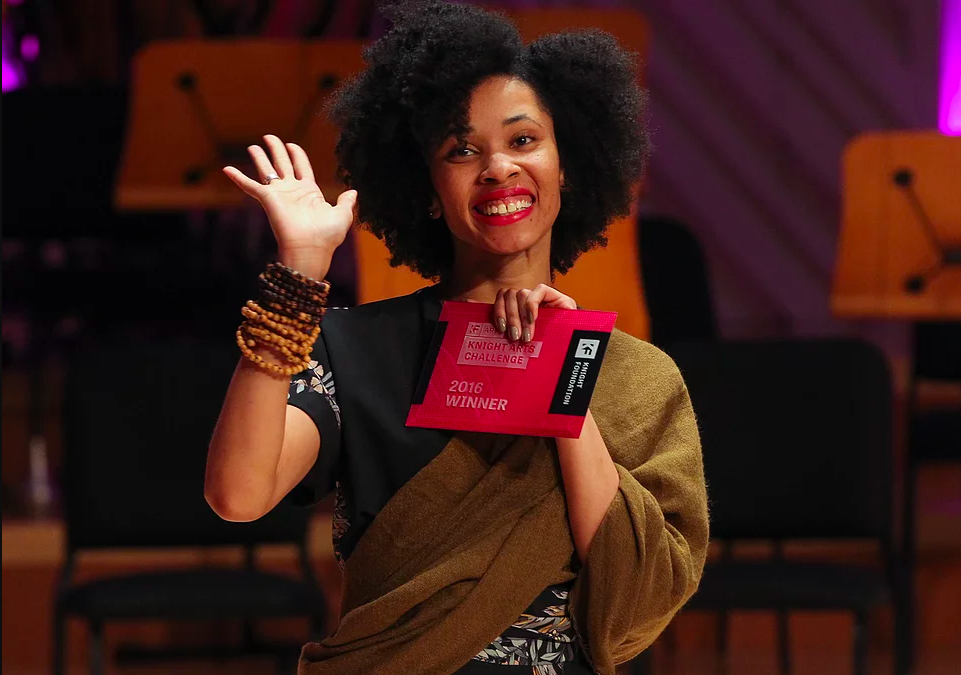
The audacious personalities of these vendors are what have inspired me to work even harder to find peace within myself and showcase the cultivating community that we have here in Goulds. My next challenge has been figuring out how to come up with the funds to actually make this event possible, because my weekly paycheck wouldn’t remotely cover the cost. One day at my goodbye luncheon for my internship at MDC Live Arts, my sister encouraged a conversation about what we had been working on. I was in awe that someone whom I consider to be a mentor convinced me that the story was good enough to apply for a grant. And so I did just that with only six hours before the Knights Art Challenge deadline. I poured my heart out about this photo series, not knowing that my project, entitled “The Unvoiced Community: BBQ Men & Women of Goulds,” would become a finalist and later a recipient of the grant. Because it is a matching grant I am now working tirelessly to raise the rest of the funds to make this initiative a success, not only for my community but for those who may also be searching for serenity in their neighborhoods.

Not only did I find peace through BBQ, I also found my voice in the community, and I encourage you to eat BBQ and unlock your peace.

Translate »