
fbpx Skip to content
Named Best Museum 2022 by Miami New Times

My journey to Florida began in Homestead – where I was born, in July of 1926.

It all started (I was told by my parents) just before the big hurricane in September of that same year, which almost swept away Homestead, as well as Miami.

My first recollections were those with my life in Coconut Grove, where my parents moved in 1927. We lived on Kumquat Avenue. My dad had a job with the Coconut Grove water plant before working with Pan American Airways in about 1928.

From Coconut Grove, my family moved to Coral Gables on Mariana Avenue, where I went to kindergarten at Coral Gables Elementary.

I attended there under the strict and watchful eye of Miss Abigail Gilday. I read the account of one of your contributors who described her as being six feet tall or maybe even a little taller. I would say he underestimated her height by about a foot! I remember on several occasions having been sent to her office (for reasons I will not go into at this point) and having looked up at her as an insect might have looked up at Gulliver. She was not only gigantic and imposing in her appearance, but she had a voice to match!

I went to school with a lot of unforgettable classmates: Walter Miller, John Tatum, Dennis Kelleher, Tom Ray and others. Because people didn’t move around too much, every year we moved along through the grades with the same kids. I could probably name a lot of my teachers, as well. Mrs. Feaster taught me to read; Mrs. Holiday, the multiplication tables; and Mrs. Furlong was in charge of “show biz” (The annual Christmas play). I learned math from Miss Madry.

I got my first job when I was at Coral Gables Elementary. I started selling and delivering the Saturday Evening Post and the Ladies’ Home Journal. The Post cost a nickel and the Journal a dime. I built up a pretty good route; I cleared about $.50 a week.

My next job was working at the Coral Gables Bowling Alley. I set duck pins and 10 pins. I think we used to get five cents a game. There was nothing automatic about any of it – WE were the pin-setting machines.

I went to Ponce de Leon High School in 1938. In many ways, it was like Coral Gables Elementary School in that most of the teachers had been there for years. Mr. Harry Rath had been the principal since they opened the doors. There were about 750 kids. There were only 125 in our graduating class in 1944.

Burdines was the only store in Miami that was air-conditioned. I think the Olympia Theater was, as well. The Coral Gables theater at that time had no AC.

Our family was pretty lucky during the Depression because my dad had been involved with aviation since he worked with Glenn Curtiss during World War I and then started working for Pan American Airways. He stayed with Pan Am and eventually became general foreman in charge of engine accessories for them at the old Miami International Air Depot.

I had my share of jobs during the years. I got up at 3 in the morning, folded newspapers for The Miami Herald, delivered them during the darkness of the wee hours with never a thought (on the part of me or my parents that there ever was a threat of bodily harm of any kind). I worked for the A&P grocery store, as well as Tanner’s market on the weekends. I even was employed for a time as an usher in the Coral Theater during my years in high school. I probably thought I was working too much and too hard. Today – looking back on it – I probably wasn’t doing enough of either one.

I had a loving family, I lived in a lovely city and made a lot of nice friends, many of whom I still have to this day.

We played “capture the flag” at night on the Coral Gables Golf Course after we had our meeting at Scout Troop No. 7. The troop’s log cabin was nestled among the trees on the back nine.

I learned to swim when I was 9 at the Venetian Pool under the tutelage of “Pop” Burr and never gave a thought to its beauty, uniqueness and/or availability to me as a kid growing up. It was only after I grew up, and traveled around in the world, that I realized it was a truly “unique” swimming pool.

We made forts using palmetto fronds nailed to pine saplings that we cut down on property and vacant land that had never seen a “no trespassing” sign.

We fought battles with “guns” we made ourselves from rubber bands cut from old inner tubes with our mothers’ scissors as ammunition.

I was given a BB gun when I was 10 with a strict admonition never to shoot where there might be harmful results. I have to confess that despite my promises to my mother to the contrary, I think at one time or another I shot at everything that walked or crawled or flapped its wings. I was never a very good shot so most every living thing was safe, but I shot many a bottle into shards and punched a lot of holes in tin cans.

After school at Ponce, we frequently cooled off by taking a swim in the Coral Gables Waterway.

My friends and I did a lot of camping out in the vacant woods south of South Miami. Of course, we usually did not have a tent, and when it rained – as it frequently did – we sure wished that we had one as we sat shivering, waiting for the warmth of the rising sun.

When we ran short of cash, we used to scout around for the deposit bottles that we redeemed for enough to get us into the movies. The movies cost $.10 for anyone under 12 back in 1938. On Saturday, they usually showed some kind of cowboy movie that preceded the regular feature. Every kid got a comic book and a candy bar when he walked in the door.

One of the most important holidays always was the Fourth of July. Today, there is not much in the way of fireworks, but in those days that was a big thing. And my parents knew it. It was the one event in addition to Christmas that they really went out of their way to make sure I had the right kind of a celebration. I think they allowed me five whole dollars to spend on whatever kind of fireworks I wanted.

I used to get a catalog from the Spencer Fireworks Company out of some town in Ohio in the middle of March. I spent the better part of two months poring over that catalog and deciding what my selections would be.

When the big day dawned, I started early, long before daylight, and finished late, long after dark. In those days, five dollars’ worth of fireworks was just about all that one man or an active boy could handle in one day.

Yes, those were the days. Before I went to high school, we spent the summers outside building forts, tree huts, battling with “rubber guns” and going to the movies on Saturday. In the fall, all of my male friends were involved in “sandlot” football with very little, if anything, in the way of football pads. No one seemed to be worried or concerned as we split up into teams and played football on the field at Salvador Park in Coral Gables or the Coral Gables Prado.

In those early days, girls were just not a romantic factor. If they could not climb the tallest pine tree like a monkey or run as fast as the wind like Carolyn Hunter, they gained no respect with the “fellas” and just had to be satisfied with playing hopscotch or jumping rope.

Of course, when we went to high school, things changed a little bit. I had a couple of romances with girlfriends that I thought were pretty super at the time.

As it turned out, I married one of them – Lenore Bennett. We were married in 1949 at the Plymouth Congregational Church in Coconut Grove and renewed our vows 50 years to the day at the same church, at the same time in the evening.

At the time I was growing up in Coral Gables, I never realized how fortunate I was. It was only after I went in the Navy during World War II in 1944 and got out and saw what the rest of the world really looked like that I really appreciated what my life had been like when I was a kid growing up in a town that you might call a place “next door to heaven.”
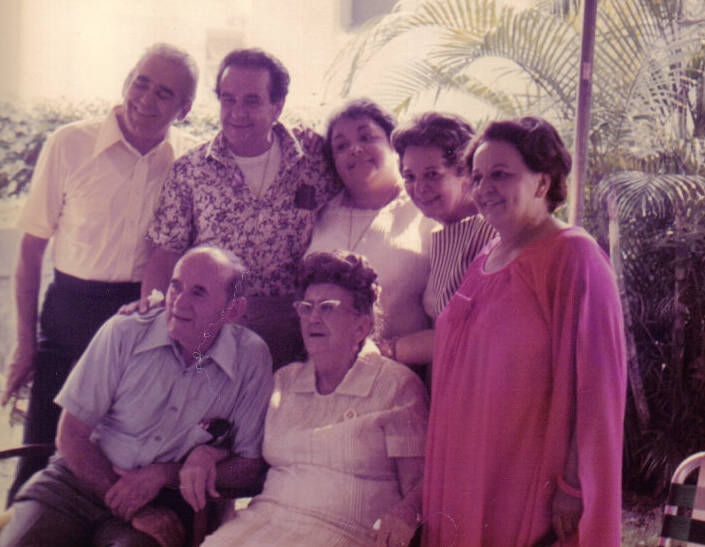
My story begins when my father decided to move with his six children to Miami from Key West in 1948. His father told him that his four boys and two girls would have more opportunities in the “big city” of Miami so my mother packed us up and we all moved from our birthplace to Miami.

Our house was built in Allapattah from beautiful Dade County pine wood. Even after my mother passed away, my father continued to live in that same house until he retired from the Florida Department of Agriculture.

I have many wonderful memories of growing up in Miami. One of my early memories was meeting Florida Native American Seminoles like Buffalo Tiger, whose son Lee served with me on the board of Friends of the Florida State Parks Association. The Seminoles would come to shop at the market where my father worked wearing their colorful clothing. On occasions our family would visit their Tropical Indian Village on Northwest 15th Street and 27th Avenue and see alligator wrestling.

On the weekends, our family would go to Crandon Park on Key Biscayne for picnics, swimming and to visit the Crandon Park Zoo. Curtis Park was around the corner from our house; my brothers and I were there almost every day after school. During the summer we would swim in the public pool. Some days we would also swim in the Miami River. We could go to the movies on Saturday to see cartoons and movies for 10 cents.

It was a treat to go to downtown Miami on the bus shopping. Shopping had to be done on Saturday because stores were closed on Sundays. On Sundays after church, my dad would take us for a drive around Miami before expressways were built and sometimes stop at Dairy Queen for ice cream or Royal Castle for a hamburger and birch beer. Some Sundays evenings we would go the drive-in movie theater.

I also remember the wonderful smell of fresh baked Holsum bread as we would drive by the bakery on U.S. 1, especially if we were on the long drive to Key West to visit family. On some Fridays my father was given tickets for a fish fry dinner, which also included a tour of Holsum Bakery.

The six of us attended Miami High and received excellent public school educations. I had a wonderful time at Miami High, attending football games at the Orange Bowl. We won national championships and we had the “Million Dollar Band.”

I am a member of the Miami High School Alumni Association and am very happy to see that the beautiful and historic building is being renovated. Like they say, there are those who attended Miami High and those who wish they had. After school I worked for Kwik-Chek (Winn Dixie) so I could buy my first car and was I proud to drive around Miami in my new 1956 Ford. I am also an alumnus of Miami Dade College.

I have served as an assistant to a state representative, a state senator, two Miami mayors, and a Miami-Dade County commissioner. I have had the opportunity to give back to Miami-Dade by joining and serving on numerous civic and community organizations. I had the great privilege to be elected to the School Board of Miami-Dade County.

I have owned a real-estate company for over 30 years and have seen Miami grow from a small village to a multicultural cosmopolitan community.

My grandfather’s advice was right because I have had wonderful opportunities and great memories in this community. Miami was and still is a great city!

Journey along the streets in the Brownsville neighborhood and you’ll see solid homes and well-kept lawns, highlighting the pride of the people who live here – past and present.

The little frame house at 2978 NW 52nd St. is one of the oldest structures in the neighborhood, having been built in 1937. But there is more to it than the age of the house and its frame structure. There is a family’s legacy of enduring pride in a community.

“We bought that house in 1949,” said Agenoria Spearman Paschal, 88, a retired teacher and administrator. Pointing to the eldest of her three children, Fletcher Alonzo Paschal III, a retired pharmacist and business owner, she said: “He was about a year old. Back then you had to take a year off from work after giving birth.”

A second child, Elvis Wardell, a retired high school band director, was born two years later to Paschal and her late husband, Fletcher Alonzo Paschal, Jr., who died in 2004.

The family was not yet complete. The couple bought a second home across the street at 2975 NW 52nd St. in 1957, where their last child, Agenoria Paschal Powell, a K-8 Center principal, was born.

That’s where a simple story of home ownership and raising a family would seem to end. But to appreciate the life and times of Fletcher Alonzo Paschal and Agenoria Spearman Paschal, you would have to take a few steps backs into their family histories and accomplishments.

The union between Fletcher Alonzo Paschal, Sr., and Lennie Rogers in 1917 produced four children – Roger William Paschal, a retired teacher at Phyllis Wheatley Elementary; Lillian Paschal Wheeler, a retired elementary school teacher in Washington, D.C., Fletcher Alonzo Paschal, Jr., a retired Miami-Dade school administrator.

A renowned jazz musician, Paschal, Jr., played with Duke Ellington, Cab Calloway, Billie Holiday and Dinah Washington. He attended Florida A&M University and played in the FAMU Jazz Band and the famed Marching 100.

“He was in the band and I was a majorette. That’s how we met,” remembered Agenoria Spearman Paschal, who majored in social studies and English at FAMU. The couple wed in 1943 and their marriage would last for more than 60 years.

“He was in the ROTC and went into the Army during World War II.”

Fletcher Jr. served in the European Theatre with the 92nd Infantry Division, assigned to Genoa, Italy. Meanwhile, Spearman Paschal lived in Washington, D.C., and worked at the Pentagon. Around the time Fletcher Jr. was discharged from the U. S. Army, she was offered a job in Tallahassee.

“He came home and said we’re moving to Miami. I barely had a chance to pack and we left.”

The young couple moved in with Paschal’s family in an apartment on Northwest 18th Street near Phyllis Wheatley Elementary School.

“He was hired at Booker T. and I was hired at Phyllis Wheatley,” Agenoria Paschal remembered.

Teaching by day and working at night, Fletcher Jr., played tenor saxophone with the likes of Nat and Cannonball Adderley, Duke Ellington and others. He also played the local hot spots, including the Reno Bar, Harlem Square, the Rockland Palace and the Night Beat, all while raising a family.

Agenoria Spearman Paschal has fond memories of the couple’s first house on Northwest 52nd Street.

“We had to do everything to it, paint, add a fence, buy furniture, add a back porch. It was really a time of getting adjusted to being married because he had been away in the Army and then we lived with his parents.”

She remembers her husband was never impressed by what others had.

“He pursued his own goals for himself and his family.”

They needed a bigger place because the family was growing. Their son, Fletcher III, was an infant when the couple moved into the house, which, at one time or another, has been home to at least one member of five generations of Paschals. And each has taken the unspoken pledge of painstakingly adding features and repairs to maintain the house’s original character.

And Agenoria Spearman brought her own strong family legacy into the union.

She was the fourth of six children born to the Rev. E. W. and Tryphenia Spearman. Her father was postmaster at FAMU.Hermother was a first-grade teacher.

Spearman attended elementary, high school and college in Tallahassee.

Her siblings: Viva T. Spearman Coleman, a home economics and vocational teacher in the Miami-Dade County Public Schools and the first black registered dietician in Florida; Dr. Rawn W. Spearman, a Broadway star, concert artist and college professor; Olivia Chandler Spearman Parker, a retired executive assistant in the Department of Student Services in Washington, D.C. schools; Dr. Elvis O’Hara Spearman, a renowned band director, jazz musician and member of the St. Louis Symphonic Orchestra; and Leonard Hall O’Connell Spearman, president of Texas Southern University and executive director of the White House Initiative on Historically Black Colleges and Universities, making him the first former president of a historically-black school to hold the position.

Their parents could not afford to send six children away to college, she said. They went to school in Tallahassee.

“Our parents instilled in all six of their children that you must educate yourself. You must go to college and make something of yourself. Our parents walked the talk.”

Agenoria Spearman Paschal fashioned a legacy in education highlighted by the role she played in developing an education model in Miami-Dade that ended up in the Library of Congress.

Fletcher and Agenoria Paschal’s children, grandchildren and great grandchildren followed in their footsteps when it came to getting a solid education.

Now, the Brownsville community is growing and changing, but it still is the reflection of a family’s legacy of enduring pride in a community.

In 1904 my family moved to Miami in horse and buggies from Gillette on the west coast of Florida.

Gillette is my mother’s family name; her family owned citrus groves and cattle. I have a certificate from the Florida State Genealogical Society certifying that I am a Florida Pioneer Descendant of the Gillette Family, who settled in Florida before Florida became a state. The certificate is dated March 3, 1845, certificate No. 515.

My paternal grandfather, Felix Travis Janes, was known as one of the best managers of packinghouses in Florida. He managed the packinghouse located on what is now South Greenway Drive and Castile Avenue (a sign is on the corner). This packinghouse was for Merrick Farms, owned by the Rev. Solomon Merrick and his son George, the founder of Coral Gables.

During the summer my grandfather was in charge of security during the building of the Dade County Courthouse and Vizcaya Museum and Gardens.

My mother, born 1899, wrote two books about growing up during the beginning of the 20th century in Miami. On Jan. 1, 1918, she married a Marine lieutenant stationed in Miami during World War I. They had two sons, my brother who was born in 1919, and me, born in 1922.

We lived on Biscayne Boulevard and Northwest 54th Street across from the Cushman School, which my brother attended. In 1926 Miami was hit by a devastating hurricane that blew the roof from our home. The water from Biscayne Bay came up to our windows.

A huge German freighter, the Prinz Valdemar, was blown almost to Biscayne Boulevard. It could not be moved so it was converted to a huge aquarium, which I visited many times.

That hurricane in 1926 preceded the 1929 stock market crash and the country fell into the Great Depression of the 1930s. Miami suffered greatly because there were no industries, no air conditioning for hotels and office buildings.

Unemployment was at 30 percent. Foreclosures were more common than today. My mother used to say that she knew of millionaires one day who were paupers the next day.

After the Japanese attack on Pearl Harbor on Dec. 7, 1941, the country began arming for an all-out World War, which put people to work in factories manufacturing airplanes and tanks for war. This helped the economy. I was discharged from the Navy in March 1946 after three years in the service.

When I returned to Miami, there was a shortage of housing and automobiles, so both of these industries did well for a few years. Many of the G.I.s who were stationed in Florida stayed after their discharge from the service.

The new Biltmore Hotel in Coral Gables closed right after the hurricane and it was converted into a military hospital during World War II.

I am 89 years old and I have seen many changes. Coral Gables and Miami still attract many big investors who have confidence in future growth due to our strategic location with respect to South America and the Miami International Airport, the beaches and tourist attractions.

Editor’s note: The Coral Gables Museum has the Robert and Marian Fewell Wing named after the author.

My first encounter with Miami was in the 1940s after the war. We lived in Curacao, Netherlands West Indies, and traveled every year to New York City on vacation.

In those days of DC3 and DC4 airplanes, one could not fly nonstop to NYC – not even to Miami – because of refueling requirements. Pan Am’s route to Miami was via Ciudad Trujillo (now Santo Domingo), Port-au-Prince and Camaguey, Cuba. KLM had stops in Aruba and Jamaica.

Arriving in Miami in the afternoon, we would stay at the Miami Colonial or Columbus hotels on Biscayne Boulevard. The next day we would board an Eastern or National plane for NYC with refueling stops in Jacksonville, Raleigh, N.C., and Washington, D.C.

As a boy I was delighted to walk over to nearby Flagler Street for piña coladas at Sloppy Joe’s and cheeseburgers and chocolate milk shakes (neither of which were available in Curacao) at Walgreens. Best of all I got to go to double features at the Olympia Theatre (in Curacao movies were largely restricted for children).

Many decades later, my wife and I would attend performances of the Miami City Ballet at the same theater, now named Gusman.

Skip forward to the early ’60s when the first wave of Cubans were ousted by Castro. My father’s uncle and aunt from Havana, Henry and Elsa Senior, had taken up residence in Palm Beach – “temporarily.” My parents, who then lived in Caracas, had visited them frequently in Havana, now visited them in Palm Beach. They liked Palm Beach so much that they decided to establish residence there. My Curacao-born father died in Palm Beach in 1984 and my Budapest-born mother, who is 97, still lives there.

After graduating from Harvard, I returned home to Caracas. Later I got an MBA from Columbia University. While in New York, I met and married my wife, Suzanne Lesh of Indianapolis, who was working in fashion for Mademoiselle magazine. With my new bride I returned to Caracas.

After working for several companies in Caracas, I set out on my own, founding the first executive search management firm in the country. By the early 1980s, however, Venezuela, which had been booming for several decades, was facing an economic downward spiral.

The logical move was to Miami, which was becoming the place to do business for Latin America. Many U.S. multinationals had set up Latin America headquarters in Miami and Fort Lauderdale. We bought a “temporary” home in what is now Palmetto Bay, where we still live.

My daughters, Jennifer and Stephanie, born in Caracas, originally went to Gulliver, but changed to Palmetto High. They both headed north to college at Penn State, then attended graduate schools in Florida. After completing their education, both worked in Miami. They now live in Parkland and Palm Beach. All of our grandchildren were born in Florida – a family first.

And that is how my family from various points of the world all ended up in South Florida.

I was born in Miami in 1940 when Victoria Hospital still existed as a full-service hospital with a maternity ward and Miami was a sleepy Southern town.

There was still alligator wrestling at 27th Avenue and Northwest Seventh Street at an Indian Village called Musa Isle. I lived in one house in the Shenandoah section when it was known as the Jewish neighborhood.
My friends and I had the freedom to ride our bikes from home to elementary school. A kid could go alone on a bus to downtown and feel safe.

My family of four lived in the same house for my entire childhood. We had a close neighborhood of 10 single family houses, where everyone knew everyone, and sitting on the front porch seeing your neighbors was an evening’s entertainment.

The first time I lived away as an adult, other than college at Tulane, was in 1965 when my wife, Rosetta, myself and my 1-year-old son, Mitchell, went to Washington D.C.

We moved there where I started my career as an attorney in the Criminal Division of the United States Justice Department.

In a year, I wanted to do trial work, which led me back to Miami and ultimately allowed me to be a part of a special time in the city’s history. It was an era that would profoundly change the place where I grew up.

I applied for a job as an assistant U.S. attorney, arriving at 7:30 a.m. for an interview. I was struck by the boss, U.S. Attorney William A. “Bill” Meadows. I remember him at the soda machine, getting a Coke at 7 a.m.

My memory may be failing me, but I’m pretty sure he would usually eat a Moon Pie with that Coke, a Southern tradition for breakfast.

I was lucky enough to get the job and it was the beginning of great friendships and a discovery of a part of Miami that I had not known before.

From 1966-1970 while I was an assistant U.S. attorney, Miami’s federal criminal scene was much different than it is today. We tried small drug cases, [even lent $20 to agents to make controlled buys], interstate stolen car cases, and an occasional fraud case. Back then, a $2 million fraud case was considered huge.

We could not even conceive of today’s multi-billion dollar Ponzi schemes. While the criminal prosecutions were not as large and complex as they are today, the federal court was busy making life-changing decisions.

The late C. Clyde Atkins was ordering school busing to complete integration, and he courageously allowed a poet, Alan Ginsberg, to recite what was then considered an obscene poem.

Today, Ginsburg’s best known work Howl is taught in schools. He once told me that he received much more obscene and angry mail over Ginsberg’s poetry than he received for the busing decision.

Judges Peter Fay, Joe Eaton and James Lawrence (Larry) King were courageously dealing with community-changing issues on a regular basis. It was the Civil Rights Era and Miami was still the South.

We worked in a small, compact office where we also met as a group once a week. Bill Meadows came from Goodman, Miss., and had been a circuit court judge in Miami when he accepted the appointment as U.S. Attorney.

With Meadows’ background as a native Mississippian and member of the Miami “good ole boy” network, one would hardly have imagined the diverse makeup of the U.S. Attorney’s office.

The office had between 15 and 17 full-time attorneys, as compared to the 200-plus today. This group included seven Jewish men, the first Hispanic lawyer in the office’s history, its first black lawyer and one of the few females to ever have served in the office.

The diversity of today’s office shows we were on to something.

These were the city’s most ambitious lawyers. Yet the spirit was collegial, “one for all.” We shared cases, we shared credit, and we shared a mission: to make Miami a safer place to live.

Meadows fostered that spirit. He never considered a person’s religion, appearance or background, only at what they could do and how he could help them do it better.

Meadows was the type of boss who would always back you up in public. He would discuss any problem in private, resolve it, and never do anything but give a single cohesive statement of the office view.

If he did not share your view at the beginning and he could not persuade you to change, then your view became the office view.

Unfortunately, this attribute is rare in public service today, where everyone wants to cover themselves.

There were some comical times as well. When it was “duty” day, one assistant would take in new law enforcement cases and citizens’ complaints.

I remember two in particular. One octogenarian came to the office and, when asked “could I help you,” he responded repeatedly, “I’m 85, my wife is 83 and we don’t need any help.”

I finally found out what he needed. He thought his wife was having an affair with a 33-year-old Secret Service agent.

Another woman complained that her thoughts were being stolen electronically. After a half hour of her story, I asked for her phone number so I could have the FBI call her. She responded simply, “phone – I don’t have a phone. They are stealing my thoughts through the walls.”

Our group, along with some who came before and some who came after, meets every September as a memorial to Bill Meadows. The spirit may not be there all year, but on that day, everyone seems to go back in time to what was, to many, a golden era.

From two U.S. District judges, Jose Martinez and Fred Moreno, who worked with Meadows, to three former U.S. Magistrate judges – Mike Osman, the late Jack Eskenazi, and the late Ted Klein – to Neal Sonnett, past president of the National Criminal Defense Association, and for the too-many lawyers to name who are listed in Best Lawyers in America, for all of them, working with Bill Meadows remained the highlight of their legal careers.

Certainly in a memory of Miami, this was a golden age.

My parents, Harry and Mildred Grand, met each other on South Beach in 1946.

My mother was on vacation from her home in a very cold Roxbury, Mass. Dad and his family owned and managed a small apartment/hotel at 112 Ocean Dr., The Rainbow.

Today the Rainbow is the home of Prime 112, the chi-chi restaurant. Previously, Dad had lived in Ellenville, N.Y., and had helped build and run a family hotel, the Paramount Lodge in the Catskills. His family had enough of the frigid winters so it was time to head south to Florida

I was born in St. Francis Hospital (now condominiums) in Miami Beach in 1948. We lived on the second floor of the Rainbow in a one-bedroom apartment with a balcony overlooking Ocean Drive. We had an unobstructed view of the beach and ocean. In fact, my bris (circumcision) was celebrated on that very balcony, which is now used for diners at Prime 112 restaurant (just between you and me).

In 1950, my parents decided they needed more room and moved to a newly built subdivision in Miami on the border of Coral Gables, named Coral Gate. Most of the homes were bought by young families purchasing their first home.

“The Gate” was a wonderful place to grow up in the ’50s. It was only two blocks from Miracle Mile, the main shopping street of Coral Gables. I remember at the age of 11 collecting candy with a group of friends on Halloween night. We would walk around most of Coral Gate, yelling in unison at each house for whatever treats we could get.

We had no adult supervision and we rarely returned home before 11 p.m. It was a different point in time.

I developed my life-long love of film at the three movie theaters in Coral Gables – the Miracle, the Coral, and the Gables. These movie theaters were all within a mile of each other.

While attending Merrick Demonstration School for fifth and sixth grades, all of us patrol boys walked after school to the Coral to see a free movie each Friday. This was a reward for helping fellow students cross a busy Douglas Road each morning. Many years later just before graduating from Coral Gables High School, I spent a summer working as an usher at the Parkway movie theater .

At the time, this theater was Miami’s only “art” theater, showing mostly European and independent films. In addition, patrons were offered free coffee and various showings of art in the lobby – very unique for 1966.

The Sears on Coral Way near Miracle Mile was the place to get just about anything you needed in the 1950s and ’60s. There were some wonderful memories hanging out there with friends on weekends and shopping with my parents.

But there were also some disturbing remembrances of a department store (at a certain time in history) with bathrooms and water fountains clearly marked “white” and “colored.”

There were always a few restaurants that were our favorites during those years. These included Red Diamond, Dean’s Waffle shop, Jahn’s ice cream parlor, Biscayne Cafeteria and China Maid. And, yes, how can we forget Royal Castle? We were all addicted!

Meanwhile, my dad had opened a store on Giralda Avenue in the Gables in 1959. He was a distributer of Westinghouse light bulbs and also sold small electrical appliances. My mother helped him each day with various accounting and secretarial duties. I usually walked over after school and helped out until closing most days.

After attending Shenandoah Junior High and during my time at Coral Gables High, I worked most of the University of Miami football season selling Cokes at the Orange Bowl. I would take a bus from the Orange Bowl at 11 p.m. back to the Coral Gables bus station and walk two blocks to Royal Castle for a well-deserved “refueling.”

College was divided between Emory University and the University of Miami, graduating in 1970. It was while attending my junior year at UM that I decided what was to be my future profession: optometry. My four years of post-graduate study brought me to Southern College of Optometry in Memphis.

I returned to the Miami area to scout for future practice locations after many dreary and cold Memphis winters. I first established my Kendall optometric practice in 1979. My present office location is in the Pinecrest/Kendall area.

Seven years ago my wife Belle and I moved to Miami Beach. We always felt a special connection being close to the ocean and the beach. Somehow, things have come around full circle.

My mother and I left Cuba on April 12, 1962, and arrived in Miami. We were processed as refugees, given coats, ate at Royal Castle and spent the night at a downtown hotel. The next day, we flew to St. Louis, Mo., on a one-way ticket.

I was 8, and my mother was 46.

My sister had been living in St. Louis with relatives for a year. She moved to the States after being spotted by Cuban security (G2) while she passed out literature on religion. My mother sent her to New York on a tourist visa. There, she stayed with an aunt for a short time. At the age of 15, she left Brooklyn and headed to St. Louis to stay with more relatives until my mother and I arrived a year later.

She worked at Ralston Purina and gave my mother her check so we could have a halfway decent life. I lived with my aunt, grandmother, sister and mother in a two-bedroom house, with the dining room converted into an additional room.

My father always believed that each year to follow would end the revolution, and things would return to normal. Once he realized that year was not going to happen, he tried to row his way to Florida.

While doing so he was apprehended by the Cuban Coast Guard. After several years, I was able to claim my father and he was given permission to leave Cuba on Jan. 6, 1966, and he joined our family in St. Louis.

My sister stayed in St. Louis for seven years; my mother and I, four; and my father, six months.

We all moved to Miami because of the warm weather and the language barrier for my father. My mother lived and worked in St. Louis for two years during World War II and learned English with a heavy accent, but my father struggled with the language. He was trained as a sewing machine mechanic but had to accept lower-paying jobs in St. Louis because of difficulty with the language.

My first school in Miami was Southside Elementary on Coral Way and South Miami Avenue, where I had the most impressive teacher and the only one I remember to this day, 45 years later: Mr. Frank Buggs.

He was a young black man teaching in an all-white/Hispanic community in the mid-1960s and surmounted most obstacles that came his way. I hope he’s reading this now and enjoys knowing that I remember him.

He took us to the Miami Seaquarium, the first field trip that I had ever been on, and Flipper performed for us. There was a monorail that took us around the park, above the sharks and manta rays, and it was very impressive to a 12-year-old. One Saturday, a group of us, without the teacher, took a bus on Biscayne Boulevard that took us to the “Saturday Hop” with Rick Shaw, which aired on Channel 10 every Saturday.

As time went by, some relatives moved to Miami, and soon more and more moved to the area. Eventually we reached a point where we could celebrate a family meal with most of the family. Our weekend family outings consisted of going to Hialeah for pizza on Sundays or the beach for the day, packing enough food for a week and parking under cover at the old dog track on South Beach. Occasionally, we would go to Crandon Park and visit the animals at the zoo or skate in the rink.

After being here a while, we ventured out to Dania Beach, where there was an amusement park called Pirate’s World, or we would drive to Marco Island and come back the same day. Parrot Jungle was a must for all of visiting relatives trying to decide about the big move south.

I worked at the downtown Burdines while attending Miami Senior High School. I later graduated from Miami Dade College and went to work for large corporations in management. While working, I traveled to 26 different countries and over 120 cities throughout the world. While I never married, I have one daughter who enjoyed going to St. Michael’s Catholic School and attending The Boys & Girls Club of Miami.

She graduated from Coral Gables High School and is now attending Miami Dade College. She dreams of moving to New York City. If her dreams come true, after a couple of winters, I believe she’ll be right back here where it’s warm all year round.

My parents both passed away in the same year, 1989, along with all of their siblings except for my aunt in Brooklyn, who is now in her 80s.

My two nieces and two nephews all grew up in Coral Gables and became successful individuals: One niece received a doctorate in math and is at the University of Miami, and the other is a salon owner and hair stylist in San Francisco. My older nephew has been living in Mississippi for over 18 years and is a successful contractor. My younger nephew became an Eagle Scout, received his bachelor’s in education and later moved to Denver.

I was born in Nashville and spent the first four years of my life in Tuskegee, Ala.

My father, Dr. John O. Brown Sr., moved to Miami in 1955 to begin his practice in ophthalmology. To this day, I’m glad he did.

We had neighbors who were white and black. Our next-door neighbor was an older white lady who inspired my mother’s love for growing orchids and my brother’s passion for collecting butterflies.

I attended schools — Jackson’s Toddle Inn and Floral Heights — that were all black. I remember those as happy years.

My life changed dramatically when I started sixth grade at Gladeview Elementary, the year desegregation was implemented in Dade County. I was too young to know this was a victory for my father and the other parents who had filed a lawsuit against the Dade County School Board in 1956 to make this possible. I only knew that I was sick every morning and that I was not happy there.

It got worse when I attended Miami Edison Junior High. In my first year, there were only three Negro children in the school, and one left after a short time. I felt different, disliked by some of the children and just tolerated by the teachers — because of the color of my skin.

It was not until the ninth grade that many more students of color enrolled and I finally I had friends. I continued at Miami Edison Senior and led a peaceful “sit-in” in my senior year to protest discriminatory practices.

My years of experience being the “token” Negro child propelled me to leave Miami in 1968 to attend Fisk University, a historically black college in Nashville.

The summer before I left for college, the riots of 1968 exploded. I remember our family being on the floor of our home off 62nd Street, frightened by bullets fired at the National Guard tanks parked in our front yard, from the residents in the projects across the street.

I recall working for the U.S. Department of Immigration and Naturalization in the summer of my first year in college. I was responsible for processing the visas for new arrivals from Cuba. I remember being instructed to type on every visa under the heading of race the letter “W” for white, despite the accompanying photo being of a person much darker than myself. It reminded me again of the second-class status of African Americans.

I graduated from Fisk in 1972 and returned home to Miami. Life seemed uneventful until the riots of 1980. I had just returned home from the hospital with my newborn baby. We had to evacuate our home due to the lootings, fires and loss of electricity in Liberty City. I remember being on the floor of our car, holding my baby for safety.

We were seeking refuge at my brother’s home in El Portal, where residents were barbecuing and watering their grass, oblivious to the civil unrest only a few miles away. Later that year, I moved to the Bahamas, where I spent the next 15 years.

I found it ironic that Bahamians referred to me as an American, an identity I had never been identified with in the United States. All through my life I was “colored, Negro, black, Afro-American or African-American” — never only American.

When I returned to Miami in 1995, it was a very different place. People of color were no longer African-Americans, but were from the Caribbean, Haiti, Trinidad, South America — with different languages and cultures.

I take pride in growing up in Liberty City. To this day, I find myself defending it against those who only see it as drug- and crime-infested and fear going there. Overlooked are the many success stories of Liberty City.

I remember my father saying that he chose to build our home in Liberty City — when we could have afforded to live elsewhere — because he wanted to be among the people he was fighting so hard for.

My father fought tirelessly to help bring about many of the changes in Miami we take for granted today. We can attend any public school, shop wherever we want, eat wherever we choose and go to any movie theater — all because of the barriers he helped to bring down. He sacrificed time spent away from his four young children, which in his later years he regretted.

It saddens me that there are no streets named after him, nor schools or community centers to honor his contributions. But in my heart, I know that because of him and so many others like him, this country now has an African-American president and he is smiling and saying it was well worth the fight.

I was born Martha Anne Peters in Victoria Hospital on Dec. 20, 1937, a second generation native-born Miamian.

My daddy, Hugh Peters, Jr., was born in the family home, on the corner of 75th Street and Northeast Second Avenue.

My paternal great-grandparents, Solomon J. and Sidney Martha Peters, moved to Miami-Dade county in the fall of 1896 from Lady Lake in Central Florida, where the Big Freeze of 1895 had killed their orange groves. The entire family of eight sons, ranging in age from 8 to the mid-20s, and their 16-year-old daughter Mattie, came with them.

The youngest boy, Hugh (Pat) was my grandpa. Solomon and all but three of his sons farmed — primarily tomatoes. The three who pursued other interests were Edgar, who became a doctor; Arthur, who was active in real estate; and my grandpa, Hugh (Pat).

Grandpa was a county commissioner for more than 20 years and was commission chairman when the Dade County Courthouse was built and when the county bought Vizcaya, the Coconut Grove estate of Chicago industrialist James Deering. He also was in charge of roads and bridges in Dade County.

One of my cousins, Thelma Peters, was a well-known historian of Dade County.

My maternal grandparents, Abner and Annie Hearn, moved to Dade County in 1911. They had five sons ranging in age from 6 to 21 and a 2-year-old daughter, Annie, who would become my mother.

Mama was born in Dunedin, a small city near Tampa. Grandpa Hearn owned several packing houses there and in other locations, primarily on the West Coast of Florida. Their oldest son, B.E. Hearn, my uncle, was a Miami City Commissioner in the 1950s.

When I was born, my family lived in Little River in a house built on the original family property. I have one brother, Gordon, named after the doctor who delivered him, Dr. J.G. DuPuis. We moved to Miami Shores when I was 11 and I have remained a Miami Shores resident ever since.

In 1958, I married Harley G. Collins, Jr., now deceased. His father served one term on the Dade County School Board. We were blessed with one daughter, Cheryl (now Calhoun). She and her family live in Miami Shores, as well.

Daddy owned a paint and glass business for many years. Mama was the registrar at her alma mater, Miami Edison Senior High School. My brother and I both graduated from Edison. Daddy, however, graduated from Miami High, which made for a very interesting Thanksgiving day and night, considering the rivalry that existed between the two schools.

I am a retired teacher, having taught high school English and Reading for 27 years.
I have been truly blessed to live in this special city all my life. I am proud of my family and what they have contributed to the growth of Miami. I am especially grateful that they had the good sense to move here.

Translate »