
fbpx Skip to content
Named Best Museum 2022 by Miami New Times

My maternal grandfather, Henry E.S. Reeves, arrived in Miami in the spring of 1919 on his way to New York to purchase printing presses for a newspaper he intended to establish in the Bahamas. While here, friends asked him to consider Miami as the site for his newspaper.

He agreed and immediately summoned his family — wife Rachel Jane, and children Cleo, Hazel, Clarice, Doreen and infant Garth. They packed up and moved from the Bahamas to Miami.

What had been intended as a brief layover by my grandfather became a turning point in our family’s history. It was here in the Magic City that my mother, Frances, was born.

After graduation from Booker T. Washington High School, she graduated with a bachelor of arts degree from Bennett College in Greensboro, N.C.

Upon returning to Miami, she was introduced to Cyrus Martin Jollivette, a pharmacist who had recently relocated from Texas following graduation from Xavier University in New Orleans. He had been recruited to Miami by Elmer Ward, proprietor of Economy Drugs. They met and married on Dec. 2, 1942. Their wedding took place in the family home at 1949 NW Fifth Pl.

Cyrus would go on to open Community Drug Store, 1500 NW 68th St., in Liberty City. It is not a coincidence that The Miami Times, the newspaper my grandfather founded, relocated next door from Overtown. My parents had three children. I am the eldest, followed by Cyrus Martin and Cleo Leontyne. I am blessed to be a member of a strong family unit. Frequent multigenerational, extended family gatherings are a part of my heritage. They remain a tradition I sponsor and promote.

My earliest memories of life in Miami involve family gatherings at the family home. All of the children of Henry and Rachel, the children’s spouses and progeny lived in the home at some point in their lives.

And so my life in Miami began at Christian Hospital on September 30, 1943. I lived in Overtown and attended Booker T. Washington Nursery School and then Dunbar Elementary School, where my mother taught first grade.

Following a move to Liberty City in 1949, we lived on the second floor of the drug store. On a daily basis, my mother would ask me to run downstairs and tell daddy that dinner was ready. Those were wonderful days.

My father was instrumental in the development of Holy Redeemer Catholic School. Initially, the plan was to start the institution with grades one through three in the fall of 1952. Because I would be entering fourth grade that year, he was able to have that grade included. I attended school there until completing ninth grade. I then attended Northwestern High and graduated as valedictorian of the Class of 1961.

There are so many wonderful things that I remember about growing up in Miami: the Orange Blossom Classic, a parade and football game every year in December featuring the Florida A&M Rattlers; the Orange Bowl parade with its beautiful floats amid a rainstorm in the late 1940s; trips to Virginia Key Beach where we rented a cabana and spent the day on a regular basis; the circus; baseball games and shopping trips downtown. We weren’t allowed to try on clothing because of our skin color.

When I graduated from Howard University with a bachelor’s degree in pharmacy, I married my college sweetheart, Ronald Eugene Frazier. I tried to convince him to live in Miami, but he did not find the opportunities he was seeking as an architect. We moved to Washington, D.C.

However, I didn’t miss opportunities to discuss relocating to Miami with him. My opportunity came with my first pregnancy. Of course, I had to come home to have my baby; Ronald Eugene II was born in 1969.

Fortunately, my husband’s architectural firm transferred him to Miami for the summer. He decided there were opportunities here and it was time to relocate. I was ecstatic.

My children were born here, Ron II, Robert Christophe and Rozalynn Suzanne. I’m delighted that Ron and Chris have made Miami their home. Rozalynn, my youngest, relocated to New York but comes home frequently. We opened a new chapter in this city with the birth of my grandson, Ronald Eugene Frazier III, on Dec. 31, 2006.

Regina Frazier, 63, worked for 37 years with the University of Miami hospital and clinics, now known as UM Sylvester. She was the director of the pharmacy from 1973 until she retired in 2007.
Early in the morning on Nov. 18, 1961, my parents, my brother and I headed for the Havana airport, Rancho Boyeros, for I was to catch the morning flight to Miami. I was 16.

The morning air seemed cooler than usual that day. Perhaps this was a physical reaction to the uncertainty of my future at that time.

My father had placed el gusano, my gray traveling bag, in the trunk of our fairly new Ford. Those of us leaving the island at this time were called gusanos by the Castro government.

According to El Comandante en Jefe Fidel Castro, we were insubordinates, did not believe in the revolution, were unworthy of being called Cubans and were the closest thing to dirt. So we were called gusanos, or earth worms.

I was leaving behind my most dear city, Camagüey, where I had lived all my life. It was a difficult move for me, but I could no longer remain in a country whose government was rooted in unnecessary unrest, repression and persecution of all those who did not agree with the government.

The Cubans, young and all, were told repeatedly by the nationalized media that the gusanos were responsible for all the ailments that our country had and could have in the future.

The traffic flow from the hotel to the airport was interrupted often by groups of militia marching in the streets. They were being trained to face aggressors and unworthy citizens. Due to all these interruptions, we were late arriving to the airport and I missed my flight!

My father talked to the military personnel in charge of the building facility and flights to the United States. I could not hear the conversation well, let alone understand what was going on.

But I could see my father’s expression and it was not pleasant. I was afraid he would be taken away by the G2, National Security personnel. Someone else joined the conversation and he seemed less militant and friendlier.

Next, this same man started to converse with my uncle, who had just arrived. I sensed things were getting better and saw a much happier father and mother. Something told me that I was going to travel after all.

One of the employees summoned me to the pecera, or the gusanos’ waiting room and asked me to wait there for the afternoon flight. There was a vacant seat in the Peter Pan afternoon flight. I was on it.

My arrival to Miami was one of the most exciting moments of my life.

Everyone was quiet on the plane. There were some teary eyes around me, and my eyes were watery, too.

However, when we were approaching Miami, the pilot said, “We are in the United States of America!” The mood changed completely in that plane, and everyone clapped while shouting “WE ARE FREE!”

I did not have to go to the Peter Pan campgrounds because a relative of mine was picking me up at the airport. I spent four days in her home. She was very kind and had other children staying in her house. There were beds and mattresses all over the house. Everyone helped and cared for each other. Most of these youngsters were surprisingly hopeful. They thought we would return to Cuba soon.

After about four days in Miami, I left for Tenafly, N.J., to live with relatives who welcomed me with open arms. I have wonderful memories from my years in Tenafly.

Tenafly Senior High School introduced me to my new life. I had very competent and dedicated teachers. I met and studied with culturally diverse students and instructors.

In addition, the school had a student-exchange program, so I enjoyed meeting students from Venezuela, Russia, Italy and Chile. Life in Tenafly was quite different from Cuba, but very nice as well.

My brother and his wife arrived in Miami in 1962. I went to live with them and transferred to Miami Edison Senior High School. Once again, I was blessed by sharing my life with my family and attending a good school. Subsequent to my arrival in Miami, I observed first-hand the difficult time most exiles were experiencing.

Jobs were scarce, salaries were very low, and since relatives from Cuba were still arriving in the United States or trying to leave Cuba via a third country, life was taxing for them.

Most of the time, the news from Cuba was not good. But as time went by, we all learned to live with the reality of our lives. I personally found great enjoyment in school.

My years at Miami Edison were challenging but hopeful. I had superb teachers, especially my government and economics teacher, who provided all of us with superior instruction and classroom atmosphere. She was fair, inclusive and promoted a positive learning environment. It was this teacher who motivated me and others to continue our education.

My friends became long-lasting friends. They all contributed to my success in my new and beloved country, The United States of America.

Angela Albaisa Santos grew up to become an educator herself, retiring last year as principal of John G. DuPuis Elementary School in Hialeah.

This is the story of Josephine Louise Carnevale Smith of South Miami, born in 1920 in New York, as told to her niece, Gina Guilford, of High Pines.

My parents were originally from Italy — mom from Siena, dad near Naples — but met in New York City, where they married in 1913. My father, Francesco Carnevale, came to Miami in 1923 and opened the first Italian restaurant here, the Boat House. It was located on a boat on the Miami River, next to the old Royal Palm Hotel, the grande dame hotel that Henry Flagler built on the north bank of the river in downtown Miami on Jan. 17, 1897.

When he got situated, he sent for my mother, Carmelinda, and his four daughters — Tina, Julia, Josie (me) and Emma. We came down from New York City on a boat in 1925 and my older sister Julia, learned the Charleston on board. I was 5; I don’t remember the trip but was told it took five days.

My father catered parties for Al Capone on Star Island. My mother would drive him in her Jewett car to Miami Beach, drop him off with the food and then come back later to pick him up. He also managed the dining room at the Royal Palm Hotel and had another restaurant on 23rd Street in Miami Beach called the Original Italian Kitchen.

I remember he always made sure the portions (such as a slice of lasagna) were the same size, so none of the customers would feel like they were getting gypped. This was around the 1930s and a dish of spaghetti with meatballs was 75 cents.

Growing up, our family would go to picnics and other functions with the Italian American Club. The Fascell family was the first Italian family we met in Miami and we grew up with Dante, who later became a U.S. Representative and for whom Dante Fascell Park in South Miami is named. On Sundays, we would spend the day visiting friends. My mother played the mandolin and others played other instruments.

Another activity we enjoyed was swimming at South Beach, around where Joe’s Stone Crab is now. We wore wool bathing suits that were heavy and itchy. We would also listen to Caesar La Monica and his band playing at the bandshell in Royal Palm Park on the weekends. I’m still in touch with his daughter, Jean.

We lived in a house my father built at 767 SW Fifth St., right next to Riverside Park. I still have a scar from sliding down a big oak tree there. My sister Julia met her husband, Jack Rice, one day while he was playing baseball there. After they married, they started one of the first nursing homes in Miami, The Floridean, which is still in operation.

I went to Riverside Elementary and walked to school. I went to Ada Merrit Junior High and Miami Senior High. I remember getting 25-cent haircuts. On Saturdays, my mother could get send us to the movies at the Tivoli Theatre, off Flagler Street. For a 10-cent admission, there were cartoons, Pathe Newsreels, weekly cliffhangers and, of course, the main feature.

After I graduated from Miami High, I got a job working at S.H. Crest, a 5 & 10 store. I made $2 a day as a salesgirl. I got another job through a friend at First National Bank. Mr. Rolf, the bank president, interviewed me and asked me what I knew about bookkeeping. I told him, “Absolutely nothing.”
He said, “Great — you’re hired!”

I learned the job and he used to call me Speedy Gonzalez because I walked so fast. I retired in 1944 when I got married to Red Smith, whom I had met through my sister Julia and her husband Jack. I had my son Robert in 1948. I got divorced in 1955, the same year Marilyn Monroe divorced Joe Di Maggio.

I lived in an apartment near The Pathways in South Miami with my son after my divorce. My whole family would come over for dinner every night and I would cook. My oldest sister Tina had gotten married, but her husband died in 1955. My mother had died on the same date two years earlier, and Emma moved in with Tina. She brought along her beloved poodle, Gigi. Tina eventually got engaged and Emma was going to move out, so we decided to build a house in South Miami, because the apartment didn’t allow dogs.

While we were in the middle of building the house, Tina asked, “Can you add another bedroom?” She called off her engagement and moved into the house with us in 1959. Tina was a vice president of Greater Miami Federal bank, Emma was a legal secretary for Bunn Gautier and I stayed home and took care of Robert and the house. Fifty years later, I am still living in the same house.

My son, Robert, his wife Linda and my granddaughter Christina live in the same neighborhood. My other grandson, Craig, lives in Pembroke Pines with his wife Jennifer and my grandbaby Madison.

Every Friday I work in the office of my son’s business, Engine and Accessories, as I have for 36 years. I enjoy watching my soap operas on T.V., going to lunch with friends, attending Mass at Epiphany Catholic Church.

And I live right next to Dante Fascell Park, named after my childhood friend.

In the early ’80s, Miami had the national reputation of a cultural wasteland, fueled in large part by films and television shows that glamorized the local crime scene. Longtime residents, like Mitch Kaplan and I, viewed our city through a different lens — one that witnessed intellectual conversation and growth incited by the opening of new art museums and libraries.

At this time, Mitch was the owner of a small bookstore in Coral Gables, and I was the president of Miami Dade College’s Wolfson Campus. Mitch knew that people in Miami were hungry for books, and I was looking for a way to transform the downtown area of our fledgling campus.

A couple of librarians, notably Margarita Cano, thought that if they put together a book sale in Bayfront Park, it would help promote the nearby library branch. Margarita asked Wolfson Campus’ librarian, Juanita Johnson, if she could borrow some tables for the book sale. I had just returned from a trip to Spain, which included a stop at an impressive book fair. So when Juanita told me about the group’s plan for a book sale, we began to envision a more elaborate affair. The college could provide more than just tables; we could offer a sizable venue, staff support and passion.

Juanita and I called a meeting with the local library staff and independent booksellers and came up with a plan for a large literary event that could serve as a powerful driver for bringing our disparate community together and helping downtown Miami live up to its artistic potential.

That first year of “Books on the Bay” in 1984 planted the seed for what is now the Miami Book Fair International. Booths lined the streets of Kyriakides Plaza at Wolfson Campus during our initial two-day festival, and fairgoers lined up to see authors such as James Baldwin, Ken Kesey and Marge Piercy. There had been a lot of skepticism about whether people would come. But they did, and we had a wonderful sense that we were onto something important. As the fair evolved in the late ’80s, culture began to gain a foothold.

When Alina Interiên came on board in 1989, she began developing the international aspect of the fair and worked to increase outreach to the multinational community that South Florida had become. The Book Fair became the venue for a who’s who in the Spanish-language literary scene, and celebrated Caribbean authors began bringing their untold stories to the city.

The Book Fair quickly became an event that attracted attention from all over the country and helped the world rediscover Miami. People who wanted to emulate our success visited from other cities, and publishers began to understand the Fair’s potential. Starting the Book Fair took a lot of hands and a huge leap of faith.

The ’80s were an era known for cocaine cowboys and violence, and tourism was at a low point. However, the arrival of hundreds of thousands of people from Latin America and the Caribbean enriched and strengthened the city’s culture and transformed Miami into the booming tropical metropolis of present day.

The Book Fair has certainly grown over the years, but some things have remained constant — remarkable support from the community, large enthusiastic audiences and terrific, committed volunteers. I am proud of the Miami Book Fair International and its role in transforming our city’s educational and cultural landscape. More than 2 ½ decades since its inception, this celebration of literature and literacy continues to unite our community.

Eduardo J. Padron is president of Miami Dade College.

The list could go on forever: The Treniers, Pickin’ Chicken, Sleepy Time Gal, Parhams, Club Calvert, Bible Joe, The Rockin’ MB, Chary’s, Silver Dollar Jake, Fun Fair, The Miami News, Embers, Riverside Military Academy, My Dad. When we wonder what happened to — or simply miss — the people, places and things that played a part in our youth, we are reassured by those four stalwarts still holding up the Casablanca.

Our story, like everyone who relocated to Miami, is filled with contrasts: high hopes then, and, looking back, lots of nostalgia.

When we drive around streets that have always been familiar haunts, we are disoriented by missing landmarks no longer where they could be counted upon, and overwhelmed by the numerous and oversized buildings that replaced them. At the same time, we are filled with pride over the mega-metropolis we have grown into. We miss the small town feel but appreciate the growth, the development and the impressive skyline.

1947 — Miami Beach development only went up as far as the McFadden Deauville Hotel around 66th Street and Collins Avenue — a sprawling green low-rise complex with a huge swimming pool and three diving boards. There, a father taught his very young son and younger daughter to put on a water show for the guests by diving into the pool. Thrilling and scary entertainment then; today, maybe child abuse.

1947 — That was the year my young, handsome father came down to Miami to find work after being fired by the post office in New Jersey after he punched a fellow employee who made a disparaging remark about Jews. Staying with his sister, brother-in-law and their baby daughter in their small apartment in Coral Gables, the promised paradise provided a disappointing first job: selling ice cream from a box attached to the back of a bicycle.

When Jack Winer landed a more substantial opportunity as doorman at the International Hotel on Miami Beach, he sent for his wife Ruth, daughter and son Richard. Our beautiful young mother — she taught us to say that — sold our home in Camden, packed our belongings, loaded up the 1939 Oldsmobile, and we were on our way.

At the age of 10 and 6, Richard and I recall only some of the sights we visited along the way: the Washington Monument, cotton fields where we picked bolls to treasure, and the oldest city, St. Augustine. Our first Spanish words were Ponce de Leon, but the Fountain of Youth remained lost and we were too young to care. We do now.

When we arrived here that first day, the color of the water took our breath away. Not the dark blue of Atlantic City’s ocean, this was bright aqua and deep turquoise. And best of all, we could take our shoes and socks off and walk barefoot. Oh yeah, and right across from that crowded apartment we shared with aunt, uncle and cousin, oranges grew on trees — real oranges you could walk to, pick off, peel and eat. We arrived on Thanksgiving Day and we gave thanks.

From doorman to pool attendant to pool manager, Jack provided for family and we moved into our very own one-room, one-bath efficiency, then graduated to a two-bedroom, two-bath apartment, then bought a tiny cottage, and a cocker spaniel. Those were the days when small children could walk by themselves six blocks at night to get ice cream cones at a neighborhood drug store. Drug stores had food and fountain service, with a long counter, and stools that twisted around. Movies were 14 cents at the Normandy or Surf Theater on Saturday matinees, plus 6 cents for candy. We each brought home change from our quarter.

We kids attended Coral Gables, North Beach, and Biscayne elementary schools, then Nautilus and Miami Beach High. Jack managed pools and cabanas at the Martinique, Golden Sands, Atlantic Towers, Bel Aire, Monte Carlo, Dunes, Lombardy, Attache and Thunderbird Motels. Everyone worked for Jack at one time or another, including his daughter, son, grandsons, and even Murph the Surf, the thief who stole the Star of India.

Greynolds Park, an important landmark, is one of the few things in our lives that remains a constant. Though the horse stables where I rode are gone, the park was, and still is, a place to picnic, jog, hike, bike, boat, roll down the grassy hill from the fort, and observe wildlife that refuses to be eliminated. It was where I spent my second date with my future husband Ezra, a field trip for our children, Izzy, Ken and Jordana, and a playground and adventure for our seven grandchildren. Ezra and I built our home two blocks from its back entrance.

Ezra’s family came here from the Bronx in 1939. They witnessed German POWs held where the Miami Beach Convention Center is now. He completed his college studies at The U, both BA and MBA, and now mentors students in the School of Business after concluding his years as an entrepreneur in partnership with a college buddy, another New York transplant.

We’ve been a lucky family: In the same house more than 48 years, married more than 52 years, with our two sons and daughter, their mates and children, my brother too, only minutes away. With my mother, defying mortality, working four days a week, we’ve resisted change. With support and encouragement from Ezra, I published a novel recently and surprised folks with a good read. When I attempted to sell our house and move into a condominium, the idea was quashed. This lucky house is headquarters for our gang.

Our only touch of bad luck came when Jack left us all too soon, with only good memories.

I was born in 1924 on Flagler Street and 57th Court. The house I was born in still stands. My father was born in upstate New York in 1878. He went to school in New York, moved to Virginia, went to engineering school and then moved to Palatka, in northern Florida, in the early 1900s. He met up with the railroad gang of Henry Flagler and worked with Mr. Flagler’s company. He worked his way down to Miami, where he worked on the Overseas Railroad in 1903.

In the 1903 Hurricane, my father was working on the rails in Duck Key and was blown away. He survived and was picked up by a tramp steamer. An article about this event appeared in The Miami Metropolis. My father was the first to build the viaducts from Florida City to Key West. The old photos show the construction of the concrete pillars, which supported the rails that carried the first railroad trains in 1912.

My father moved back to Miami. He visited his two sisters in Merritt Island, near Cocoa Beach, in 1917. There he met my mother, Ruby Griffiths. They were married in Titusville, then returned to Miami and the house on Flagler Street. All six of the children were born in that house. My father worked for a Miami engineering firm building sea walls and bridges. After the 1926 Hurricane, he went into real estate and was doing quite well until the Great Depression came along. We went from being very rich to very poor.

We then moved into a house on Southwest Eighth Street near 32nd Avenue, near an orange grove. We had a two-story house. The first floor was a filling station and a grocery store. We were next to the Seybold Railroad. As kids, we used to flag the traffic down for the trains or steam engines. I went to school at Kinloch Park at Flagler Street and Le Jeune Road. At that time, Le Jeune Road and Flagler Street were set up like a little pigtail. All the decent roads stopped at Ponce de Leon at Flagler, where the street cars turned around. By 57th Avenue, it was all hunting grounds.

In 1945, I married Ivey Ritch in Key West. After graduating from Miami High in 1941, I served in the military and participated in World War II. I saw many things during the war. I remember one day when I was in Italy and we were very hungry. We went to an Italian family’s house to see if we could get some eggs. A German Messerschmitt fighter plane flew over a hill and swooped down with machine guns firing at us. There were five soldiers, one woman and three children. I remember running all over them trying to get into the house.

I was a member of the Great Impersonators, which raised money for terminal children. In 1980 I was elected president of Post 72 Fraternal Order of Police Association, (FOPA) Everglades Lodge, which I enjoyed very much. The photo of me standing in front of the No. 153 is a steam engine FEC Coach 136. I am a member of the Gold Coast Railroad Museum, which is near Metrozoo. We have some wonderful pieces out there. The Ferdinand Magellan is a Presidential Pullman Car. This was the first train custom-made to carry the U.S. presidents. It carried presidents Roosevelt, Truman and Reagan.

I will be 85 on Nov. 30, 2009. I have a daughter Terry and two grandsons, David and Reed, who live in Sebastian. I work every day six days a week. I arrive at work at quarter to five in the morning. I get up every morning around 3:30. I work for MEI which is Master Excavators Inc. I have been maybe 17 or 18 years. I enjoy working for this corporation and we are working really hard to get through these rough times.

I have been through these rough times before with my family in the 1930s. I remember and I know we will get through them.

We were sponsored into the United States by a dentist in Detroit. My dad was from Sweden and didn’t speak English very well. My mom was born in Trinidad to a Barbados family. I was born in Barbados. We lived in an efficiency on top of a garage. My dad joined a union and worked for the power company repairing meters. My mom worked at St. Elizabeth’s Hospital.

I remember the two successive cars we had — an old Packard and then a Studebaker with porthole windows. I got very sick from the cold weather in Detroit, so my mother took me back to Barbados. When I was 4, we flew back to the United States to meet my dad in Florida. Again, we lived in an efficiency on top of a garage in the Coral Gables area.

My father got bookkeeping jobs at Sanborn Plumbing and then Chapman Septic Tank Co. and then at Polly Davis Cafeteria on Miracle Mile. I remember my father taking buses to and from work and then to and from the University of Miami for night school, where a large portion of what he earned went, as there were no local state colleges at that time. He finally scraped enough money together to buy a clunker of a used car, a Ford Edsel. He worked and went to night school at UM for seven years and finally earned his degree in accounting.

We made the move west to unincorporated Miami-Dade County. We lived on the western edge of countywide development, almost to where the Palmetto Expressway is now. For me, the late 1950s and early ’60s were so much simpler for a kid than it is now. I played baseball at Flagami Khoury League, played football or basketball at Flagami Elementary School or fished in a local canal. We usually had a used black-and-white TV, and sometimes listened to radio shows when the TV was on the blink. We were the first family in our neighborhood to get a color TV. The neighbors would come by to see a TV in color.

Our school would take field trips to Dressel’s Dairy, just west of the airport, and a great place for kids. I would fall asleep at night with my transistor radio (all the kids had one) under my pillow, listening to UM football and basketball games. Everything changed so fast in the ’60s. This was also the beginning of the Miami Dolphins, when the bus ride was 10 cents each way, and the student entry ticket was $1. My mother would take me to Pier 5, where Bayside now is, to buy fresh fish.

With his degree and experience bookkeeping, my dad was able to get accounting jobs at local banks and savings and loans. Among the ones I remember were Citizens FSL, Greater Miami FSL, American FSL, Dania Bank, Hollywood FSL, Home FSL and others. My father got an opportunity to be comptroller/treasurer of American Savings and Loan in Miami Beach, so we moved in the middle of my “promising” football and basketball career at Coral Park Sr. High School. (This move proved disastrous for my hopes and dreams.) My father later ended his career as the finance director of several local municipalities, such as Opa-locka and Pembroke Pines.

It was a long way from our arrival in the United States with virtually nothing — thereby proving the American Dream is alive and well.

Howard and Iris Kaplan both had early ties to the Miami area, although they were both born and raised in Chicago.

Howard’s parents brought him to South Beach in his teen years during the winter. His sister couldn’t take the cold weather; she had a heart condition, and in the 1930s, there was no surgery to help her. Iris had an aunt, Aunt Mona, who lived in Miami Beach. They met on a beach in Indiana. When she graduated from the University of Illinois, they decided to marry. Before their big wedding in Chicago, they took a lunch break and married in the tallest building in downtown Miami, the new courthouse.

He had started a business with his family, A&A Glass; he was the installer. She started having children, and they moved to West Miami, off Southwest Eighth Street and 62nd Avenue. It was a quiet street in a tract house at a development called Best Homes. All the kids on the block went to Sylvania Heights Elementary. They are still friends with those neighbors some 60 years later: Ed and Barb Myers, Doris Leventhal, Norm Leventhal, Bea Taft and Essie and George Rosenfield.

They raised their kids, traveled and still play cards once a month, meet at the track and go out for a bite. Iris was a Girl Scouts leader, a substitute teacher, and until very recently, a longtime volunteer at the Baptist Hospital Auxiliary. Howard worked at A&A Glass until he was 65, and now enjoys tennis (he sets up games in a senior league).

They both have been civic activists, helping with the recent charrette in East Kendall. They once stood on 10th Terrace trying to plant trees in the median and protested their removal. (This is where I get my tree-hugger background.) Howard runs the Crime Watch program on the street in East Kendall where they have lived for 47 years.

Iris can be seen around town shopping — Dadeland Mall’s director once said she thought the middle of the mall should have been named the Iris Kaplan Pavilion. Both can be seen up at the horse track, whichever one is open, enjoying the races and eating the clam chowder. They also love going to the movies, where the attendants know their names.

Half of their children are here: Son Steven Michael owns a beauty shop in Cutler Bay, and Howard and Iris love to go down for a trim; daughter Martha Backer lives in West Kendall; daughter Audrey Vance is the city attorney for Bonita Springs; daughter Joy Davies is a seventh-grade teacher in Flagler Beach.

We have given them 10 grandchildren, and now there are five great grandchildren. Since they settled here, both their parents also moved to Miami. It makes for one big happy family.

The house stood amid the pine and oak, far removed and away from what might pass for civilization in middle Georgia. It sat battered by time, the hot Georgia summer sun, and the harsh winter wind. The porch was falling down, and sagged at the front door.

Nearly 700 miles from the red Georgia clay, this became my parents’ house on Southwest 47th Court, just off Sunset Drive. It was in this house where my mother Keeker raised three boys, hung contemporary art, played the piano, rehearsed neighborhood children’s Christmas choirs, blasted her stereo and generally held court to her dying day.

To understand my mother, you had to understand her house. The house was built around 1850 near Dames Ferry in Monroe County, nearly 15 miles from the courthouse in Forsyth. When the Civil War came to Monroe County, it was in the form of a great army of Sherman’s soldiers, who camped on the hills northwest of Forsyth. When they passed into town the next day, the soldiers burned any structure of military potential. Thus the great antebellum homes of the town, save three, were destroyed.

Of those three houses, Agnes, Keeker’s mother, came to own one. Miss Alice, my mother’s maiden aunt, owned another. The third, the home of a judge, was too far removed from the town and too far separated from the main Northern force to justify its destruction. It is this house that made its way to Miami.

The truth is that the house did not look like much. If one were serious about moving an antebellum home to South Florida, there were undoubtedly better and grander candidates. But what Keeker saw was not its state of repair, but its dimensions — its scale, lines, and possibilities. The house consisted of four large square main rooms, paired on either side of a great hallway which ran front to back. The rooms were large with 12-foot ceilings. The house was heated by two fireplaces, which opened to each paired room.

My father George Cornell moved from Georgia with his family to Miami in 1926 just in time for the great hurricane. He attended the “new” Miami High where his classmates and friends included U.S. Sen. George Smathers and Charles “Bebe” Rebozo, the Key Biscayne confidant of President Richard Nixon.

In 1929 my father returned to Atlanta to attend Georgia Tech. When his father’s shoe store on Flagler failed, he ordered Dad to come home. Dad instead put himself through Tech drawing ladies shoes for newspaper advertisements. After college he worked in North Carolina until World War II. His first marriage having not survived the war, he joined his brother Elder in the roofing and sheet metal business in Miami. He met my mother Keeker at a party in Macon, Georgia, and they were married in 1947.

They moved the house from Georgia to 47th Court in 1952. My parents lived in the house until their deaths, and then my brother, Howell, lived there for a number of years. Growing up there seemed ordinary to me. It was neither the biggest nor smallest house on 47th Court. My father went to work every day just like all the fathers on the street. My mother did charity work at the Red Cross and taught herself enough about contemporary art to land a position on the Art in Public Places Trust in the 1970s and ’80s.

Our antebellum home was filled with Warhol cows and Lowell Nesbitt flowers. My father’s protest about the incongruity of Greek Revival design and the art was dismissed by my mother. “If it’s good,” she told him, “it looks good anywhere.” Southwest 47th Court in the 1950s was a land of kids. Between Sunset Drive and Southwest 74th St, there were eight houses. By the end of the decade those houses held 22 children.

We spent our weekends and after school playing football on our lawn, engaged in pine cone battles that would last for days or driving go-carts up and down 47th Court. Kids from nearby neighborhoods would often join us. Johnny Wolin, who became a legendary Miami Herald editor, played football with us. He was fierce and a good player in spite of his small stature.

We had neighborhood traditions. Every Christmas, Dr. Jim Lancester, our neighbor and pediatrician, and my mother, would try to whip us into musical shape so we wouldn’t embarrass ourselves when we caroled up and down the street. This tradition went on for years until the kids became teenagers who were way too cool to go door to door singing songs off key. With so many kids, birthday parties were common. Bobby Matheson probably had the best of them. We would go to his family’s coconut plantation on Key Biscayne, where the Ritz Carlton is today, and picnic and play baseball on what amounted to a private beach.

We had a few famous people on 47th Court. Phillip Wylie was a prolific author in the 1940s and 1950s whose attacks on ‘mom-ism’ probably did little to endear him to our own mothers. Another father, Boots Norgaard, was the AP bureau chief in Miami. Boots had been one of the most famous correspondents of World War II. Aside from his own kids, not one of us knew that for many years. Out of that bunch of kids came six lawyers, an Episcopal priest, a photo editor at the New York Times, an architectural historian, a painter, a home builder and a tree surgeon.

Few remain in South Florida, but our street remains a part of each of us.

G. Ware Cornell Jr. is an attorney who now makes his home in Weston.

My name is Steven Michael Moser, Steve Moser casually. I was born in 1953 in St. Louis, Missouri, the “Show Me” state. I grew up in St. Louis primarily, though I lived in D.C. and Iowa for a time. Then I decided I had enough of winter and moved to Texas for 10 years, and I visited Florida many times and I liked it, especially the water. I think I got lucky, so here I am in Key Largo. I moved here in 1989 officially, 27 years ago. I came here to be on the water.

When I got out of school I wanted to build and create things rather than do office work. I’m very obsessed and compulsive about high-end, meticulous work, which is a good trait for making things. I primarily did wood working, remodeling, building furniture, cabinets, and mill work.

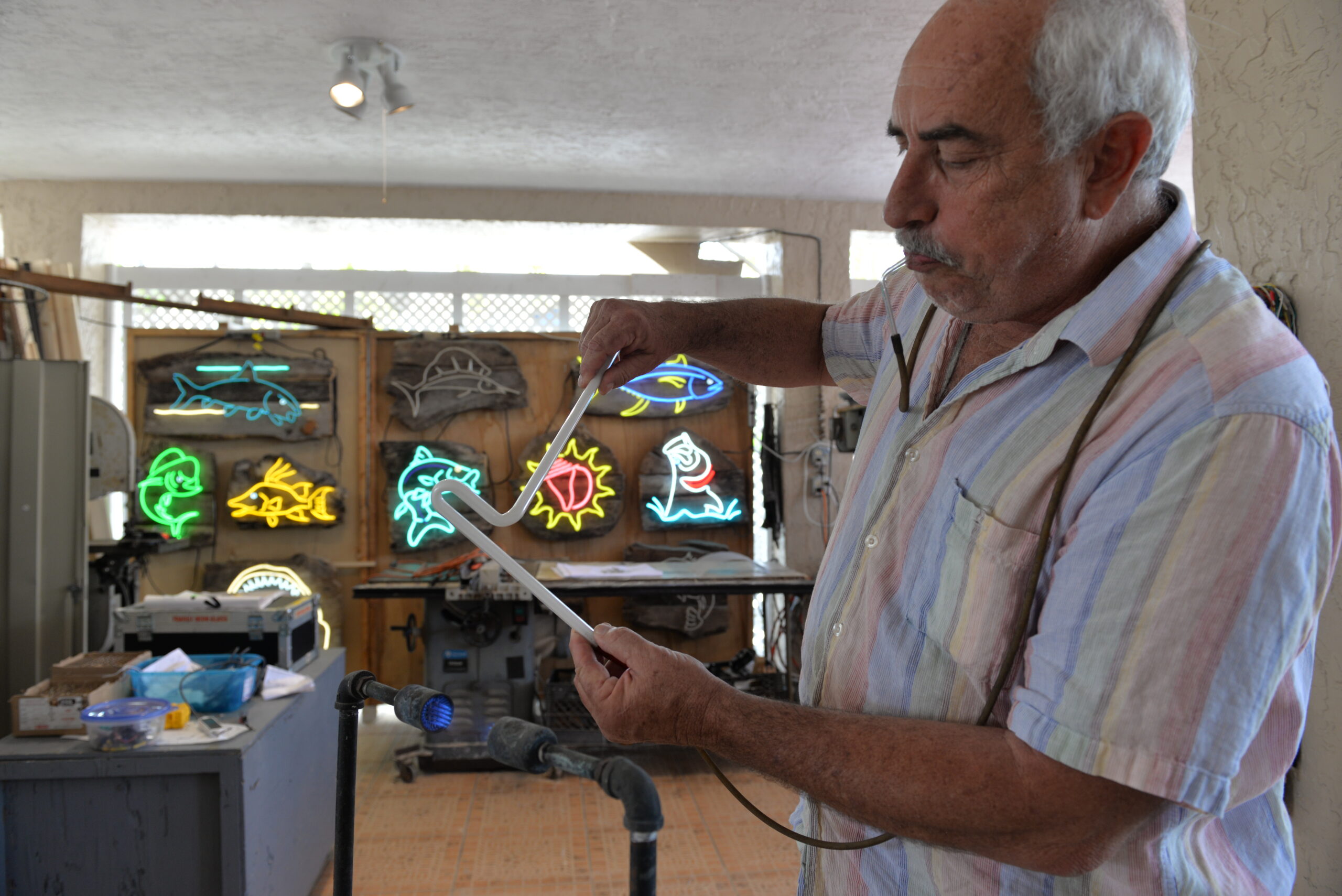
Then I met Cindy the Neon Lady and got a flamingo from her. I ended up spending 9 or 10 years working with her. She had a shop where she did mill work and contracting, and I had space in my wood shop for her neon business. She had gone to neon school to learn to make neon. When she set up shop I watched her work, and I was fascinated by neon and wanted to learn. Working with neon was a natural combination for me because I’ve always been a hands-on guy and this was another outlet for my need to create with my hands.

Making neon is definitely very hard and a lot of time is spent doing it and practicing. But if you stick with it and have a natural ability, that helps a lot. There’s a lot of frustration involved, lots of bad glass, lots of bending that breaks. It’s part of learning, though. Nobody can magically become a good glass bender. I was a licensed pilot and had been flying planes for 10 to 15 years, and it’s easier to get a pilot’s license than it is to learn how to be a good tube bender.

The wholesale business was going up and down so we moved to Miami together and set up shop in Overtown, down on the Miami River. It was a cool shop. We were there working with the ups and downs of the business cycle, and we were a couple and a little in love. But in 1998 she moved back to be with her family in Texas and I’ve been soloing since then.

When I moved from Miami to the Florida Keys the economy was really bad. I didn’t have a website yet and my business depended on old-fashioned word of mouth, yellow pages, that sort of thing. I started making Florida Keys-related fish and neon stuff. I did all of the local seafood festivals and shows down here. Neon is a little pricey, and the economy was bad, but it was a little bit of cash coming in and my creativity had an outlet.

I’m obsessed with making fun, weird and cool things. My mind is always moving on to the next project. My brain is where I keep my ideas; I don’t sit and write them down. I have the idea, get the tools, and start making and measuring. I don’t really design or draw it up – if I want to make it, I start working on it and getting it together. Whether it’s neon or boats or furnishing projects.

Fundamentally, the craft of neon hasn’t changed at all. I’m doing the exact same style and types of bends that they’ve been doing for 100 years. There’s no good way to improve upon it. The only real advancement has been with the transformers and power supply side of things. The neon tube manufactured today is essentially the same tube that they used 100 years ago. George Claude designed it and 100 years later it’s still the standard. If you watch me do it, it’s the same as watching someone 80 years ago do it. It’s a really, really cool medium and people love it. It has a magical feel to it. People see it done and they still think it’s magic. And some people may follow through and try to learn it, but for most it’s pretty difficult.

You know some people say that neon is wicked evil and they will find any way to outlaw neon in inner-city and downtown environments. They think it’s cheap and sleazy, and it’s true that there’s cheap neon work that’s tacky and terrible. But really well-made neon is incomparable and can’t be beat for splash and eye-grabbing advertisement. Some of my local pieces are the outdoor Eternity Now sign and the Panther Coffee sign – everybody loves the Panther Coffee sign. I did the sign in Wynwood, the original one.

I’ve had commercial stuff in different TV shows. A Bruce Willis movie, “Mercury Rising,” had one of my neon pieces, and another was in the movie “Something About Mary.” So yeah, I’ve been around; for most of my wholesale work, I did thousands and thousands of neon lights that are scattered across the planet. I’ve shipped stuff all over the world. I’m sure a lot it will still be around when I’m not. Neon is forever, so they say.

It’s pretty cool that there’s so much neon in Miami. Miami has been good about that, the inspiration. I take inspiration from pieces here and decide how I want to make my work by adding creativity and thought to make it new.

Before coming to South Florida, I was in Texas for a decade and I loved the water down there, too. When I first came and saw the crystal clear waters of South Florida, I decided that I wanted to be a boat bum in the Florida Keys. So, the water is what drew me here. I like the outdoors here, and playing with boats. I feel lucky to be doing this in the Florida Keys, but neon is still a Miami thing, and that’s where the work and business are. Miami is where the action is.

Translate »