fbpx Skip to content
Named Best Museum 2022 by Miami New Times

The house stood amid the pine and oak, far removed and away from what might pass for civilization in middle Georgia. It sat battered by time, the hot Georgia summer sun, and the harsh winter wind. The porch was falling down, and sagged at the front door.

Nearly 700 miles from the red Georgia clay, this became my parents’ house on Southwest 47th Court, just off Sunset Drive. It was in this house where my mother Keeker raised three boys, hung contemporary art, played the piano, rehearsed neighborhood children’s Christmas choirs, blasted her stereo and generally held court to her dying day.

To understand my mother, you had to understand her house. The house was built around 1850 near Dames Ferry in Monroe County, nearly 15 miles from the courthouse in Forsyth. When the Civil War came to Monroe County, it was in the form of a great army of Sherman’s soldiers, who camped on the hills northwest of Forsyth. When they passed into town the next day, the soldiers burned any structure of military potential. Thus the great antebellum homes of the town, save three, were destroyed.

Of those three houses, Agnes, Keeker’s mother, came to own one. Miss Alice, my mother’s maiden aunt, owned another. The third, the home of a judge, was too far removed from the town and too far separated from the main Northern force to justify its destruction. It is this house that made its way to Miami.

The truth is that the house did not look like much. If one were serious about moving an antebellum home to South Florida, there were undoubtedly better and grander candidates. But what Keeker saw was not its state of repair, but its dimensions — its scale, lines, and possibilities. The house consisted of four large square main rooms, paired on either side of a great hallway which ran front to back. The rooms were large with 12-foot ceilings. The house was heated by two fireplaces, which opened to each paired room.

My father George Cornell moved from Georgia with his family to Miami in 1926 just in time for the great hurricane. He attended the “new” Miami High where his classmates and friends included U.S. Sen. George Smathers and Charles “Bebe” Rebozo, the Key Biscayne confidant of President Richard Nixon.

In 1929 my father returned to Atlanta to attend Georgia Tech. When his father’s shoe store on Flagler failed, he ordered Dad to come home. Dad instead put himself through Tech drawing ladies shoes for newspaper advertisements. After college he worked in North Carolina until World War II. His first marriage having not survived the war, he joined his brother Elder in the roofing and sheet metal business in Miami. He met my mother Keeker at a party in Macon, Georgia, and they were married in 1947.

They moved the house from Georgia to 47th Court in 1952. My parents lived in the house until their deaths, and then my brother, Howell, lived there for a number of years. Growing up there seemed ordinary to me. It was neither the biggest nor smallest house on 47th Court. My father went to work every day just like all the fathers on the street. My mother did charity work at the Red Cross and taught herself enough about contemporary art to land a position on the Art in Public Places Trust in the 1970s and ’80s.

Our antebellum home was filled with Warhol cows and Lowell Nesbitt flowers. My father’s protest about the incongruity of Greek Revival design and the art was dismissed by my mother. “If it’s good,” she told him, “it looks good anywhere.” Southwest 47th Court in the 1950s was a land of kids. Between Sunset Drive and Southwest 74th St, there were eight houses. By the end of the decade those houses held 22 children.

We spent our weekends and after school playing football on our lawn, engaged in pine cone battles that would last for days or driving go-carts up and down 47th Court. Kids from nearby neighborhoods would often join us. Johnny Wolin, who became a legendary Miami Herald editor, played football with us. He was fierce and a good player in spite of his small stature.

We had neighborhood traditions. Every Christmas, Dr. Jim Lancester, our neighbor and pediatrician, and my mother, would try to whip us into musical shape so we wouldn’t embarrass ourselves when we caroled up and down the street. This tradition went on for years until the kids became teenagers who were way too cool to go door to door singing songs off key. With so many kids, birthday parties were common. Bobby Matheson probably had the best of them. We would go to his family’s coconut plantation on Key Biscayne, where the Ritz Carlton is today, and picnic and play baseball on what amounted to a private beach.

We had a few famous people on 47th Court. Phillip Wylie was a prolific author in the 1940s and 1950s whose attacks on ‘mom-ism’ probably did little to endear him to our own mothers. Another father, Boots Norgaard, was the AP bureau chief in Miami. Boots had been one of the most famous correspondents of World War II. Aside from his own kids, not one of us knew that for many years. Out of that bunch of kids came six lawyers, an Episcopal priest, a photo editor at the New York Times, an architectural historian, a painter, a home builder and a tree surgeon.

Few remain in South Florida, but our street remains a part of each of us.

G. Ware Cornell Jr. is an attorney who now makes his home in Weston.
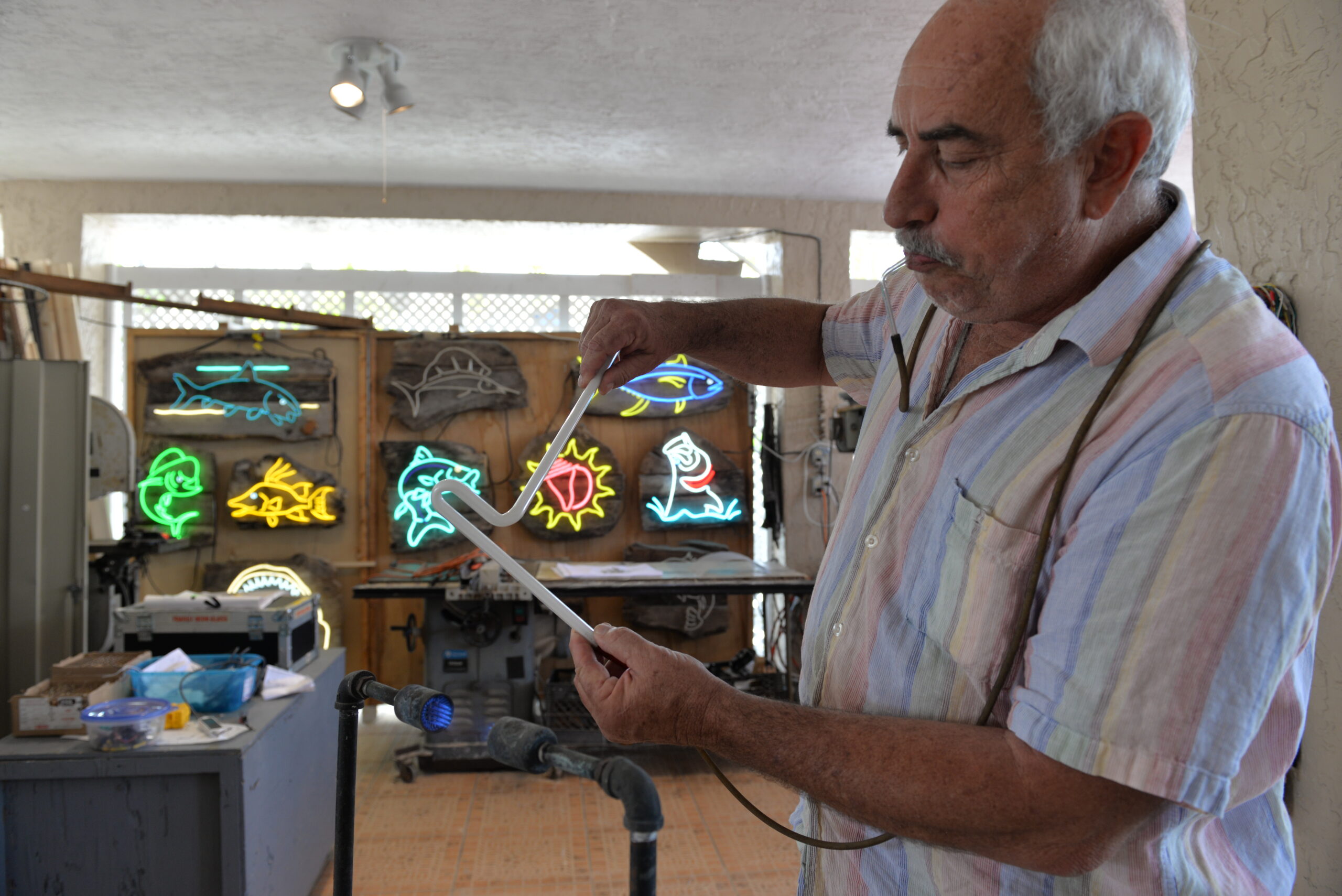
My name is Steven Michael Moser, Steve Moser casually. I was born in 1953 in St. Louis, Missouri, the “Show Me” state. I grew up in St. Louis primarily, though I lived in D.C. and Iowa for a time. Then I decided I had enough of winter and moved to Texas for 10 years, and I visited Florida many times and I liked it, especially the water. I think I got lucky, so here I am in Key Largo. I moved here in 1989 officially, 27 years ago. I came here to be on the water.

When I got out of school I wanted to build and create things rather than do office work. I’m very obsessed and compulsive about high-end, meticulous work, which is a good trait for making things. I primarily did wood working, remodeling, building furniture, cabinets, and mill work.

Then I met Cindy the Neon Lady and got a flamingo from her. I ended up spending 9 or 10 years working with her. She had a shop where she did mill work and contracting, and I had space in my wood shop for her neon business. She had gone to neon school to learn to make neon. When she set up shop I watched her work, and I was fascinated by neon and wanted to learn. Working with neon was a natural combination for me because I’ve always been a hands-on guy and this was another outlet for my need to create with my hands.

Making neon is definitely very hard and a lot of time is spent doing it and practicing. But if you stick with it and have a natural ability, that helps a lot. There’s a lot of frustration involved, lots of bad glass, lots of bending that breaks. It’s part of learning, though. Nobody can magically become a good glass bender. I was a licensed pilot and had been flying planes for 10 to 15 years, and it’s easier to get a pilot’s license than it is to learn how to be a good tube bender.

The wholesale business was going up and down so we moved to Miami together and set up shop in Overtown, down on the Miami River. It was a cool shop. We were there working with the ups and downs of the business cycle, and we were a couple and a little in love. But in 1998 she moved back to be with her family in Texas and I’ve been soloing since then.

When I moved from Miami to the Florida Keys the economy was really bad. I didn’t have a website yet and my business depended on old-fashioned word of mouth, yellow pages, that sort of thing. I started making Florida Keys-related fish and neon stuff. I did all of the local seafood festivals and shows down here. Neon is a little pricey, and the economy was bad, but it was a little bit of cash coming in and my creativity had an outlet.

I’m obsessed with making fun, weird and cool things. My mind is always moving on to the next project. My brain is where I keep my ideas; I don’t sit and write them down. I have the idea, get the tools, and start making and measuring. I don’t really design or draw it up – if I want to make it, I start working on it and getting it together. Whether it’s neon or boats or furnishing projects.

Fundamentally, the craft of neon hasn’t changed at all. I’m doing the exact same style and types of bends that they’ve been doing for 100 years. There’s no good way to improve upon it. The only real advancement has been with the transformers and power supply side of things. The neon tube manufactured today is essentially the same tube that they used 100 years ago. George Claude designed it and 100 years later it’s still the standard. If you watch me do it, it’s the same as watching someone 80 years ago do it. It’s a really, really cool medium and people love it. It has a magical feel to it. People see it done and they still think it’s magic. And some people may follow through and try to learn it, but for most it’s pretty difficult.

You know some people say that neon is wicked evil and they will find any way to outlaw neon in inner-city and downtown environments. They think it’s cheap and sleazy, and it’s true that there’s cheap neon work that’s tacky and terrible. But really well-made neon is incomparable and can’t be beat for splash and eye-grabbing advertisement. Some of my local pieces are the outdoor Eternity Now sign and the Panther Coffee sign – everybody loves the Panther Coffee sign. I did the sign in Wynwood, the original one.

I’ve had commercial stuff in different TV shows. A Bruce Willis movie, “Mercury Rising,” had one of my neon pieces, and another was in the movie “Something About Mary.” So yeah, I’ve been around; for most of my wholesale work, I did thousands and thousands of neon lights that are scattered across the planet. I’ve shipped stuff all over the world. I’m sure a lot it will still be around when I’m not. Neon is forever, so they say.

It’s pretty cool that there’s so much neon in Miami. Miami has been good about that, the inspiration. I take inspiration from pieces here and decide how I want to make my work by adding creativity and thought to make it new.

Before coming to South Florida, I was in Texas for a decade and I loved the water down there, too. When I first came and saw the crystal clear waters of South Florida, I decided that I wanted to be a boat bum in the Florida Keys. So, the water is what drew me here. I like the outdoors here, and playing with boats. I feel lucky to be doing this in the Florida Keys, but neon is still a Miami thing, and that’s where the work and business are. Miami is where the action is.

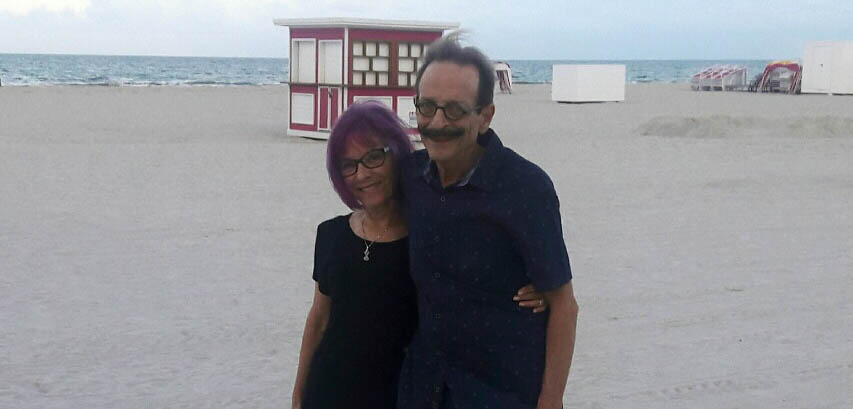
My husband, Stewart Stewart and I, Dena Stewart, landed at MIA in November of 1986 for a two-week vacation on the beach. The South Florida Art Center was new on Lincoln Road and as artists, Stewart and I were enticed by the opportunities we were offered – a 1,000 sq. ft. storefront studio/gallery space for $100 a month. Two months later, in January 1987, we left New York and became Miamians. We were the first out-of-state artists to benefit from the grant awarded to the SFAC.

During the 33 years I have lived in Miami Beach, I have served and promoted the greater Miami community as an activist, serving on Commission-appointed committees and as a presenter of cultural events.
In 1990, Stewart and I founded Deco Echo Artists’ Delegation (non-profit organization) to raise awareness of the culture on the Beach. Now d/b/a Center for Folk and Community Art, we use our original nationally recognized outreach program “Telling Stories Through Visuals” to address social issues by combining writing and illustrating activities for intervention, prevention and education.

In 2001, I was recognized as a “Woman Worth Knowing” by the Miami Beach Commission on the Status of Women. I served on the board of the first Miami Beach Women’s Conference, and was recognized by Miami County and Miami Beach with Proclamations for my community involvement. In 2010, Stewart and I created, and for the past ten years have been producing, an online video show called “Alive on South Beach” (for Syndicated News Network). We go behind the scenes at events to talk with the wonderful people, celebrities, visitors, and locals, who make Miami, MIAMI.

Stewart and I gave up our upper East Side high rise apartment in Manhattan to make Miami Beach our home. I have never even considered leaving Miami. We love it here. When we travel, our video show Alive on South Beach goes on the road with us, and Miami is always promoted.

What makes Miami, Miami? A picture – in my case, Alive on South Beach videos show what makes Miami, Miami! The multi-national congeniality of the community, the many art and cultural venues, the sand, sun and palm trees, and the quirky people, all together give Miami a flavor unlike any other.

Having lived and worked in Miami Beach for 33 years, I have seen the evolution of Miami, the development, gentrification, ups and downs of the social and cultural scenes, hurricanes, and gorgeous weather. I trust the future will be as exciting as its past.

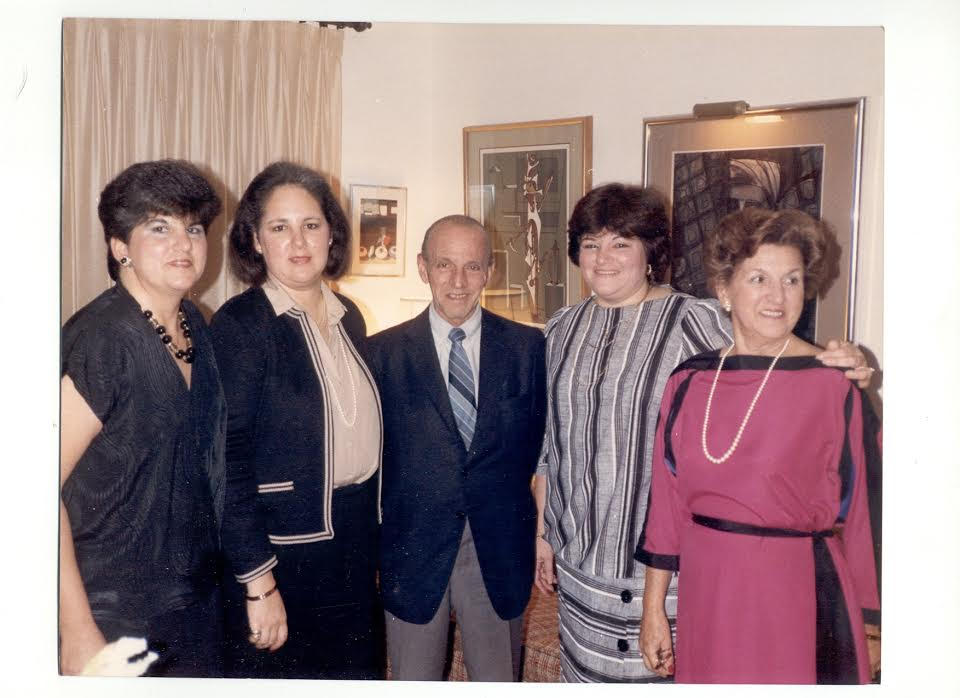
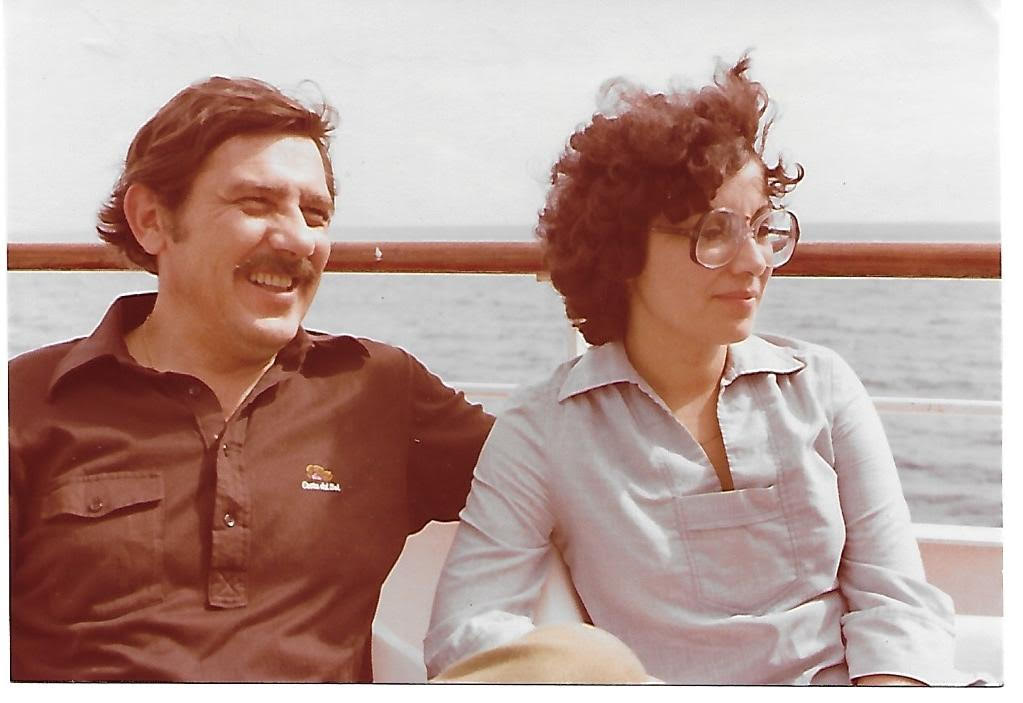
Our mother and father fell in love with Miami while on their honeymoon on September 13th, 1948. Their first night at the Ritz Plaza Hotel was spent in the lobby due to a hurricane coming on shore that night. Hurricanes were not named back then. Despite this “stormy start,” they moved from Brooklyn, New York, in 1949. They rode on the Florida East Coast Railway and arrived at the railway station near the Miami-Dade County Courthouse.

Our mother, Anna Agnello Perini, was a registered nurse and graduated from the Cadet Nurse Corps. She attended Long Island School of Nursing and graduated just as World War II ended. When Mom and Dad moved to Miami, Mom began working at Victoria Hospital, Jackson Memorial Hospital and Baptist Hospital until she took 10 years off to be a full-time mom. When she returned to nursing 10 years later she found her passion for pediatric nursing at Variety Children’s Hospital where she worked until her retirement. Mom loved pediatric nursing and it showed, so much so that both her daughters and two granddaughters became pediatric nurses and still carry on her legacy at Nicklaus Children’s Hospital (formerly Variety Children’s Hospital).

Our father, Anthony Perini, a World War II Navy veteran, worked at the Miami International Airport maintenance facility with National Airlines while he studied mechanical engineering. He then worked at Anchor Boat Supply near the Miami River. My parents were indeed part of the Greatest Generation.

In 1953, Rosanne was born at Mercy Hospital, followed by Roy in 1955 and Regina in 1957. We grew up appreciating the simple things in life. We have fond memories of going to Royal Castle for birch beer, Breeding’s for milkshakes, Burdines to see Santa Claus, Crandon Park for the zoo and train rides, and weekend picnics at Haulover Beach. We’ll never forget swimming lessons at Venetian Pool in ice-cold water!

In 1964 our parents put a $50 down payment on a new house in a brand new community called Westchester. We were one of the first houses on the block. The kitchen was state of the art for the time. We had a GE electric stove that was featured in the 1964 New York World’s Fair.

Summers were great and always filled with something to do outdoors. Central air conditioning had not become a household staple yet, so outdoors was the best! We took summer school just for the fun of it. Often we would walk to Bird Bowl or the skating rink next door. Working up an appetite, we then walked across the street to Frankie’s Pizza. On special weekend nights we piled into our station wagon wearing our pajamas and Mom and Dad would take us to the Tropicaire Drive-in Theatre on Bird Road. It was a great way to see “The Music Man” and “Mary Poppins.” In the daytime on weekends, the Tropicaire Drive-in became the Tropicaire Flea Market where you could always find great deals!

We were always excited when our cousins and family from New York would visit. We would spend weekends at the Castaways on Miami Beach, go to Wolfie’s for dessert or just walk down Lincoln Road.

Now, four generations later, we have truly settled in Miami. While we continue to carry on traditions from when our parents first moved down, new traditions have been established as well. We celebrated Dad’s 96th birthday at home with a family reunion of cousins coming in from coast to coast. Dad continues to be the patriarch of the family and enjoys our reminiscing and traditions. Though our hometown of Miami seems unrecognizable at times, the memories remain crystal clear. We are thankful and grateful for each and every one. We have truly been blessed.

After I left Cuba in 1959 as a teenager, I spent almost two decades living in Washington, D.C., New York and Maryland. For about 15 years, my family and I would always come to Miami on vacation. It was the closest we could get to our native land. We enjoyed visiting relatives and friends, the beach, the lush tropical vegetation, the sound of Spanish and savoring Cuban food. We would return home tanned, nostalgic, with a box of books, another one of pastelitos, and the determination that we would someday move here. In the summer of 1978 we finally did.

Not too long afterwards, in the spring of 1980, more than ten thousand Cubans sought asylum in the Embassy of Peru in Havana. A few days later, Fidel Castro declared that everyone who wished to leave the Island was free to go. Cuban exiles in Miami spared no effort to secure boats and sail to bring their loved ones to the United States. What followed was a unique page in the history of South Florida. More than 100,000 Cubans arrived by sea in a just a few months.

At that time, I was working as a secretary and going to school at night, but soon quit my job to volunteer helping with the new arrivals. At the beginning the refugees were taken to the Orange Bowl and later on to Tamiami Park to be processed.

I served as an interpreter in both locations. What I saw appalled me: hundreds of people with dog bite marks; a small boy with both arms fractured; and a desperate woman crying incessantly because she could not find her baby, snatched from her arms as she boarded the ship.

In addition to the huge number of men, women and children who fled, Castro included some mentally ill and criminals among the legitimate escapees. Some inevitable chaos ensued. However, the City of Miami created a tent city to house them, some were relocated to other cities, and many found relatives who took them in. In a surprisingly short period of time, the Marielitos –as they were called either with affection or contempt– were on their path to fulfill the American dream.

At the beginning, the first wave of Cubans accepted them with open arms. Then, they saw them as different and distanced themselves from the newcomers. At the end, they were integrated into the community. Miami changed. The new residents revitalized the use of Spanish. There were several well-known writers and visual artists among the refugees.

Others were actors, radio and TV announcers who enriched the community with their knowhow. The street vendors, so abundant in Cuba, started to fill the streets of Miami. The youngsters mingled in school with the children of early exiles and talked to them about the lives they had left behind. Personally, I can say that my daughters´ new classmates taught them more about Cuba than I had been able to do throughout the years.

However, it was also an unsettling time for Miami, with raising crime, homelessness and drugs.

Almost forty years after the Mariel boatlift, I can reflect on the lessons learned. Some Cubans even mortgaged their homes to bring their relatives from Cuba, giving us an example of how family love transcends ideological differences.

I appreciate, particularly in these times signed by xenophobia, how Key West, Miami and the Unites States generously received my compatriots, as they had welcomed us two decades earlier. I am thankful for how much Marielitos have contributed to our culture.

In 1981 Time Magazine featured Miami as Paradise Lost. To many, it was the opposite. In spite of struggles and difficulties, they found freedom and their own personal slice of paradise. The Florida sun always manages to shine bright, even among the darkest clouds.

I am glad we moved here.

My full name is Robert Joseph Ingram. I was born in Long Island City, New York, in 1938. I came to Miami literally by accident. I was hit by an automobile in New York and came down to recover in that winter of 1952 when I was 14 years old and I just never went back.

My father was a musician who worked in the hotels in Miami Beach in the winter and in the Atlantic City area in spring. It was just my father and I at first and then my mother and father reunited here after years of separation.

When I got to Miami, I started ninth grade at Horace Mann Junior High and then after one year went on to Edison High School. I was there until my senior year in ‘56 when some friends and I decided mid-year to join the Navy.

A couple of us went to boot camp together at Great Lakes. Being smart kids, we went in February. We left Miami, where the weather was perfect, to go to Great Lakes in the Chicago area where it was very unpleasant.

After that, I went to submarine school in New London, Connecticut, and wound up in Key West. I never thought I was going to leave Florida and wind up back in Florida. When I joined the Navy, I thought I was going to Hawaii or some exotic place like that, but I didn’t. I went to a very exotic place, Key West.

When I came with the military, it was just a couple of months after the Cuban revolution ended. We would make weekend trips to Havana because our captain was senior and he liked Cuba.

So I enjoyed it, I really did. I enjoyed it so much that when I came out of the Navy I didn’t stay home very long. I went to New York and got a seaman’s card and went back out on a merchant ship. I went to work for what became ExxonMobil. We sailed from Beaumont, Texas, to the ports up north – New York, New Hampshire, Boston – delivering fuel. It was a week each way, seven days down and seven days back, coming up the Gulfstream. I enjoyed that for a while.

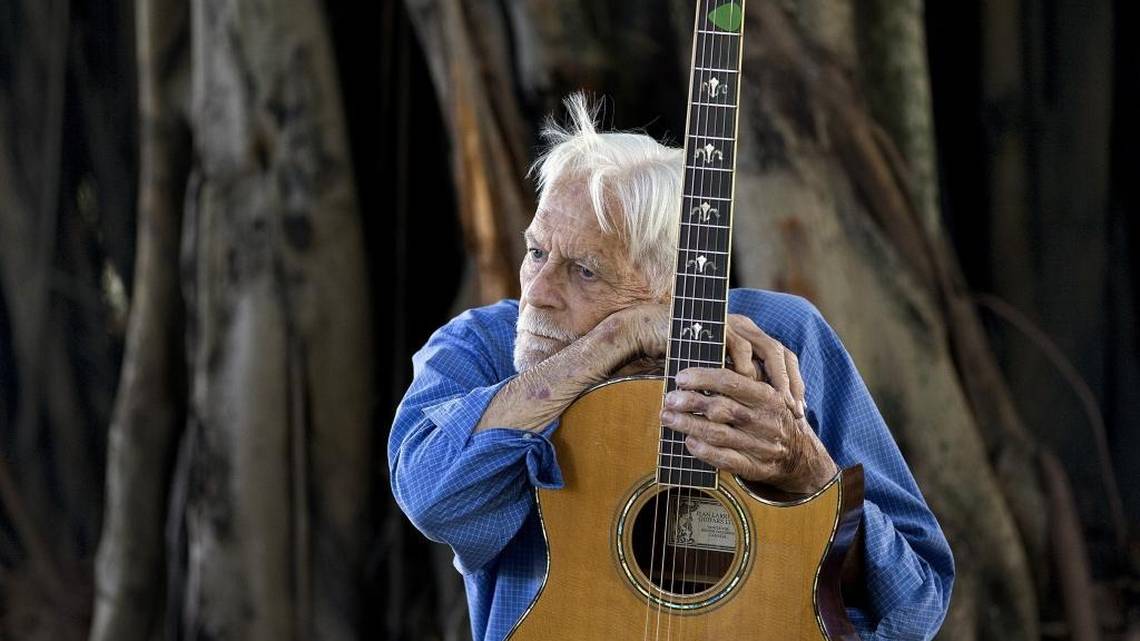
I was home on one of my vacations, hanging out with my old high school buddies who were either in college or working. A friend of mine said, “Let’s go to this bar tonight. I want you to hear this guy, he’s a singer. He plays guitar. You play guitar, don’t you?” My father had taught me a little bit. So we went to a place called the Drum Beater’s Lounge on 79th Street and Biscayne Boulevard.

There was a guy called Vince Martin singing there. He’d come down from New York and had had one hit record in the early burgeoning folk music scene, a song called “Cindy, Oh Cindy.” And he made a lot of money on it. Then that song was re-recorded by Eddie Fisher and it became a major top-40 hit. So Vince was riding the crest of that. He came down to Florida and bought some boats, tried to start a charter business, and wound up back singing in the bars.

I went into the bar and heard him sing. When I came out of there that night I thought, I could do that. I started playing my guitar again and listening to folk musicians like Joan Baez.

We all used to hang out in the Gold Dust Lounge with a guy named Stu Gray, who ran the Gold Dust Lounge. He eventually got me to play guitar and sing in his lounge. That’s how I started, and I never went back to the merchant ships.

All these years later, I’m still happy to be here. I know a couple of things. I know I’m not going to hell. And I also think that I’ve already been to heaven, here. That’s about all I know.

In 1955, my new husband and I, as an exciting afterthought, sprinted on an Eastern Air Lines plane from Puerto Rico to Miami to cap off our memorable six-week honeymoon on the “Island of Enchantment.” It was fun to think that an added week to our honeymoon would parallel Elizabeth Taylor’s much celebrated 1950 seven-week honeymoon with Conrad “Nicky” Hilton, Jr., heir to the Hilton Hotels chain.

Miami in 1955 could have been called “a one-horse town.” Acres and acres of outlying areas were dedicated to the farming of agricultural products, such as green peppers, tomatoes, and limes; within the town itself, retail stores closed at 6:00 PM and traffic snarls were unheard of. This cosmopolitan Magic City of the 21st century could not be envisioned in anyone’s crystal ball nor in anyone’s psychedelic dreams.

We crossed the main streets and roads of Miami for one week by foot, rental car, and tour bus, awed by its wide, clean, empty streets, sausage trees we had never seen before, whole streets lined with huge Royal Poinciana trees in full bloom, a tropical ambiance exuding Hispanic footprints and history and, most importantly, the University of Miami campus with its luscious, sun-bathed landscaping and beckoning call.

When we realized at the end of the week that we had spent our last penny, we donated our blood for $20 and a donut, to help pay for our trip back home to New York City, our birthplace. This not being enough to take us home, we checked the personal ads in the Miami Herald and contracted to drive an elderly man’s Cadillac to New York City. So, although penniless, we arrived home in style. Once home, we decided to quit our jobs as soon as possible, pack our wedding gifts, and move to Miami.

We were married on April 23, 1955, in Brooklyn, New York, and arrived in Miami with a car that barely made it, on August 10th that year, at about 10:00 PM, somewhere on S.W. 8th Street, tired and sweaty, not knowing exactly where we were. We could not find a motel in sight. Finally, we saw one in the distance because of the red neon light blinking in front of it. The room, however, did not have air-conditioning. When we inquired, the manager told us that we did not need air-conditioning because we had “cross-ventilation.” The next morning, when we looked out the window, we discovered that we must have arrived at “motel row” because we were surrounded by motels.

That was how we arrived in Miami. Most local apartments and residences did not have air-conditioning. As time went by and people started moving in, noisy room air-conditioners were installed in master bedrooms and later extended to other rooms. Finally, central air made its mandatory entrance into all buildings in Miami.

Open discrimination was still observed in this vestige state of the Old South. At the Coral Gables bus depot, there were separate water fountains for colored and white people, and separate bathrooms. When we applied to rent a one-bedroom apartment, the landlady (we still call her The Dragon Lady) was chatty and giddy about what a nice couple we were. As we were signing the lease agreement, she told us, “There are only two people I don’t rent to: University of Miami students and Puerto Ricans.” My jaw dropped because my husband was a University of Miami student and we were both of Puerto Rican ancestry.

We are forever thankful to God for that first impromptu visit to Miami by two young people in love who knew nothing about life. Over the next 63 years, Miami proved good to us, even more than good. We lived through many stories, some happy, some sad, which would take up more space than is warranted here. In the end, we have enjoyed a good life, full of blessings, health, abundance and prosperity. We have three outstanding, compassionate, beautiful, productive and civic-minded children, four grandchildren who bring us joy each time we see or even think of them and, to date, two great-grandchildren.

A year ago, we moved out of Miami as the exciting, 24-hour a day teeming lifestyle and overwhelming traffic became too stressful for our advanced years. We have moved further north in Florida to Port St. Lucie, where we are surrounded by green open fields, and life is calmer, much as it was in Miami back in the early fifties.

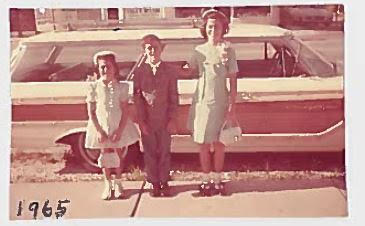
Once upon a time, downtown Miami was THE place to go for Christmas! I especially remember one Christmas, 1960. My parents, Mildred and Edmund Stahl, brother Matthew, age 12, sister Vickie, age 10 and myself, age 7, witnessed the streets transformed into a glorious fairyland!

We all dressed in our best dresses, suits and ties in anticipation of our trip to the city. Our first stop was the Miami Public Library, where my parents put on a puppet show. My father had designed the puppets and had painted the scenery and my mother served as puppeteer. Matthew and Vickie recited Christmas poetry they had learned by heart!

Night was falling when we exited the library, at Bayfront Park, where colorful floats were being prepared in advance for the King Orange New Year Jamboree Parade. But the REAL magic was in the shopping district. I felt like I was walking through streets of heaven!

Thousands of shoppers thronged Flagler Street, which was a constellation of Christmas stars, wreaths, lights and music. There were very few “Walk-Don’t Walk” lights; police directed cars and pedestrians, handing out candy canes to children. We visited McCrory’s, Kress, Woolworth’s, J Byron’s, and Richard’s Department Store, which had a basement, (something you don’t see often in Florida). This was mom’s favorite; they sold “irregulars,” slightly imperfect underwear, socks and pajamas at discount prices.
We proceeded on to our final stop, Burdine’s, where mom worked as a temporary employee, to earn Christmas money. We enjoyed a dinner of turkey and stuffing in the Burdine’s employee break room.

Mom then changed into her “Santa’s Elf” costume to assist with photography of children on Santa’s lap. While she worked, Matthew, Vickie and I accompanied Daddy up to Burdines “Carnival in the Sky” on their rooftop. The tamest ride was the merry-go-round, the most dizzying was the spinning top, but the most exciting (and frightening) was the roller-coaster. I was catapulted skyward! Biscayne Bay looked like a blanket of diamonds. The colorful red and green lights on the causeways resembled emeralds and rubies. But the rapid descent made me feel I was flying off of the roof! In fear for my life, I screamed until an attendant sympathetically stopped the roller coaster just for me. I then stayed on solid ground.

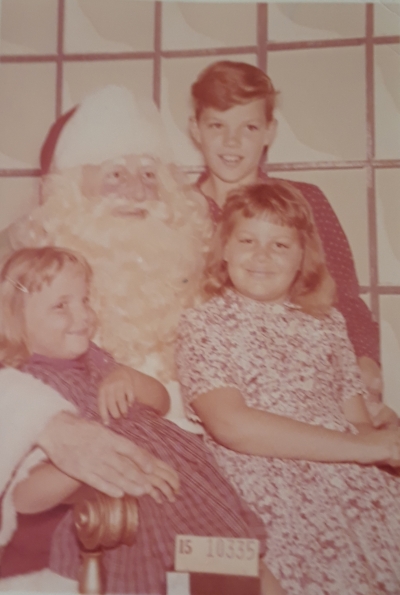
Our final stop was to visit Santa, where we posed for our photograph. Santa exclaimed, “Look at that display of toys and tell me what you want!” Confused, I explained “We don’t have a chimney.” He replied, “Don’t worry, I’ll get it to you. I’m magic.” I selected a Betsy Wetsy Doll, Matthew a microscope, and Vickie, a book of fairy tales. Before the age of reason, I guess I didn’t realize Santa told my mom what we wanted!

In the ensuing decades, downtown lost its glamour. The sidewalks were gray and cold, with abandoned storefronts. Sadly, the joyous shoppers were gone; now there were just grim-faced lawyers scurrying to Court.
And yet….I visited downtown recently, after a long absence. It seems new life is being breathed into what once seemed dead. New high-rise condominiums and office buildings are reaching high up into the sky. I saw many young people walking, jogging and congregating in outdoor cafes. It infuses me with the faith that someday, the magic of Christmas can return to downtown Miami!

Translate »