fbpx Skip to content
Named Best Museum 2022 by Miami New Times

My great-grandfather, Joseph Rapisardo, Sr., was a farmer in Chester, New York, with my grandfather, Leo Nicotra. As the cold and nasty winters arrived every year making crop growing a challenge, they decided to move to sunny Florida in 1950.

After arriving in Florida my great grandfather and grandfather built a home in Homestead, Florida on the corner of NW 8 Street and 6 Avenue. On the adjoining property they decided to plant onions. The crops grew well in the South Florida’s sunny winters. In 1950 the area was rural and Homestead only contained 4,573 residents.

After being so cold in the winter, South Florida was a piece of heaven and that is why for more than 50 years the family has continued to live in South Florida. At first my great-grandfather and grandfather tried to settle in Naples, Florida, but did not care for the area or the soil. They both agreed to move to the small town south of Miami known today as Homestead. It was a perfect fit for raising a family and starting a farming business.

After the elder Rapisardo and Nicotra were deceased, the children and grandchildren continued the family tradition. My father, Gaetano Talarico married my mother in 1962 in New York and in 1967 he also moved to Homestead, Florida. After falling in love with the area he started F&T; Farms, which is now over 40 years old.

I, too, went to school here in the winter and also in New York for the summer to continue the planting of the onion seeds. My uncle, Joseph Nicotra, continued the tradition that his father, Leo Nicotra, and grandfather, Joseph Rapisardo, started back in 1950.

The seeds were planted in December and the plants were pulled in April. Joseph and Leo made the long trip back by truck to Chester, New York, where they were planted again only to be re-harvested in July.

In 1953 the Homestead Air Force Base opened and grew the community to 9,152 residents and became a national center of attention since it contained the closest jet fighter facility to Cuba. With the new growth in Homestead, it still remained a part of an agriculture spot as it is today.

The property to date, now on the corner of NW 8 Street and 6 Avenue, houses duplexes that are still owned by the family. I have now lived in Homestead for nearly 46 years and was so proud to be a part of the Nicotra-Rapisardo family and learning the history of the planting seasons.

The winter in Cleveland was very cold and snowy in 1975.

We just came home from a night on the town, and Mort tried to put his key in the front door lock, but it was iced over.

He grabbed The Plain Dealer, which was under the mat, and luckily had a match in his pocket. He burned the newspaper to melt the ice so he could unlock the door.

As soon as we were inside, we said, “Let’s get out our Florida file.”

We had started the file a few years before since someday we planned to move to the warm weather.

“You better study for the Florida State Optometry Board,” I said. Mort wasn’t ready to retire at 48. He graduated from Ohio State University in 1951 and after 25 years, studying again was quite a determination. But he passed the state board in 1976.

We were boaters and spent weekends on our boat, Eye Spy, at Cedar Point on Lake Erie.

At first, we were going to sell the boat, but we decided it would be an adventure to sail to Florida.

It was September 1979. We contacted two boating couples, each of whom accompanied us half-way.

We started the voyage from Cedar Point, then sailed east to Buffalo, where we entered the Erie Barge Canal. It took us several days to go through the 33 locks and descend from 564 feet to 49 feet above sea level, to the Hudson River near Albany.

Sailing down the Hudson was beautiful. We passed FDR’s home, West Point and Sing Sing prison.

In the New York harbor, we cruised past the Twin Towers of the World Trade Center.We cruised down the Intracoastal; our voyage took 22 days. We sailed right into the dock at the Eden Roc condos, where we bought a three-bedroom, 2½-bath unit on the Intracoastal in Sunny Isles — for $79,000.

Collins Avenue back then was a string of motels. Now, it’s a string of high-rises. The Thunderbird is still here — we go there for great dining and dancing.

We loved the Rascal House, which sadly is gone. Our kids water skied on Maule Lake near the Bay.

We are very lucky to have all our children near us. Our two daughters settled here and our son moved here shortly after we arrived.

Today Mort is 81 and I’m 79. Mort had a wake-up call in 1972, had a heart attack and by-pass heart surgery.

This prompted him to start a healthcare program, which includes diet, nutrition, exercise and stress management. We do not take drugs, feel great and go dancing EVERY night.

We join other couples and call our group, “Do Ya Wanna Dance?”

I got here by way of birth, born in Victoria Hospital, which was built in 1924. My mother, Louise Guckert, came from Louisville, Kentucky, and she married Ralph Yount, also from Louisville.

My mother was a trip; she never counted this first marriage because today people would just have lived together. The only reason I know about it is because Ralph’s mother remained a friend to us and was there when I was born. Ralph worked for a cruise line that was based in Miami, and the ships went from Miami to Cuba and back to Miami. My mom and his mom would go on the cruises. Can you imagine what a ball this was in the 1920s?

Between marriages my mother worked for Smith, Richardson & Conroy. Her second marriage was to Verne Vivian Buell, born August 23, 1902, in Ft. Pierce. He was the owner of a dry cleaners located just over the Flagler Street bridge. They were married in June 1935 in Louisville. I came along the following year. Mother attributes her one and only pregnancy to the June Taylor dance studio where she took tap lessons. Mom was third-generation American.

My father is another story. He was the last child of Lula Mae Summerlin, born January 8, 1867, in Florida, daughter of Capt. John Alexander Summerlin, Confederate, 1st Regiment, Florida Cavalry. My father’s father, whom I never knew, was Sylvania Selvester Buell, a Union soldier. My lineage goes back so far I lost patience, but stories have been handed down that these two men could have some very heated conversations.

Mother never told her correct age on anything — my birth certificate, her marriage license, her driver’s license, or her voter registration. We lived on 12th Street near the Orange Bowl. There were no gates to keep people out so this was my very early playpen. Mom would take me there and I’d run up and down all over until I was exhausted.

We moved to Southwest 32nd Avenue between 8th Street and Flagler. I went to school with Indians and white Americans at Orange Glade Elementary, located on the corner of 27th Avenue and 8th Street. The buildings were little wood houses. My second grade teacher, Ms. Rice, thought I was such a pretty little girl she entered me in an audition for the opera Carmen. I made it. The opera took place at Miami High’s auditorium.

I remember riding a trolley car on Flagler Street. It went from 32nd Avenue to downtown. My mother would take me to Burdines, and on my birthday, I would get a special princess ice cream with a porcelain doll that sat on top of a flowing skirt of ice cream, trimmed with silver candy beads.

I loved school, especially when first and second graders got to bring a blanket to school and lie down under the pine trees after lunch and take a nap while listening to classical music coming from a gramophone. I would give anything for all you who came later to know what it was like.

Sometimes my mom would pick me up after elementary school and we would go downtown to Richards Department Store and for a dime the jitney would take us to South Beach.

First we would stop at a street corner juice stand and have a fresh-squeezed orange juice. We then walked a block to the ocean and you could look down the beach, and as far as you could see the water was crystal clear blue. The sand was clean, so white it hurt your eyes, and not a high rise in sight. There were very few people then and you felt like you could run free.

The war broke out, for those of you too young to remember World War ll. It didn’t seem to faze us much until south Miami Beach, full of Art Deco hotels and small apartments, became a training ground for American soldiers. This didn’t stop my mom’s family; they were snow birds of the first degree. The little motels and Art Deco hotels became barracks and the rest was left for vacationers.

The family always rented a place for winter and Mom and I would join the relatives. Wolfie’s was the choice for lunch pickles in a bucket and sauerkraut in another. Soldiers marched all around the apartments. Remember, I was very small but won’t tell tales out of school.
Early in the morning two soldiers would come by and pick me up and take me to the beach where binoculars were available. They would lift me up to see and sure enough there were submarines close to the land. I don’t know if they were kidding or not but they told me they were German submarines.

I would ride my bike to school and go home a different way, and sure enough the bike was always where I left it.

I’m still here, married to another native Miamian. He shot missiles to the moon, went to MIT and owned Clifford’s restaurant. We both remember when.

The Chandler clan arrived in Miami early in the 1920s so that my father’s father, Thomas Chandler, could make a living working construction in those boom years of early Miami prior to the big hurricane of ’26 that destroyed it all. The family, including six children, lived in the Allapattah area enjoying the fruits of the tropics and fresh-caught fish from the-then pristine Miami River.

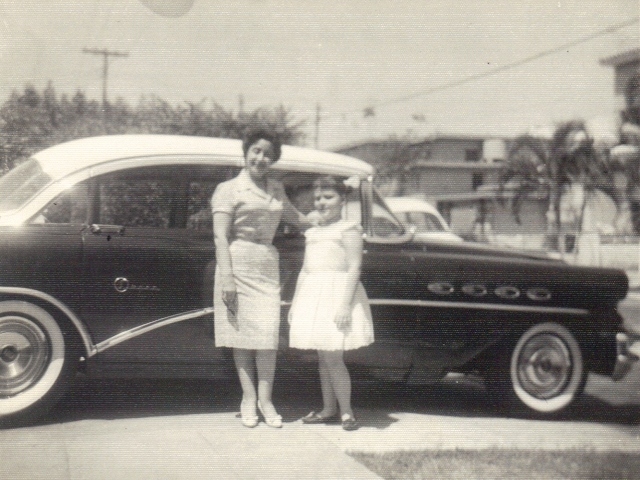
The maternal side of my family arrived in 1944. My mother, then 23, had had enough of the cold Indiana winters and longed for warm breezes and the glittering nightlife that was Miami. She arrived by train, suitcase in hand, $75 in her purse along with the phone number of a friend’s grandmother who might be able to put her up for the night.

It was with this journey that Velma Ruth Villwock of Indianapolis became Ruth Villwock of Coral Gables. Always one to dream big, my mother took the bus downtown and, looking skyward, saw the towering Alfred I. DuPont building on Flagler Street and declared that she would work there.

I don’t think that my mother ever took no for an answer, and consequently worked there a short time until seeing another impressive building that called her name. While living on Alhambra in Coral Gables and renting a room in the home of a wealthy elderly couple, “Mom and Pop Rhoads,” she became acquainted with the majestic Biltmore, then an Army Air Force hospital.
Once again, setting her sights high, she gained employment as a medical secretary in orthopedics at the hospital.

She changed her residence to an apartment within walking distance of the fabulous edifice. Thus began her magical “Biltmore days,” eating lunch by the pool, watching celebrities like Johnny Weismuller and Esther Williams come and go, meeting wounded GIs, and dancing with soldiers at USO parties. Her photo album is filled with lovely, smiling young women and handsome men who crossed her path and are ever immortalized in fading black-and-white photos, names unknown.

A highlight of those days was a reception given at the Biltmore for General Dwight D. Eisenhower where, as a date of her boss, Mom shook the hands of the general and his wife, Mamie. Miss V., as Mom was known to her boss, was dressed to the nines and was as glittery and sparkling that evening as the event itself.

In 1947 at Coral Gables Methodist Church, she married a handsome young Marine, my father, Joe Chandler. In 1950, they bought a house on the GI bill for $50 down and $50 a month in West Miami. It was there they began their family, which included my brother Bob and me. They raised us in Riverside Baptist Church in a city where we could walk to the corner Grand Union for groceries and play outside until the street lights came on.

In 1960, when our first Cuban neighbors moved into the house next door, my mother made them feel welcome and mentored the young mother in the ways of our city. Neither spoke the other’s language but as mothers, they communicated with the same language of the heart with a little help from their children and much pantomime.

My father was busy building a business, Craftsman Commercial Interiors, which was located on the Palmetto Expressway near Hialeah. The business built and installed interiors for restaurants and bars. It couldn’t have existed at a better time. Miami was growing and prospering, as was the Bahamas. Dad frequently flew on a small plane to the Bahamas for installations. His business had among its clients Chippy’s restaurant on Miracle Mile, where the New York-style cheesecake was out of this world. Our family got a kick out of sitting in the booths that were our dad’s handiwork.

As the business prospered, my parents wanted more for their children, so we moved to a new pool home in the Westchester area where Bob and I could attend the new, all air-conditioned Miami Coral Park Senior High School.
Miami grew and changed quickly; when my parents retired in 1975 they, like so many others, left for northern Florida. In 1992, my mother returned as a single woman because Miami had never left her heart. She closed on her condo in Kendall the weekend Hurricane Andrew arrived.

After six months, she was able to move in and lived in her condo 20 more years, enjoying all that Miami had to offer. Her connection to the Biltmore continued as she went for tea in the lobby and had brunch on the terrace. She especially loved the 4th of July fireworks at the Biltmore and even took the tour inside, adding details of the Biltmore’s war days to the docent’s speech.
My mom’s love of Miami never ended and her tales of the magic of being young in Miami during the war years live on with her children and grandchildren.

We gather back in Miami for her funeral this week and to celebrate her life. The balmy breeze and slanted light of autumn remind us that for everything there is a season. This magic city grew in my mother’s lifetime from a winter vacation playground for northerners to an international metropolis. It changed with each decade as we did. What doesn’t change is the clear, clean air from the ocean, swaying palm trees, the vibrant green of our tropical plants, explosion of color from bougainvillea and hibiscus, along with stories and memories of our beloved and unique home. We all attest to the fact that Miami with her flair and charm is in our hearts always.

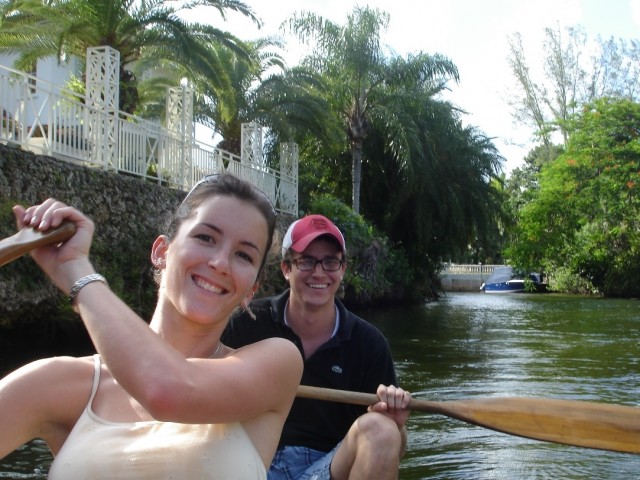
We hauled my parent’s aluminum canoe off the roof-rack of his 2002 Mitsubishi Montero and onto the grass near the edge of the Biltmore canal. I grabbed the essentials from the trunk and tossed them into the canoe: two wooden paddles, a foldable, plastic seat, a faded, waterproof cushion, and a couple of well-worn life-jackets.

Larry—the tall, Colombian-American I had just been introduced to a few weeks before—adjusted his maroon FSU hat and repositioned his thick-rimmed eye-glasses before reaching down to help me lift the canoe.
My water bottle rolled towards the stern as we lowered the boat down the grassy bank to the water’s edge. I glanced over my shoulder at Larry, trying to keep the giddiness I felt from showing on my face.

“You ready?” I asked, eager to embark on our first date adventure.

“Let’s do this,” he replied.

I held the canoe steady as he stepped in and made his way towards the back of the boat. Once he was seated, I nudged the boat so that it slid further into the water, until all that was left on the rocky shore was the tip of the bow, just enough to let me climb aboard without having to get my feet wet.

I had been in this canoe countless times before. Growing up in Coral Gables, my parents would often take me and my brother out for a Sunday afternoon stroll along the waterways that snaked their way through our neighborhood and out towards Biscayne Bay.

Our usual route would lead us from the starting point near our house to a spot where the canal dead-ended across from the football fields of Coral Gables High. There, we would spot manatees that had come in from the bay in search of more tepid waters. In the winter time, when cool air graced a muggy Miami and the ocean temperatures dropped, the warm waters of the canal offered a sanctuary for these marine mammals.

From the edge of the water, on-lookers often congregated to count the rounded backs of these dormant sea-cows, which emerged from the surface like buoys. Every few minutes a pair of circular nostrils appeared as a manatee brought its nose up for air. From the canoe, however, it was easier to see through the murky canal water and observe what went on beneath the surface.

With a few quiet strokes of our wooden paddles, we let our canoe glide right up next to them, stuck our hand in the water, and caressed their slimy, algae-covered backs. It was easy to spot the older ones, who were often coated with barnacles and striped with scars from motor boat propellers. The younger ones were more curious, and came right up to the side of the canoe, rolling belly-up and lifting their flippers out from the water as if to offer a high-five.

As Larry and I paddled through the canal on that cloudless, summer day, I was hoping that we would get to see a manatee up close. Larry had grown up in Miami as well, but had never canoed through these parts before, and I was excited about showing him a side of his home town that he had yet to discover.

From the few times we had hung out since our first encounter on a South Beach dance floor the previous month, I already knew he was the type of person who, like me, enjoyed being in nature and staying active. In our first phone conversations, he’d told me about his years playing basketball and running track, about his days owning a longboard and surfing the waves on the northern coast of Florida, and about his plans to hike in Patagonia with some friends that fall. While getting “outdoors” in a city like Miami sometimes felt like a challenge, this, I thought, would be a great way of doing it.

Cruising passed the unique Spanish-style homes that lined the waterway, with their lush, tropical landscaping and beautiful backyards, it wasn’t long before we noticed the wildlife that called the canal their home: a great blue heron perched on a mangrove; a charcoal Anhinga drying out its wings; a giant iguana sun bathing on the coral rock.

At the edge of the lawn to our left, a family of ducks wandered towards the canal, squawking a dissonant tune as they hurried passed the canoe. On the opposite bank, a slender white egret waded in the water, keeping its eyes and beak fixed on the ground below its branch-like legs as it crept towards a potential meal.

And as we drifted down the canal, I thought about how comfortable I felt spending time with Larry. Perhaps it was his laid-back personality, or how he’d been so eager to join me on this canoe ride through the Gables.

Perhaps it was the way he joked about almost anything, and how good it felt to laugh so much whenever we talked. I never expected to find myself starting a new relationship weeks before moving overseas to teach English, but that day in the canoe, as we explored the hidden outdoors of the “City Beautiful” together, I couldn’t help but recognize that being with him just felt right.

And as we slid past a “no wake” sign and turned the corner towards the high school, hearing nothing but the sound of water hitting the sides of the canoe, my eyes fell upon a pair of rounded, barnacle-covered backs emerging from the surface. There in front of us, floating near a dock at the end of the canal, a pair of manatees rested in the tropical waters of Coral Gables.

Growing up in Miami has been an experience for me. You never realize that where you live can have such a great impact on your life. Living in Miami has taught me some things — through struggles and hardships, to moments of rejoicing and opportunities, it has taught me that with endurance and faith I can achieve anything.

Living in Miami has made me versatile. My mother was a single parent raising my sister and me; sometimes we struggled and fell on hard times. We moved several times, so I got exposed to different areas of Miami such as Opa-locka, Carol City, North Miami, Miami Lakes, Hollywood and Pembroke Pines. I went to schools that were predominantly African American, Hispanic and other cultures, and I met students from a mix of these. This experience not only helped me to learn and understand other cultures, but I gained a mixed diversity of friends from various backgrounds.

I have participated in several activities and programs that were located in various parts of Miami. My mother believed in exposing us to different things. I participated in the Lamplighters, which is sponsored by the Omega Psi Phi Fraternity (Sigma Alpha Chapter, Miami), a program for minority young men ages 12-18, “Focused on Helping Shape & Develop Tomorrow’s Future Leaders.”

I participated in the Manhood Youth Development Camp and Educational Institute, a community-based, non-profit organization that provides personal development education, counseling, and mentoring services to youth and families. Their mission is to increase the young male’s potential of leading a productive, responsible, and self-disciplined life crossing into manhood. Through this organization, I had the privilege to go to New Orleans to help victims that experienced devastation due to Hurricane Katrina.

Other programs I participated in were Teen Upward Bound; its mission is “to build strong families, youth and teens through education and faith.” I participated in the North Miami Beach Teen Summit, volunteered at Alonzo Mourning’s Overtown Youth Center, and I am currently on my last year of a three-year internship with Teen Miami. Teen Miami is three-year research and collections initiative on the history of teen life and culture in Miami-Dade County.

My mother also encouraged us to participate in school activities. I joined the band, chorus and the drama club. Through the Flanagan Senior High School drama club, I had the privilege to go to New York and attend workshops, as well as see Broadway shows. I also got the opportunity to go to Statesboro and Savannah, Georgia, to learn about the history of my grandfather and the history of both states.

My experiences living in Miami have been inspiring, informative, interesting, with some low and high moments. Through my experiences in Miami, I have learned to take hardships and struggles, my moments of rejoicing as my learning grew, and my opportunities as a blessing, and to live my life to the fullest.

Stories of families separated and reunited, of language difficulties, of nostalgia for the old country, of countless vicissitudes, but also of triumph, success, happiness: all immigrants share very similar stories, and mine is no different.

My mom, dad, sister, and I lived in Marianao, Havana, in a huge home with my uncle and aunt, who had a very successful pharmaceutical business. My dad and his brothers owned two auto-parts stores. We were happy.

On that fateful New Year’s Day 1959, when I was just 5 years old, our lives and those of countless other Cubans were forever changed. Two years later, my sister would leave Cuba for Canada – the first exodus of our small but close-knit family.

The next year, Castro officials would call up my dad in the middle of the night and offer a one-way ride to Miami on the African Pilot in exchange for the keys to his business and his car. This was the modus operandi for the Castro government. They would play your desire to leave the country against your assets.

If a person had a business or any other substantial asset, government officials would tap them to see if they were willing to make a deal. There was no halfway – you gave them everything you owned in exchange for the ticket out. You had to hand everything over at a moment’s notice; you did not have a chance to select some things you might want to keep or give to your relatives – it was all or nothing.

My dad took them up on the offer in order to pave the way for my mom and me to join him. A church group from New Jersey sponsored my dad and moved him to Orange, New Jersey, where he worked as a school janitor to earn enough money to prove to the U.S. government my mom and I would not be a public burden.

After enduring an extensive “inventory” of all our belongings by the government (where they would catalog everything you owned before you left and come back to check it again the day before your departure to make sure you didn’t give away, sell, or get rid of anything).

Mom and I left Cuba for Mexico City on a Cubana de Aviacion flight in late October 1965. After four months, in what seemed to me to be a paradise of food, clothing, entertainment – all available for the buying without the “libreta” (the notebook where the government keeps track of your food allotments), we traveled to Orange, New Jersey, in the dead of winter, to join my dad.

My mom and I had not seen him in over four years. We all had to get used to each other again. We lived on the third floor (a semi-attic) of a three-family home. There was only one room which was divided by a sheetrock partition; I slept on the couch and my parents on the bed on the other side. Still it was wonderful to be together again. But painful memories remained on our island – my aunt and uncle were still there with no hope of leaving.

I was enrolled in school midyear and had a very hard time with the language. I was forced to repeat the fifth grade again because the principal didn’t think I could make it in the sixth grade with my poor English. I recall the teacher dictating sentences in English for the class to write down. It was a terrible feeling not to understand a single word and seeing all the kids writing and my own page a complete blank!

Despite this setback, the unfamiliar-yet-beautiful snow, the cold winter, and the long walks to and from school, I learned English quickly. I passed the fifth grade in only four months and was promoted to sixth grade. But I was always teased because of my accent and the way I dressed. There were no Hispanics in my town and my classmates didn’t even know where Cuba was!

Every summer we visited Miami Beach for two weeks (no SoBe then!) and stayed at the White House Hotel. I fondly remember a little restaurant on Washington Avenue that served black beans and avocado salad (something we rarely saw in New Jersey).

We used to go for drinks to the Doral’s Starlight Roof on Collins, we went swimming off Lummus Park on Ocean Drive, and attended concerts at the Sportatorium in Hollywood (now the BankAtlantic Center).

I attended Berkeley Secretarial School in East Orange and got a job with Exxon Corporation in Florham Park. After a year, I moved down to Miami with my aunt and uncle, who had been able to leave Cuba via Spain by turning over their house and business to the government, in the same way my father and countless others had done before.

My parents moved down the next year and we all lived in an apartment in Hialeah – together as we had been so many years ago in my beautiful Havana.

Wonderful, beautiful, sunbright Miami! – the weather, the smells of Cuban food, the chatter on street corners, the royal palms dancing in the breeze. Here, so close to our homeland, life is pleasant and the dream of going back to Cuba one day that much better defined. I will go back one day.

My sister never moved back to Miami. She made her life in Montreal until she passed away in 2008. My mom and dad are also gone, as are my aunt and uncle.

I made my life here, married, and had two wonderful sons who are now 27 and 25. I offer my eternal gratitude to this great country that offered us a safe haven and that continues to open its arms to so many. There are many days when I look at the shimmering blue skies and remember the sky over my house in Cuba, the palm trees, the trips to the beach, the durofrios (little frozen juice cubes).

On those days, I drive over to Little Havana to get a colada and a pastelito and to hear some good old-fashioned “Cuban” Spanish. I take a deep breath, and for a moment, I am back home.

In the winter of 1937, when I was 5 years old, my grandparents took an apartment in Miami Beach for the winter.

The apartment was on the corner of Española Way and Meridian Avenue. Our family was from Youngstown, Ohio, and we would drive down for a visit and spend a few days on the beach like any other tourist. That was my first long car trip, and I fell in love with Miami Beach. Along with my brothers, Bert and Bob, and our parents and grandparents, we all had fun at the beach. That was something I can never forget. It was fantastic.

My earliest recollection of Miami Beach was in that winter. We lived there for a few years and then moved to an apartment at 15th Street and Euclid Avenue, where we spent the war years. I vividly remember seeing the soldiers marching up and down the street singing, as they counted cadence, during their period of basic training. The entire city had been converted to a large Army base, and we lived right in the middle.

I attended the Lear School on Bay Road for a couple of years, then in third grade switched to Central Beach Elementary. Then it was on to Ida M. Fisher Junior High across the street, and then next door to Beach High, where I graduated in 1950.

During my early years in Miami Beach, the west side of Ocean Drive was lined with recently built hotels. They all had front porches with chairs facing the ocean so that the patrons could sit, relax and enjoy the gentle ocean breeze while on their vacation. Lifelong friendships developed among the fellow tourists who chatted on the porch.

Ocean Drive, with its beach of golden sand, was “combed” freshly each morning by beach boys who had a chair concession every hundred yards or so along the beach. Our special spot was under a clump of three Coconut Palm trees on the beach at 14th Street. For a dime or so, you could have a beach chair set up foruse all day. Another quarter got you and your group some towels and a large umbrella planted nearby to provide shade from the broiling sun. Sunburns were frequent, and unwary visitors suffered much pain if they didn’t take proper precautions by taking the blazing sun in small doses.

Teams of lifeguards would protect the occasional bather in trouble, and each lifeguard station had a lifeboat that was used for more serious emergencies. This setting made Miami Beach a picture-perfect place to spend a vacation.

Flamingo Park provided outdoor sports venues of all types for natives and tourists alike. Baseball diamonds, tennis courts and a jungle gym kept a sports enthusiast busy from dawn to dusk. The older folks had shuffleboard and horseshoes to keep them entertained. The park also had a football stadium used by the Beach High Typhoons. Free concerts were held often, and the park was the central attraction outside of the beach scene.

Lincoln Road, today’s equivalent of an upscale shopping mall, was meticulously manicured and lined with Royal Palm trees. The Beach and Lincoln Theatre provided the latest in movie entertainment.

Miami Beach at the time was a city of less than 10,000 permanent residents that swelled to an estimated 50,000 or more during the winter season. The “season” was considered to last from November through March. Because of the extreme heat in summer, most commercial establishments would close during June, July and August. A few businesses would remain open with skeleton crews to accommodate the people who remained. In those days, even the permanent residents would leave town in the summer, leaving Miami Beach a virtual ghost town.

While about a hundred hotels had been built, all in close proximity to the beach, the city council had wisely reserved the beach along Ocean Drive be used for the public. There was also a 12-story height restriction on all buildings. The city of Miami Beach was fairly small, linking together several islands. The main island extended to 87th Street, where the village of Surfside began.

The east side of Washington Avenue from First Street to Lincoln Road housed block after block of small, mostly family-owned businesses — bakeries, food stores, restaurants, delicatessens and butcher shops. Most of these shops were owned by Jewish people who had found that a good living could be made catering to the permanent residents, as well as the tourist population.

In 1950, my grandparents built a fabulous home at 45th and Pinetree Drive just north of the Firestone property on Indian Creek. We could look across the creek and see the ocean from our living room. This view was spoiled somewhat when the Eden Roc Hotel was built.

While growing up, we spent a lot of time fishing in the Everglades, picking grapefruit and just sightseeing. It was a great time that I shall never forget.

Hopefully, some of my friends will see this article and recall with me those happy times.

I moved to Miami Beach in 2009 from Naples, Florida, with my boyfriend, in search of better career opportunities.

I grew up in Massachusetts, however, and lived in Massachusetts until 2005. When I first moved to Miami Beach, I was not a happy camper. It took me a while to adjust to the craziness of South Beach. I couldn’t find my comfort zone and was intimidated by the whole “party” scene.

I didn’t have a true understanding or love for Miami Beach, until I started working for the Miami Design Preservation League. Since starting my position at MDPL, I have learned about the history and culture of Miami Beach. I continue to learn about the Art Deco, MiMo, and Mediterranean Revival historic buildings and architecture and about all the passion and hard work that went into saving these gorgeous buildings that surround my home and office.

My appreciation for these architectural gems grows every day. I feel so lucky to live in such a beautiful place.

MDPL has allowed me to become more involved within my community. I am able to meet people that live and work in Miami Beach. I’ve learned that although Miami Beach is a huge tourist attraction, it is also a small community of residents.

I’ve never lived in a place in which people are so passionate about their community. The residents of Miami Beach care about Miami Beach’s image, its businesses, its organizations, and about each other. They want it to be a safe place, a beautiful place, and a place people want to live and visit.

I feel settled in Miami Beach now. I have made wonderful friends. I am in love with the design and art scene of Miami and Miami Beach. I am a regular at Second Saturday Art Walks in the Wynwood District (the food trucks are a bonus).

I LOVE the Design District, too! I stroll down Lincoln Road every weekend and often have breakfast at Books and Books. I have become a HUGE Heat fan (don’t tell my friends and family back in Boston).

I love spending afternoons at South Point Park and sometimes splurging for dinner at Joe’s Crab Shack afterwards. I LOVE being a car ride away from the Keys, a boat ride away from the Bahamas, and only a short three-hour plane ride away from my friends and family back in (freezing cold) Boston.

I have developed a love for Cuban food and I cannot live without my cafe con leche each morning! I always take my visitors to dinner on Espanola way (its a hit every time). I take my young visitors to the Everglades for a Florida adventure they will never forget. Miami Beach is always a hit for my guests. I have developed a true love for Miami/Miami Beach and the WEATHER!

Miami Beach is my home now. I look forward to many years living and working here.

My family moved to Kendall in the fall of 1975. Both from Ohio, my parents settled here with a pioneer spirit, building a home together in an old pine tree forest at a time when the area felt like it was at the edge of civilization.

A reserve filled with Dade-County pine trees now surrounded them— these tall, skinny trees are covered with red and brown bark plated like paper scales and have tufts of evergreen needles that flourish at the top.

Early settlers built their homes from these pines because they believed them to be strong and capable of withstanding hurricane winds, in addition to being termite resistant due to their high sap content. My parents felt that “high pines” was desirable as it was supposed to fare better than most areas from flooding if Miami was ever struck by a major storm.

They bought the house from an Irish builder on a handshake, and opted for an English Tudor style design. My dad installed his own solar heating system for the pool, circulating the water through black piping on the roof, which was considered innovative for its time and featured in the Miami Herald Tropic section.

The warm tropical climate lured a succession of friends to visit from up north, so having a heated swimming pool was an exotic addition. The first order of business was to ensure that I could swim, so I was enrolled in “water baby” classes—I learned to swim before I knew how to walk.

I attended Leewood Elementary and would walk to school every day. My mother would accompany me to and fro, and when I got a little older I was permitted to ride my bicycle. She would quietly trail behind me until she was confident of my skill and I was then allowed to commute to school on my own.

The area was ripe for development with sidewalks and small homes starting to appear, yet the moment retained so much possibility and opportunity. The pine tree lots were expansive and the generous space predicated the sprawl of urban growth. It was the emptiness that was full. This was the era of magical realism, where childhood was still immersed in innocence and dreams, the excavations of invented worlds abound.

When not in school, I would spend endless days venturing out into woods with neighborhood kids, finding a clearing for forts which we would construct from discarded plywood sheets and old particle board cabinetry, making ladders of 2x4s, furnishing the hide outs with contractor bucket seats and holding court.

Traversing the soft needle carpet beneath my feet, my footsteps padded and dowsed yellow with pollen and sticky sap speckled every surface I made contact with. The edge of the woods was populated with towering cane sugar plants that had downy razor sharp leaves, leaving a stream of paper cuts on my legs in the wake of a mad dash of tag and game playing.

What kind of future could I dream about? I would always lose myself in thought, my head full of possibility and reveling in freedom — definitely a sign of my artistic temperament. Rays falling fast across the sky designating it was time I head home. My mom would be anticipating our return, hair matted hot with sun and retaining the wild airs of adventure. I remember the light had these mysterious ways of southern light, gathering itself together and suddenly dissipate.

The passage of time brought with it inevitable changes. This was a rapidly shifting suburban environment and development was encroaching, and with it came more trouble, incidents of crime were reported, and these occurrences indicated the transformation.

Someone tried to coax a young child into their car after school, a sign of times to come. I negotiated my way into middle school, and the internet became more prevalent as outdoor activities lost their appeal. My parents sold their green Karman Ghia because it didn’t have seat belts. Things were forced to change, to become something new and something different.

The early 80s also brought turbulent times — the Mariel boatlift with its Cuban mass exodus and heartache, the drug trafficking, and the abduction of Adam Walsh forever scarred the landscape of our childhood. Miami had its edge, Miami Vice and South Beach and its lively pursuits of pleasure and the pulse of constant culture, but this atmosphere was not for me. I left Miami to attend college up north, with the assumption that I would not return for a long time.

I was home with my family when Hurricane Andrew hit in 1992, and our house was one of the only ones in the area that withstood its powerful and destructive winds. That Irish builder had designed the house so the doors would swing out- not in, which would prevent the interior corridors from being blown through.

When we woke up the next morning after Andrew, our home was one that was not emptied of its contents. The majestic pine tree forest, or what was left of it after development, was decimated. Those treasured moments of solitude in the woods, and how it provided me with a childhood full of discovery and revelation still remains firmly anchored in my mind.

Translate »