fbpx Skip to content
Named Best Museum 2022 by Miami New Times

My grandfather and other family members were Miami pioneers, having arrived in 1895 from Crescent City, Florida.

My grandfather, T. N. Gautier, was one of 500 signatures needed for Miami to incorporate as a city. He was also the first school superintendent for Miami. His grocery store, Miami Groceries, was listed in the one page 1902 telephone directory as “T.N. Gautier Groceries, dial 9.”

My father, T.N. Gautier, Jr., was part of the Miami “Dirty Dozen.” I have no clue what those guys did. I do know that they were a young group of successful businessmen in Miami back in the day.

I was first introduced to Miami at my birth in Victoria Hospital many years ago. Victoria was a small 30 to 40 bed hospital on Northwest Third Street and Ninth Avenue.

My first real memory of Miami was the Labor Day hurricane of 1935. It hit without warning, as there were no TV hurricane advisories back then. I was 3 years old, but not afraid of hurricanes because I was 3 years old. My dad came home from his job at Burdines during the eye of the storm. During the lull, my family walked through a vacant lot behind our house to Flagler Street where we weathered the hurricane at fire Chief Henry Chase’s two-story concrete block house. It was a fortress against the storm. The Chase’s house was next to Fire Station #3. For me, the highlight of that day was seeing the roof of the Dempsey’s house fly off and sail away. Of course, that was not the highlight for the Dempsey family.

I attended Riverside Elementary School from first to sixth grade. Shoes were optional and many of the kids didn’t wear shoes, and I, “Shoeless Joe,” was among the many. However, I did wear shoes to church and weddings.

We lived five blocks away from Ada Merritt Junior High. It was an easy bike ride for me. Our Ada Merritt boys’ teams won the Dade County Soft Ball Championship every year for our three junior-high years.

The old Miami Orange Bowl was half a mile away from our house. My dad and I would walk there to watch the Miami Seahawks. The Seahawks were a professional franchise in the All-American League. They had an All-American running back named “Bullet” Bill Daley and a lineman named Gene Ellenson who graduated from Miami High and ended up a coach at the University of Florida. Those two men were the only redeeming players on the Seahawks team. Sadly the team eventually folded due to lack of paying fans.

My mother Claire Gautier was a soprano soloist at Trinity Methodist Church in downtown Miami. I was used to her practicing on our piano at home and took her talent for granted. But because I loved football my mother became my hero when she sang at the wedding of Army’s All-American quarterback Arnold Tucker in the mid ‘40s.

The Mackle Company, later to be known as the General Development Corporation, changed the dynamics of home building in Miami as they provided affordable housing for hundreds of families. They developed Key Biscayne and built the Key Biscayne Hotel. They also built other developments, including Ascot Park and Westwood Lakes.

My job for The Mackle Company was titled “Industrial Expeditor and General Coordinator,” which technically translated into…GOFER! When I left Mackle to answer the call of the U.S. Army, the Mackle Brothers gave me a watch that they had engraved, “Joe Good Luck Mackles.” The watch is still ticking to this day. It’s like the houses that they built — still being used.

Fast-pitch softball was another thriving sport. It was an outdoor sport and Miami being hot did not stop fans from going to various city parks to watch the games. This, of course, was before TV and air conditioners. The softball games were an evening of entertainment for people of all ages.

I pitched in all of the city parks, but the one I remember most is Moore Park. There was a man there who went to every game. His name was Scotty. He was a one-man cheering section and encourager to all the players. He knew every player’s name and called it out when they were up to bat. I could always hear him with his Scottish accent yelling out when I got to home plate, “Hit a homer, Joe!” Eventually many thousands of people in Miami welcomed air-conditioning and TVs, and didn’t go out at night to watch fast-pitch softball in the heat and hard benches. It was a gain for them and a death knell for fast-pitch softball.

In 1956, I had the privilege of being one of the coaches for Miami’s Little Major League. The team represented Miami for the Florida state championship held in St. Petersburg. We won the state title. Several on that winning team went on to be baseball stars, including Steve Hertz, who went on to play for the Houston Astros and Eric Wanderon who played baseball for Miami High and received a scholarship for both football and baseball at the University of Miami. Tommy Shannon, a pitcher for our team, got a scholarship to the University of Florida as a baseball pitcher and quarterback for the Gators.

Miami is my hometown, where I grew up and met my wife Miriam. It is where my daughter and son were born and went to school. Living in Miami taught me about living through hurricanes, traffic, hot weather and mosquitoes. Miami, to me, was a great city to grow up in.
In the 1940s, my father Joseph Lanteigne Sr., worked at the Grain Federation League grain elevators on the docks in Albany, N.Y. My mother, Elizabeth Lanteigne, was a nurse at Albany Hospital.

Each morning, after returning home from working the night shift, Mom would turn on our black-and-white television set to watch the Arthur Godfrey show, which was broadcast from the Kenilworth Hotel on Miami Beach. Watching the sunny skies and the palm trees swaying in the ocean breezes fill the television screen, my mother would say, “This is where we are going to live.” After several bitter winters, our family packed up and moved to Miami in 1957.

My dad was employed with Dade County Parks Department at Matheson Hammock Park, and my mother worked for Dade County Juvenile Court and Domestic Relations in Miami. In the late 1980s, my mother was honored by the Juvenile Court, the only nonjudicial staff member to be so recognized. After more than 30 years of service, my parents retired from Dade County.

It was at our first residence, an apartment on Southwest 27th Avenue and Fourth Street, that my sister Andrea and I first experienced living in the South. It began when we took our first bus ride into downtown Miami on bus route No. 14.

My sister and I got on the bus and began to walk to the back of the bus. The bus driver instantly stopped the bus and in an aggressive tone told us to sit in front of the white line. That was just the beginning. Later that day we saw separate seating at the dime-store lunch counter, and separate drinking fountains and restrooms.

After my parents purchased a two-bedroom home on Southwest Fifth Street and 28th Avenue, we would go to Toby’s Cafeteria at Eighth Street and Beacom Boulevard for dinner on Friday nights. Afterward, we would go grocery shopping at the Kwik Chek Food Store on Eighth Street and sometimes visit Velvet Kreme Donut Shop for an evening treat.

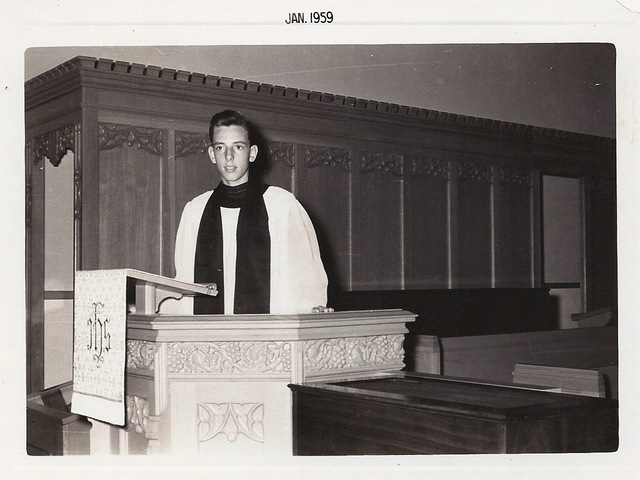
I was an acolyte at the 8 and 11 a.m. services at Holy Comforter Episcopal Church, located on Southwest First Street and 13th Avenue. Between services, Father Garret would take me to Tyler’s Family Restaurant on Flagler Street for a hot Danish pastry.

I attended Miami Senior High School and graduated in June 1960. I believe that the graduating class was more than 1,300 students, which was the largest high school graduating class in the state of Florida at that time. My sister attended Citrus Grove Junior High School and then Miami Senior High School, graduating in June 1962.

Miami High was a wonderful experience back then. The school’s architecture allowed for the Miami breezes and the noise from the planes passing overhead to flow into the classroom.

The auditorium was the home of high-energy pep rallies for games against rivals Jackson, Coral Gables and Edison high schools. The Orange Bowl football stadium hosted more than 40,000 students and family members for the annual Thanksgiving evening football game between Miami High and Edison.

In the summer of 1957, I applied for my first job, at the Dade County School textbook distribution center and warehouse on Southwest 22nd Avenue and Fourth Street. This is where I spent my summer days during my high school years. I also worked in the evenings at the Coral Gables Country Club.

Living and growing up in Miami during the late 1950s and early 1960s was full of wonder. In the winter, we’d wait for the big black vultures’ annual arrival to roost at the Dade County Courthouse from their summer home in Ohio. That was a sign that the Burdines department store Christmas carnival was going to be set up on the roof of the downtown store soon.

On Saturday evenings, we’d often eat dinner at the Shrimp Place on Northwest Seventh Avenue. We’d stand outside hoping to be able to see the Russian Sputnik in the evening sky. I remember the excitement felt when our first space shot was successful. Even more exciting was when our first astronaut in space, Alan Shepard, lifted off from Cape Canaveral. That was an era of great American pride.

The later 1960s and 1970s had their share of history in Miami. There were political conventions held in Miami Beach that sparked civil-rights and anti-war demonstrations. Miami faced many civil-rights demonstrations during that time period, which greatly changed our community, as did the later arrival of the refugees from the Mariel boat lift.

Shortly after the assassination of President John F. Kennedy, I enlisted in the United Sates Army. While in the First Infantry Division at Fort Riley, Kansas, I volunteered as part of the division’s advance to Vietnam.

When I returned home, I became an internal auditor at the First National Bank of Miami. Later, Southeast Banking Corporation was incorporated and I was asked to transfer and become one of the first employees of Southeast.

My passion for banking began. In 1969, I attended Miami-Dade Junior College, and then transferred to Florida Atlantic University, graduating with a degree in accounting in March 1972. I returned to work at Southeast Banking Corporation in 1974, and it was there I spent the last 20-plus years. I retired in 2013 as president of Mercy Credit Union, located in Mercy Hospital.

My wife Linda Blondet Fondas Lanteigne graduated from Immaculata-La Salle High School in the 1960s. She knew as a child that she wanted to be a teacher. Linda graduated from the University of Miami with her degree in education. Her first marriage took her to the Bahamas where she taught for 15 years.

When she returned to Miami, Linda began teaching first grade at St. Brendan’s, then Blue Lakes, Coral Reef and Kenwood elementary schools. For the last seven years, Linda has been a first-grade teacher at Pinecrest Elementary School.

For the past 18 years, we have lived in our High Pines 1952-vintage home. The first several years, we spent long hours remodeling to ensure we could retire in our home. We were always careful to maintain the integrity of the original house. We now spend most weekends taking care of our tropical garden. Lots of time is spent with Pee-Wee and Chi-Chi, our special Quaker parrots, and Buddy, our faithful Maltese dog.

Miami has gone through major growth and dramatic changes. There is still no place better to see the blue sky and feel the warm, gentle winds. When asked where we are from, with pride we say Miami. Miami is an unbelievable place to call home.

My mother hanging on to the top of a telephone pole is one of my earliest memories of South Florida. It lingers in my mind some sixty years later. Soon after we moved here from up north, a hurricane blew through. My father was away on business, so it was just my mother, my two younger sisters and me.

We were lucky to have long-time Florida residents as neighbors, so we did whatever they told us to do to prepare. We made it through the storm with little damage, but, as usual, we lost power, and telephone. The power came back on in a day or two, but the telephone didn’t.

Over the next week, everyone else on our street got their telephone service back, but ours was still out. Using a neighbor’s phone, we’d call every day, only to be told to be patient. Finally, after about ten days, I watched with amazement as my short, slim mother (I was only eleven, but already taller) shinnied up the telephone pole. Wrapping one arm around the pole in a kind of “death hug,” she used her free hand to reconnect the wires into the main line.

From her perch she sent me back into the house to make sure the telephone worked before she came back to earth. One try and she managed to get it connected. No one from the telephone company ever came.

That definitely “low-tech” repair job was accomplished many years before women would be seen wearing hard hats and working on telephone lines. My mother’s climb provided a telephone that still worked when she moved out of the house thirty years and many hurricanes later.

I grew up in Miami Shores beginning in the mid-1940s, a beautiful place to live where you can still view Biscayne Bay today, as you could then. I went to Miami Shores Elementary School and have fond memories of the teachers and my friends, some lifelong friends. I remember our teachers who were special, such as my first-grade teacher, Mrs. Gonzales, and the Easter Parade for our class. My fourth-grade teacher, Mrs. Dees, played classical music for us during rest time after lunch. We sometimes drew pictures to interpret the music.

I took ballet, tap, and toe dance lessons in a home studio where many young people took lessons. We had our dance recitals on the stage of the Shores Theater. We went to the movies there every Saturday morning.

I learned to swim at the Miami Shores Country Club. There was an Olympic-size pool with a high-dive and low-dive boards. It took great courage just to jump off the high dive! Miami Shores did have one real Olympic swimmer, Shirley Stobs. Her swimming specialty was the butterfly stroke. The pool has since been removed to expand parking and a water park has been built on the north side of the main clubhouse.

It wasn’t necessary to swim when I had a water adventure around the third or fourth grade. My friend had a grandmother who lived in a house on Biscayne Bay, just south of Miami Shores. They had a small boat dock. Toni and I tried a little fishing off the dock. After a while, I got a nibble on my line that kept getting stronger and stronger. I pulled and wound and finally landed the fish on the dock. It was a baby sand shark! It was thrown back into the water.

Brockway Memorial Library opened in Miami Shores in 1949, made possible through funds donated by industrialist George A. Brockway. I often felt like I had read my way through all the books in the children’s section and can remember checking out stacks of books during the summer months. A couple of years ago the library requested donations of Miami Shores historical items so I donated my Miami Shores Troop 39 Girl Scout badge sash with earned badges. Troop 39 members started with the Brownies in the first grade, continuing with the Girl Scouts into junior high school. In scouting our troop visited places in Miami such as Greynolds Park, Camp Mahachee, Parrot Jungle and Matheson Hammock. Our last farewell to Troop 39 was a weekend hotel stay on Miami Beach.

We had our meetings after school at the Miami Shores Community Church, the longest established church in the community and near the school. Many of us rode our bicycles to and from school. I rode my bicycle to school starting in the first grade. Miami Shores Elementary was a little over a mile from my house. I continued to ride my bicycle to Horace Mann Junior High School in the first year or two.

In 1948 I participated in a pet and doll show at the Miami Shores Community House. I didn’t win any prizes but someone took a photo that was published in a newspaper. It was spotted by Mrs. Carnegie Cline who later taught me modeling and drama. She was also involved with the Miami Daily News Youth Roundup of Dade County. I got to know the youth editor of the paper and was involved with many of the Roundup activities. I had the opportunity to model in fashion shows at the Burdine’s Tea Room and The Surf Club, ride floats in the Orange Bowl parades and meet famous people like Olympic champion Pete Desjardins at the Deauville, movie star Preston Foster and some of “the little people” who starred in The Wizard of Oz.

The Cuban revolution was taking place while I was at Miami Edison Senior High School. I remember hearing the news announcement on the radio that “Batista has left the island of Cuba.”

After graduating, I went off to college, and then moved to Atlanta, Georgia, but made visits home for brief periods. In recent years I’ve been to Miami for extended periods. When I referred to the Miami News building in downtown Miami, no one knew what I was talking about. It wasn’t until I went to an Art Basel 2012 exhibit in the Freedom Tower that I learned the Miami News building had become the Freedom Tower. Miami-Dade College unveiled the adjacent Pedro Pan sculpture to mark the 50th anniversary of Operation Peter Pan, which resulted in over 14,000 unaccompanied children sent from Cuba to the United States.

I’ve enjoyed subsequent visits to the tower for special exhibits. I learned that a year after this Spanish renaissance revival tower was built it was damaged during Miami’s1926 killer hurricane and was rebuilt twice. It was donated to Miami Dade College in 2005 by a local developer. It’s a tribute that Miami has saved this U.S. National Historic Landmark that stands tall as a reflection of the city’s history while new development grows around it by leaps and bounds.

Suddenly there is fire in the treetops along the turnpike. The sidewalk is carpeted with orange petals and the Poinciana preens itself above the jacaranda’s demure lavender feathers and the frangipani’s pink and yellow pastels. The calendar doesn’t tell us it is time for our yearly Poinciana Walk, but the world does. While we go for the sake of the trees, the homes in the Gables that they guard and grace have become characters in a never-ending story.

On one of our earliest peeking-through-the-Rangoon Creeper days in the French Village, we stumbled onto the storybook house at the southwest end of the block of chateaus. Double garage doors and peeling white paint abutted the perfectly restored wall and manicured yard we had been admiring. A diminutive arch with a black iron gate opened out diagonally to the corner of the street from a postage-stamp herb garden. Above and below, casement windows hinged inward, screens offering only the filmiest filter. The wavy glass panels of the butler’s pantry cabinets were clearly discernible from where we stood outside. Farther down the walk, a vase of fresh flowers bloomed in the window, and next to it a gray top-knotted head was turned toward the flickering screen across the room. We were mystified and mesmerized by the house, a vestige of the neighborhood’s 1920s legacy. We ached to get inside.

Then, one afternoon, we rounded the corner to hear the sounds of pans scraping through the kitchen’s casement window. Pungent garlic and onions sizzled on an unseen stove top, and plates clattered on an imagined table. Two shadowy figures floated in the lampless kitchen, one seated and one busy in the evening light lingering along the freckled street, while a gray head watched at her post, as always, next to the flowers in the living room window.

Months later, as we paced back and forth along the length of the house, by now the object of fantasy and imagination, two wiry little ladies appeared in the open door and looked out at their stalkers. The tiniest one, with delicate bird fingers, pushed open the wrought iron, screen-covered door and smiled at us. Her face was encircled with a white cottony halo and the parchment skin on her face creased into smile lines from her eyes to her chin. The woman behind her seemed younger, more serious and stern, or just responsible and justifiably wary. “Hello ladies,” The snowy one spoke. “Are you enjoying your walk?”

We were nearly speechless. For all our wishing, we weren’t prepared for this sprite to actually speak to us.

“Oh, yes. This is our favorite street. Yours is our favorite house.”

“We think it is pretty special, this house. That’s why we have stayed here all these years. Of course, the Realtors won’t give us any peace. They come by here nearly every day.”

“You aren’t going to sell it are you?” Our simultaneous question belied fears of contractors and realtors circling like vultures.

A little giggle slipped into the pixie’s voice. “Would you sell paradise?”

The taller woman reached out for the handle of the iron door and began drawing it toward her and closing the little doll lady inside. “Enjoy your walk.” She gave a tiny wave, her open palm nearly as papery as her face. A walk in paradise.

Today, perhaps because we had already walked on many streets, we drove to Cotorro Avenue, turning in from the northern end of the French Village block. Maybe if we had been on foot, the awareness would have come gradually. Instead, we were shocked to find the Garlic Sisters’ house standing naked on the sidewalk. The grizzled hedge, ripped from the ground, exposed ancient pipes and spigots that had quenched its thirst for perhaps as many years as we were old. The Florida honeysuckle vine that circled and wound and draped luxuriously over the garden wall was now twisted dry and gnarled in the side yard under piles of debris, boards and nails and chunks of plaster.

Tears blurred our vision, but we scarcely hesitated to duck through the arch and tiptoe gingerly around the rubble that had once been a garden, to French doors, standing open in the back. We stepped through onto original tile floors, terra cotta cool, and looked up to a black, wrought iron chandelier dangling above. Straight ahead, the wood paneled front door, directed a turn into the living room where a TV antenna wire dangled onto the floor.

Off the front hall, a door stood open to the kitchen where black and white tiles checkered the floor. In the empty butler’s pantry, wooden drain boards, grooved and stained, sloped down to an old porcelain sink with iron faucet and knobs still intact. On the drain board stood a vase of flowers, once fresh cut carnations, daisies, and spider pompoms, now drooping with curled and wilted petals. Not the stuff of potpourri, but of memories.

A simple ribbon circled the vase, its color indistinguishable. A florist card stuck out from a stiff plastic stem. The envelope was addressed to Virginia O’Dowd, 1032 Cotorro Avenue, Coral Gables, Florida. Dreading to see what the message would say, fearing a get well wish or sincerest sympathy, my hands shook as I turned over the card. The typed letters read: Happy Birthday, with Love.

Outside, a child’s riding toy rumbled by, a stroller wheel complained and young women’s voices drifted up through the pantry casement. Neighbors. Maybe they would think we had no right to be there, to find the flowers, to sniff for garlic, to walk over dining room tiles the sisters’ feet had crossed and re-crossed until they wore a pattern in the stone, to listen for the echo of a little birdlike chirp. “Enjoy.” So we left the French door just as we had found it, passed through the garden wall, and whispered an apology to Virginia for not somehow leaving her flowers in the open window.

I was born at St. Francis Hospital in March 1947.

My parents both came to Miami Beach for work, my mother in 1936 and my father in 1939. They met while working together at a deli, owned by my great aunt and uncle (Mary and Dave Alper).

We lived on 15th Street, near Washington Avenue and the old Miss Ehrman’s dance studio. We were one of the first families to move to the very new Morton Towers. A lot of my family moved to Miami Beach soon afterward.

My grandmother Fannie Malschick, already retired, lived in one of those apartment/hotels on South Beach that now host the rich and famous. She played cards with her cronies, did group exercises on 15th Street and safely walked everywhere.

My uncle, Gilbert Malschick, worked at the Eden Roc as a bartender from the 1950s to the 1970s. My cousin, Allen Malschick, was a well-known Miami Beach photographer who took pictures of many celebrities who entertained at the hotels on Collins Avenue.

My father eventually opened his own deli with partner Phil Seldin (Raphil’s Deli on 41st Street). His customers included the famous and infamous. Before that, my dad owned The Little Inn restaurant in Miami, a popular hangout for soldiers and friends during World War II.

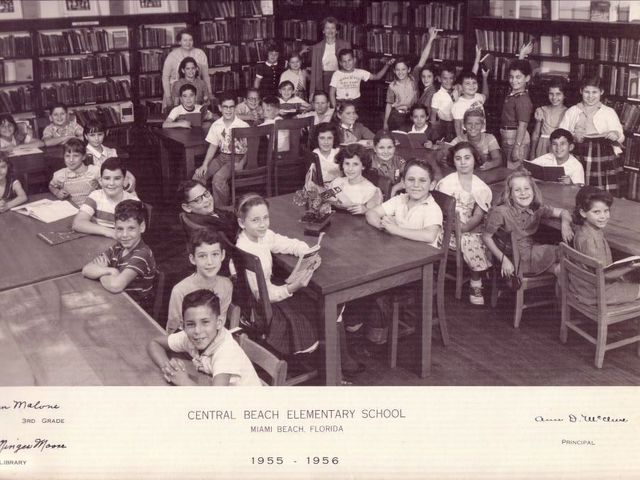
I attended Flamingo Park preschool, Central Beach Elementary, Fisher Jr. High and Miami Beach High School. Many of my friendships, born during those years, have stood the test of time and I am in touch and close to many of those “kids” today.

In 1960, the first wave of Cubans came to Miami Beach. All of a sudden a new culture was introduced, and we had tons of new friends. We spent the sweet years, as I now refer to my childhood, at Saturday afternoon matinees, shopping on Lincoln Road, and eating at Liggett’s or Wolfie’s. Friday night was dedicated to dancing at the 10th Street auditorium, and on Sunday, many beach parties were held at 14th Street and Ocean.

As we began to drive farther from the Beach, we hung at Fun Fair and the bowling alley across the street, Corky’s and Marcella’s Italian Restaurant, known for the amazing garlic rolls. We ventured even farther to the Coconut Grove coffee houses and playhouse.

I left Miami Beach after high school graduation in 1965, but my heart remains in the memories of those wonderful years. Our lives are richer for the experience and we have grown both up and together these many years later.

The year was 1942. My father, Don Terry, was in the Navy stationed at the Everglades Hotel in downtown Miami. During World War II, the hotel was used as a Navy barracks. He swept every floor of that building.

One Sunday evening, he went to Central Baptist Church where he met my mother, Margaret. Instead of marrying right away, he left and served in the South Pacific theater for the remainder of the war.

My parents wrote letters back and forth and each letter was numbered. Not ONE letter was lost over a period of three years. Today I enjoy reading parts of those letters. One day, I hope to write a book about their experience.

In March 1945, they were married and they honeymooned at the Leslie Hotel on South Beach. I was born a year later.

After his honorable discharge from the Navy, Dad returned to Miami and worked awhile at Eastcoast Fisheries along the Miami River. Having taught school in Texas, he applied to teach here in Miami. He taught speech, drama and band at Hialeah Jr. High., Robert E. Lee Junior and West Miami Junior until his retirement in 1975. Sen. Bob Graham is one of his former students. He passed away right after Hurricane Andrew in 1992.

Mother, a native Miamian, was a graduate of Miami Senior High, class of 1935. She worked at the downtown Burdines store and then at Florida Glass & Mirror. She also worked several years as registrar at Kinloch Park Junior High and retired from the payroll department of transportation to enjoy watching her only grandchild.

Also a native Miamian, I attended Miami Senior High, (class of 1964), then went on to Miami-Dade Junior College, Barry College and University of Miami. I taught in Dade County Public Schools for 32 years — at Kinloch Park Elementary, Gloria Floyd and South Miami Heights Elementary, from which I retired from in 2001.

I now co-own and manage Bijoux Dance Center, 4150 SW 70th Ct., where I teach ballroom dancing. I have so many memories of Miami over the past 60-plus years and how it has changed. The skyline, demographics and spoken languages now reflect the cosmopolitan nature of my hometown.

The Orange Bowl is gone, the parade, the old zoo on Key Biscayne, the amusement rides on the roof of Burdines at Christmas, pony rides on Northwest 36th Street, the Coliseum in Coral Gables, drive-in movies, IHOP on U.S. 1, the amusement rides on Northwest 79th Street and 27th Avenue.

But the Venetian Pool and Biltmore Hotel are still are part of the scenery.

“My kind of town, Miami is.”

The homeless man knocked on my window while I was stopped at a red light on North Federal Highway, just east of the Miami Design District. He made the motion of hand-to-mouth, the one that says, “Feed me. I’m hungry.”

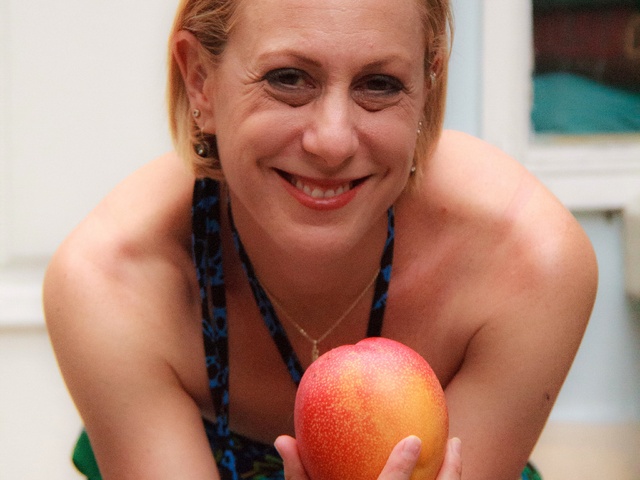
It just so happened that it was June, and in the middle of a heavy mango season, when eight of our 14 trees were throwing fruit at me as if we were playing a long, continuous and particularly juicy game of dodge ball. Because I never go anywhere without them, I had several Publix bags filled with fruit on the seat beside me. I rolled down the window and handed him one, bulging with the aromatic globes.

He was about to thank me when his expression turned suspicious. The overwhelming perfume of dozens of mangoes shot out of my car window along with the air conditioning. “Wait,” he said, “what are these?” He looked inside and his nose wrinkled. Then he handed the bag back to me. “No thanks. I don’t like mangoes.”

The light turned green at that moment and, with Miami’s notoriously impatient drivers honking at me, I didn’t have the opportunity — or, at this point, the charity — to explain that while he might be one of the few people in South Florida to disdain the world’s favorite fruit, perhaps he could trade them on the street for something else. I just shook my head and drove off.

This anecdote popped into my head when I woke up one recent morning and discovered a criminal act had occurred on my property the night before. Someone had stolen all the guavas from my tree, fruit that were still hard knobs of verdant acidity, but would any day begin transforming themselves into softer, sweeter and kinder versions. My dog walker, Jorge, and I were keeping a close watch — there were about 75, maybe more — waiting for that first tinge of yellow and hint of distinct aroma, caught somewhere between cat pee and tropical mold (but closer to cat pee).

Our vigil was for naught, because my tree has apparently been marked for a while now, and every harvest I’ve almost had for the past two years has magically disappeared. Worse, this time, the thieves didn’t just pick the fruit. They ripped off entire branches, the main arteries where the guavas had proliferated most, rather than take the time to tug them from what would have been, surely, their unforgiving stems.

Several weeks later, I came home from a weekend away to find that all of my low-hanging, early-ripening avocados had been taken as well.

Posting my losses on social media, I learned in response about the rumored “mamey wars” in the Redland region, where mamey sapote is so treasured that it has to be grown under guard. I heard about a fellow Miami Shores resident’s jackfruit tree, which was robbed of its Dali-esque fruit at 2 a.m. one night (a neighbor on a night shift caught the perpetrator in the act). I was given lots of recommendations about planting away from front yards and fences, and suggestions on how to espalier young trees so that they’re less of a target for the drive-by, rip-off artists who sell ill-gotten nighttime gains to fruit cart purveyors. It’s all good reasoning and sound advice, except that it comes far too late.

On the other hand, mango season is so prolific I wouldn’t notice if 500 pieces of fruit took a walk one day. I’d actually probably be grateful. But that rarely happens. Even the mango trees on the nearby properties that have gone into foreclosure remain untouched, the fruit decaying into the ground.

Indeed, as much as mangoes can foster love and lust during the first of the season, by the middle or end no chef, neighbor or homeless person within miles wants to catch a glimpse of me. I was even denied entrance to the Sunday poolside brunch at Hyde Beach in July this past year, where I was bringing mangoes for the kitchen, because the security staff considered them on par with groceries. As in, per the Terminator dude at the velvet rope (yes, for brunch, an element I’m still trying to figure out): “You can’t come in here with a bag of food.”

“No, you don’t understand,” I said. “I have a reservation for brunch, and I brought these mangoes for the kitchen.”

“No entrance with a bag of food.”

“This isn’t ‘a bag of food.’ These are beautiful, tree-ripe mangoes. From my trees. Picked by me. For the chef.”

No one asked for my reservation name, called for a manager or even bothered to turn around to talk to me directly, although it was obvious that they did consider me a middle-aged idiot. Very slowly, the same man said, “Ma’am, we don’t allow outside food to be brought in.”

I was, by now, angry and exasperated, not to mention hot, holding twenty pounds of mangoes in July and arguing at a velvet rope to a venue where I had been invited by the public relations firm for brunch. “Really, it’s not like these are potato chips. I hand-picked these for the chef. It’s mango season. Backyard growers like me do this. Trust me, it’s a Miami thing.”

“We don’t have a chef.”

Check and mate. I left the premises because, well, who would want to eat brunch there anyway?

But along with the lesson of not accepting brunch invitations at what is essentially a club, in Miami, I have learned, some kinds of fruit are valuable currency. (I wonder, had I been holding guava, would Hyde Beach security have parted the Red Sea for me?) Yet those fruit that are plentiful and common, no matter how well-loved, are like the old Italian lira: inflated, worthless. And at the height of season, you can’t even give them away, not even to those who have nothing at all. Including, it seems, a chef.

In the 1920s, the film industry was beginning to invest in “sound” for movies. Impressive theaters were built and audiences came rushing to escape the reality of life. Movies and vaudeville drew thousands of people to these spacious, elegant buildings known as movie palaces, and Miami was no exception.

The Olympia Theater was one of them and she was the heartbeat of downtown Miami. Her lights were brilliant and kept their sparkle through the economic and natural crises of the times from the energy left by the many performers and stars who graced her stage.

Then the glamour and excitement vanished. The dazzle of the movies and the up-tempo of the vaudeville acts no longer thrilled the crowd. The stock market crashed in 1929; the ‘30s saw a hurricane disrupt the lives of Miami audiences. The Olympia’s seats were empty; the audience was gone. The halls were dark except for the ever-present traditional, single bulb, caged in steel standing near center stage and left to burn eternally. This light–the soul of the theater– never goes dark.
It is called the “ghost light.” There is a superstition connected with it that says a spirit floats through and haunts every theater, even Miami’s Olympia Theater. I know it exists.

With all its problems, the Olympia was destined to become a parking garage until millionaire businessman Maurice Gusman bought the theater, saved it from the demolition ball, and it became Maurice Gusman Theater, Center for the Performing Arts.

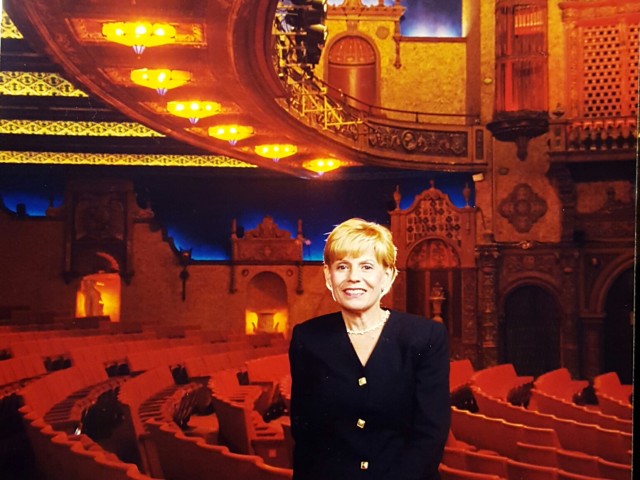
The theater’s rebirth began and the lights returned brighter and stronger than ever before. I came to Gusman as a Florida International University intern in the 1980s. Upon graduation, I was hired as an assistant to the managing director. I began my dream job on December 26, 1984. Downtown was quiet but I was intoxicated with excitement. This same feeling led me through the next 20 years of my life in a job I loved. Yes, it was filled with long hours but I gained priceless experiences, as well. I also discovered the value for details and contractual requirements unique to major stars. I reveled in the personal moments with these major stars, which I was privileged to see.

I like to call this “my Renaissance period” for it was that for both my beloved theater and me. It formed a lifetime of love for me and a rebirth for the theater as Miami audiences begged for a stage for world performers.

Edward Villella gave birth to the Miami City Ballet, forming a ballet company with local talent and New York dancers with a full week of performances; Michael Tilson Thomas auditioned musicians from all over the world to come to Miami to be a member of a teaching orchestra, the New World Symphony; and my boss created programs for the season of traditional jazz performers, such as Marian McPartland, Dave Brubeck, Ramsey Lewis and Carmen McRae to note a few. These programs brought music lovers to downtown to the corner of Flagler Street and 2nd Avenue.

I loved going to downtown Miami even though everyone told me how frightening it was. Strangely, I never felt threatened by the street people. I felt sadness for them but never fear. The dark streets and empty store-fronts did not intimidate me, nor did the dark of the theater. The “ghost light” was always on so I could stand at the top of the mezzanine balcony and look all over the theater as the light created unique shadows throughout this exquisite atmospheric theater designed by John Eberson in l925. The single stage light cast dramatic shadows on the proscenium arch making the sculptured faces and the carved stone gargoyles grotesque and macabre.

Remember I mentioned the “spirit that floats through and haunts” every theater. The reason I know it exists is because I did see it. Laugh if you will but I did. Here is what happened:

My boss loved to drop last minute projects with immediate deadlines on my desk to see if I could manage it. It was Friday at 4 P.M. He picked up his briefcase and as he left the office rushing down the back staircase of the theater foyer, he said “don’t forget, you have to feed the dance company on Saturday night two hours before show time. See ya.”

What was that? I yelled as I came out of my concentration over a contract and ran to the top of the stairway only to see his 6-foot tall body slip out into the backstage alley. As the door slammed shut, and I started back into my office I thought I heard something or someone but I knew I was alone in the theater. I stopped at the doorway, listening for a familiar sound but there was only the silence of the theater. Then a swath of light floated through the chandeliered balcony foyer making its way up the stairs to the mezzanine. I was not frightened. I was inquisitive. I believe buildings and houses have “energy.” I looked for reflections from 2nd Avenue traffic but there were none. I believe this kind of energy manifests itself in some way, especially if you are sensitive to its existence. I saw the spirit that floats through our theater. I never saw it again but what a beginning.

I love the theater, I love the ghost, I love the audiences and I loved my life at Gusman Center for the Performing Arts, now The Olympia Theater again.

I have called Miami home for 82 years.

Sometimes I feel like “The Last of the Mohicans” because there are so few native born left.

I was born in 1927 at Victoria Hospital. My husband Pete Williams also was born that same year, but we grew up in different neighborhoods so never met until high school days. We both had parents who came to Miami in the early 1900s — his from Tennessee and mine from Illinois and Georgia.

After dating all through our Miami High days, he went to the U.S. Naval Academy and I went to Florida State University in 1945. We both graduated in 1949 and then married in 1950 — after I taught school for a year and he served in the Navy. We’ve been married 59 years and have three wonderful daughters. God has blessed our family!

I have always wanted to honor my grandfather, James E. Crammond, and grandmother Lula Harry Crammond, as they were pioneers who came to Miami in 1912. They were both born in Gibson City, Ill.

As a boy my grandfather helped his father in the grocery business and learned the art of proper display of foods.

When he came to Miami seeking a warmer climate for his family and since the grocery business was all he knew, he established his first store on Avenue “L” or Seventh Avenue (as it is now known) and 10th Street. Within four years he had a chain of six stores.

Then he realized that he could better utilize his talents with a consolidated store so the White House Grocery was born.

It was one of the first, if not the first, supermarkets downtown.

He was the first to introduce the “cash and carry” system in Miami — and possibly Florida. He said he had never seen the system anywhere but with the coming of the war, employees became scarce and expenses ran high so he had to diminish both. The plan was a success!

The White House Grocery was located on North Miami Avenue between Fourth and Fifth Streets. His only son, my father Emert Crammond, worked for him and he loved to take photos from the store’s rooftop. He was so excited to see Miami growing, the first causeway being built to the beach and the Miami News Tower growing tall on the boulevard.

Then the 1926 hurricane came along and ruined everything, including my father’s pharmacy, which he had just opened. He and my mother, Sarah Jones Crammond, married in 1925. Then the 1929 Depression hit. Everyone was hit hard.

My grandparents decided to tear down their home on Northwest Seventh Street near 12th Avenue and build the 12th Avenue Curb market, their last store. Sadly my grandfather died of the flu in 1937 but the Curb Market survived for about 10 more years.

I am proud of my loving grandparents and parents. My grandmother died in 1949, my father in 1977, and my mother in 2001.

We must never forget the people who came before us and made Miami what it is today.

Translate »