fbpx Skip to content
Named Best Museum 2022 by Miami New Times

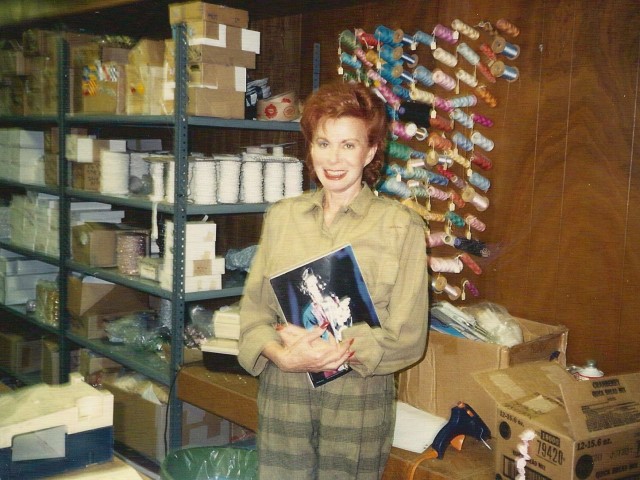
Every mother who wanted to buy her daughter a stunning dress will remember the name “Dorissa of Miami.”

This is the story of our mother, Doree Fromberg, a girl who won a scholarship to attend the New York Fashion Institute of Technology (FIT) after graduating high school, began designing and sewing dresses in her home in Miami and developed the business into an international company.

Starting with $5 and a talent, Doree became an icon in the girls dress manufacturing business. Her dresses were eventually sold all over the world including top retailers such as Bloomingdales, Macy’s, Lord and Taylor and Saks Fifth Ave.

After Doree graduated from “FIT” she did an internship at a manufacturer of childrensware. She then got married and moved from NY to Miami, and had two sons. Her mother, an energetic and affable woman, recognized Doree’s talents and took her samples on the road around the state of Florida to try and sell the dresses to specialty children’s shops.

Orders started to pour in, requiring more home sewers. She was very fortunate to find Cuban women — who had fled the island and resettled in Miami in the 1960s — and who were outstanding seamstresses. They were able to sew the dresses in their homes.

Within a short time, it became necessary to buy a small factory to handle the increased business. Without any formal business training, and no capital or financial backing, she somehow was able to build the business. She modernized the equipment, hired and trained the staff and managed the business. She also designed the dresses for all five seasons; buying the fabric and accessories and creating a sales team.

At the time, the official name of the business was “Dorissa Of Miami.” Her girl’s dresses became recognized all over the United States. The lines catered to girls party wear, communion and baptism dresses produced in sizes from infants to preteens. An additional label of “Nicole” was introduced and took off immediately.

The business kept expanding and the increased demand required a larger building. A large auto showroom building was purchased in 1972 and converted into a factory. The address was 2751 North Miami Ave. in Wynwood It was a two-story building.

On the first floor were offices, a reception area and spaces for sewing machine operators. There they pressed, ticketed and prepared garments for shipping. On the second floor was the cutting department and areas designated for stocking fabric and trim. There were also additional sewing machines, the purchasing department, designing rooms, pattern making areas and Doree’s office.

The company opened a showroom in the manufacturing center of New York City where a major part of sales volume was generated. In addition, sales were generated for the “Dorissa Collection” by a staff of independent sales people with their own showrooms in all major United States cities.

The company produced a Back-to-school, Fall, Holiday, Spring and Summer collection.

As the business continued to thrive, Doree needed to find other sources of production. This was available in factories in Honduras, Mexico and Guatemala. The cut goods were air-shipped to those factories, which had qualified seamstresses and were able to finish the goods quickly.

A girls’ sportswear line was added and received immediate national acclaim. After just one year of production, “Dorissa Sportswear” won the national award in 1989 as “the best sportswear line in the USA.”

A retail outlet store was opened to the public 1987 at NW Fifth Avenue and 29th Street. It was called “Dorissa Children’s World, The Place to Shop for Children.” In addition to the Dorissa, Nicole and Dorissa Sport lines; the business carried out other well-known children’s lines, including boys wear. It became a very popular outlet-shopping place for local families. On “Sale Day,” a twice a year event, lines of customers would form around the corner waiting for the store to open.

The Dorissa company experienced a number of very outstanding events. Doree appeared on The Merv Griffin Show representing the girls dress-manufacturing companies of America. Other well-known designers appeared with her on the same show, i.e. Aldolfo and Oscar De La Renta. One of the covers of the New York Times Magazine section featured two girls together wearing Dorissa dresses.

There was a strong camaraderie that prevailed in the Dorissa factory. The employees became family and many continued to work at Dorissa for years. They were treated well and responded with loyalty. There was a lovely outside lunchroom where many a birthday occasion was celebrated with loud cheering and singing.

Between 2004-2006, Doree Fromberg decided it was time for her to “stop and smell the roses.” Her sons were successful in the medical field. Her husband of seven years — a prominent attorney and former Mayor of Miami Beach — wanted to travel and both of them desired to have more time to pursue some other interests.

Doree decided to sell the Dorissa label to another girls dress company. In that way the company name and label was preserved and Doree was fully relieved of all responsibilities. She did, though, consult on occasion.

The people who purchased the factory building requested that the name “Dorissa” appearing in large letters across the front of the building be left on the building. They felt it had become a landmark.

Their request was granted. It now remains the nostalgic landmark of a remarkable children’s dress manufacturing company that started out many years ago in Miami with $5 and became an internationally recognized company. This all due to the help of the influx of talented Cuban seamstresses and garment manufacturing workers.

Doree is now retired from manufacturing and has her own art studio. She’s still is able to use her creative ability in painting and making decorative collages on many themes and for special occasions. She and her husband Malcolm travel the world. They also derive pleasure from supporting many local charities.
My parents, John and Muriel Greist, my sister, Judith, and I were all born in New Haven, Connecticut. The Greist name was pretty well-known in the area because the Greist Manufacturing Company was a major producer of sewing-machine attachments.

I don’t remember much about New Haven because I was only 3 when our family moved to Miami in 1948, coming via train, except for my father, who drove from Connecticut.

My dad had a chance to pursue some new banking ventures in South Florida that were very promising. He eventually ended up at the Pan American Bank of Miami on Southeast First Street in downtown Miami. The bank was founded in the mid-1940s by P.J. Serralles, a Puerto Rican sugar planter. The story is that he decided to open a bank due to his difficulty cashing a check in Miami because almost no one spoke Spanish.

One of my earliest memories of Miami was Hurricane King in October 1950. We were living in our new house on Irvington Avenue in Coconut Grove, and my dad was in the hospital when the hurricane hit. I remember kerosene lanterns guiding us through the power outage during the storm, which was one of the strongest to strike the Miami area since the 1926 killer hurricane.

Other early memories of Miami included Christmas holiday fun at the Burdines in downtown Miami, with a merry-go-round and a Ferris wheel on the fifth-floor level bridge connecting the two sections of Burdines over South Miami Avenue; the annual New Year’s Eve Orange Bowl Parade, including some great views from the Walgreens’ second-floor cafeteria on Flagler Street; and the old Miami Baseball Stadium, where I got to sit in the Brooklyn Dodgers dugout in March 1956, the year after they won their first World Series.

In the summer of 1955, I had attended a Dodgertown camp in Vero Beach, where my counselor was Peter O’Malley, son of Dodger President Walter O’Malley. The following year, I was invited to attend a Dodger spring-training game at Miami Stadium. The Dodgers trained there before the Baltimore Orioles moved in a few years later. I got to meet many of the Dodger greats: Jackie Robinson, Pee Wee Reese, Gil Hodges and Duke Snider, my favorite player. What a thrill for a young kid 10 years old.

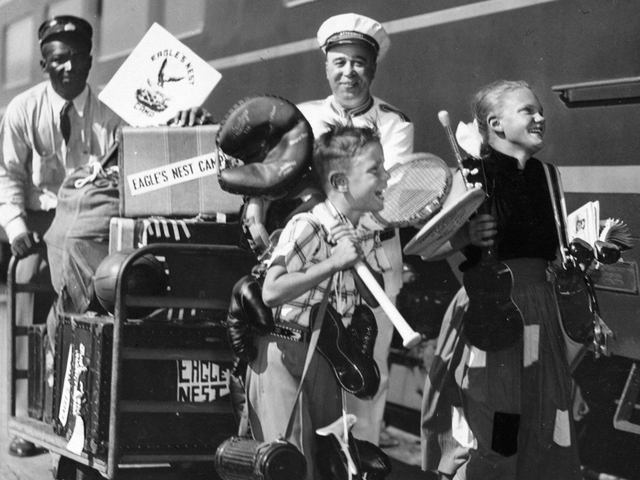
In addition to the summer I spent at Dodgertown, my sister and I attended summer camp a few times in North Carolina. One of our trips was “immortalized” on the cover of The Miami Herald’s old “Fun in Florida” Sunday magazine on May 30, 1954, as we prepared to board the train for our journey to Eagle’s Nest Camp in Piscah Forest, N.C. The cover photo was taken by Herald photographer John Walther, and the inside cover story was written by “Fun in Florida” magazine editor Betty Garnet. (Full disclosure here: I think the photo was “posed” because we didn’t actually go to summer camp until sometime in June.”

I attended first through sixth grade at Coconut Grove Elementary School. Our principal was Oliver Hoover, a native-born Miamian and longtime educator. An elementary school in The Hammocks is named after him.

During elementary school, some of the “Old Grove” memories included after-school trips for sodas at the Liles Pharmacy and the Florida Pharmacy in the Engle Building and Saturday matinees at the Coconut Grove Theatre (yes, it was a movie theater before it became the Coconut Grove Playhouse).

Another favorite spot in the Grove was the Krest 5&10 next to the school. That 5&10 store sold almost everything one could imagine, and it stayed in business for over 60 years. I also spent a lot of time at Bryan Memorial Methodist Church on Main Highway, from my younger years all the way through college. A minister from that church performed my wedding ceremony.

After spending seventh grade at South Miami Junior High, I attended the newly constructed Palmetto Junior-Senior High School in Pinecrest beginning in eighth grade. My sister was in the first graduating class in 1961, and I graduated two years later in 1963. The school celebrated its 50th anniversary in 2008, and the class of 2011 will be the 50th graduating class from the school. My senior year in 1963, I was newspaper editor, president of the Key Club, chairman of the Dade County Student Traffic Safety Council, and was the school’s Silver Knight nominee in journalism.

Favorite hangouts in high school included the Hot Shoppes at U.S. 1 and Bird Road; Jimmy’s Hurricane at Bird and Douglas Road; the Burger King on U.S. 1 just south of Dadeland; the original Shorty’s; Royal Castle, where we could easily consume a six-pack of Castleburgers along with their birch beer; the Krispy Kreme on SW 8th Street; Suniland Shopping Center; A&W; drive-ins; and Central Stadium on Coral Way, where Palmetto’s home football games were played.

Local area attractions included Bill Haast’s Miami Serpentarium; South Dixie Bowl-O-Mat; Dixie and Tropicaire Drive-Ins; Colonial Palms Golf Course; and, of course, the Parrot Jungle. Before multiplexes, there was the Coral, the Gables, the Miracle and the Riviera theatres. We loved the aromas from the Holsum Bakery in South Miami. Restaurants included The Flame, Grentner’s, Flynn’s Dixie Ribs and the Dixie Belle Inn.

My best friends in high school are my best friends 50 years later, even though they were in the class of ’64. Those friends include Ron Lieberman and Dexter Lehtinen – both still practicing attorneys in Miami – and Fred Luss, a retired Chrysler financial executive. Another member of the class of ’64 was Vicki Campfield. I didn’t know her in high school, but she would eventually become my wife.

The first paycheck I ever received was for a one-day job as a press-box assistant for the 1963 Orange Bowl game won by Alabama over Oklahoma 17-0. The game was attended by President John Kennedy. I was near the locker room under the stadium when the game ended and JFK was leaving. I reached out to shake his hand but was rebuffed by the Secret Service. The president smiled and waved at me. Sadly, just eleven months later, he was gone.

I met my wife, Vicki, in 1967 and married her a year later. Vicki had a wonderful career in pediatric nursing at Miami Children’s Hospital and the state of Florida Children’s Medical Services. After almost a decade with Burger King Corporation and Florida Power & Light, combined with some part-time sports broadcasting on local radio, I spent the remainder of my career with Miami-Dade County. Vicki and I raised two sons, John and Patrick. Both attended Sunset High, Miami-Dade Junior College and Florida International University.

My overall favorite Miami memory was the many years of watching University of Miami football at the Orange Bowl, from the 1950s with my parents to the years with Vicki and my sons in the West End Zone family section, to the last event ever held there. That was a flag-football game in January 2008 between former Miami Dolphins and University of Miami players. The event was extra special because my two grandchildren, Zachary and Taylor, were with me. It was their only time at the Orange Bowl, and it represented the fourth generation of the Greist family to attend an event at the Orange Bowl.

Vicki passed away too prematurely in 1997, but we were blessed to share 30 special years together and many happy experiences in Miami raising our two sons.

My 60-plus years in Miami have been filled with a lot of wonderful memories. In a strange way, I guess you could say I owe all my Miami memories to a Puerto Rican sugar planter who opened a bank in Miami in the 1940s due to his difficulties cashing a check because almost no one spoke Spanish.

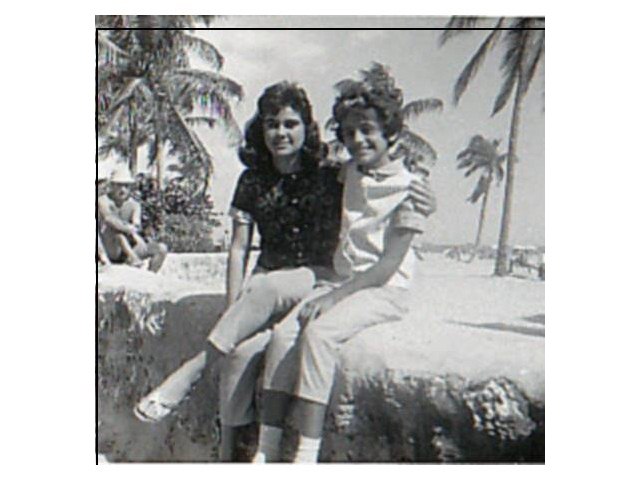
I was born in New York City to Hispanic-American parents. Osvaldo Hernandez, my father, arrived in the United States in the 1940s, served in the U.S. Army and met Maria, my mother, in 1950.

They married and two years after my birth we traveled to Havana, Cuba, where I stayed and was raised by my grandmother, a Canary Islands native. I lived in a middle-class Havana suburb and attended Cambridge School, where I received English and Spanish instruction.

Unexpected changes in Cuba occurred, however, when Fidel Castro took over in January 1959. In 1962, seeing that the situation on the island had worsened, my father requested my departure, through the Canadian embassy.

On Jan. 25, 1963, at age 11, I returned to the United States on the last American Red Cross flight for U.S. citizens. I have never forgotten my unpleasant exit from the Havana airport, where militia men searched me, kept my valuables and called me gusana (a disrespectful term for Americans that means “earthworm”) and gringa before I prepared to board the plane.

I traveled alone, but was warmly received at Miami International Airport by my father, aunt, uncle and cousin, who were residing on Alton Road in Miami Beach.

The city of Miami Beach became my new home. My father and I were the only American citizens who spoke English in my immediate family. My school days happily unfolded at Central Beach Elementary. At Ida Fisher Junior High School, I learned how to swim at Flamingo Park’s pool and practiced tumbling at the school’s gym.

My saddest experience at that time was hearing the announcement, over the loud speaker, that “President Kennedy has been shot!” It was Nov. 22, 1963.

During the 1960s, South Beach consisted mainly of small stores that sold beach wear, surf equipment and souvenirs. When I was 12, I would assist a souvenir store owner by arranging the merchandise and assisting tourists with their purchases – for 25 cents an hour.

After my part-time job, I would join my friends at the Cameo Theater on Washington Avenue and 14th Street for an ice cream and a movie. The 25-cent ticket admitted me to popular films of the time, such as Psycho and The Great Escape.

A half-dollar Kennedy coin was my weekly allowance. When I had saved a dollar, I would embark on a visit to downtown Miami on Saturdays, via public bus. I loved viewing the store window displays of Kress, McCrory’s, Woolworth’s, Sears, Burdines, Baker’s, Lerner’s and Jackson Byron’s. Shopping trips with my father to Baker’s always led to a new pair of shoes with a matching handbag.

We also munched on sauerkraut hot dogs at the Sloppy Joe’s shop, next to the Tower Theater. At Jackson Byron’s, I bought my first 45 rpm record for 49 cents and began to collect music memorabilia. An ultimate treat was to watch a movie at any of the downtown theaters: the Olympia Theater, the Tower Theater and the Paramount Theater.

My most cherished Beatles experience occurred at the Paramount Theater where, with more than 100 other teenage girls, I eagerly watched the Beatles’ first feature-length motion picture, A Hard Day’s Night. I still have the admission ticket from this event.

The Beatles’ revolution in the United States had a profound influence on my musical preferences. On Feb. 13, 1964, I remember hearing on my pink transistor radio that the Beatles had landed at Miami International Airport to tape their second appearance on The Ed Sullivan Show.

A local Miami radio station, 560 WQAM, and its announcer, Rick Shaw, heavily promoted the Beatles’ arrival. I purchased a promotional pamphlet of The Beatles from WQAM for one dollar. Many students did not attend school on that day, hoping to catch a glimpse of them.
I fondly remember twisting with other teenagers to the sounds of Chubby Checker, The Beach Boys and The Beatles at the Miami Beach Recreational Center on Tuesday nights.

The Miami Beach High School Ensemble and the Acapella Choir fulfilled my interest in music. Rehearsing for school performances and singing at the Fontainebleau Hotel were standard practice for all chorus members. My overnight stays at the San Souci Hotel – to prepare for district music competitions – were exhilarating.

In June 1969, the Jackie Gleason Theater was the host of my graduation ceremony. Throughout my teens, I had visited the theater, attending rock music concerts by Three Dog Night, The Who, Chicago and Rare Earth.

I used to ride a tram from Alton Road to Washington Avenue, through the Lincoln Road Mall. As we traveled aboard the tram, we eyed the variety of luxury stores such as Lillie Rubin, where TV personalities purchased exclusive evening wear.

Finally, my recollection of the Miami Beach Lions Club is of utmost importance. The Lions Club funded a college tuition grant that enabled me to further my education at Miami Dade Community College and Florida Atlantic University.

I majored in education, began as a teacher, and now serve as a director for the public schools. I will always appreciate how the Miami Beach Lions Club helped shape my future.

The city of Miami has been my home for the past 36 years. I still hold a deep affection, however, for the Beach.

I now work in downtown Miami and own a condominium in South Beach. I cherish my precious preteen and teenage years’ memories of South Beach during the groovy and colorful ’60s.

My father, Osvaldo, passed away in 2005 at 84. He last lived on Meridian Avenue. He truly loved the Beach as much as I did.

I grew up a somewhat typical teenager in suburban New Jersey in the late 1950s. I was halfway through high school with a lot of friends and an active social life. My world was perfect. What did I know?

The winter of 1960-61 was particularly harsh, with several severe snowstorms. A few times we were snowed in. As the most agile family member, it was my job to climb through a window, trudge to the garage, retrieve the shovel and then dig us out. For me, it was an adventure. My parents had other thoughts.

Over the Memorial Day weekend of 1961, my parents flew to Miami and rented a three-bedroom house in North Miami Beach. After they returned to New Jersey, they rented out our house. I packed what I could, but much of my childhood was left behind. The day school was over, we got in our car — a red-and-white Ford Fairlane station wagon (remember those?) — and drove to Miami. The plan was to try it for a year, but I knew we would never move back north.

I was 16 years old, and the world as I knew it was over. After what seemed like three endless day of driving, I became a new kid in a new neighborhood, with all of my lifelong friends and most of my “stuff” a thousand miles away. No cellphones, no e-mail, no Facebook, no Twitter, and no long-distance phone calls in our family budget.

I made a few friends, but mostly I explored the neighborhood. In those days, the “heat” was not a basketball team, it was what you confronted every time you went outside. I was taking three to four showers a day. Even back then, teenagers did not do that sort of thing. But I soon learned that it was a great way to cool off.

Aventura was still a swamp in the early 1960s. Who even knew about mangroves? The 163rd Street Shopping Center was the big deal in town: an open-air mall with covered walkways to provide shade and to help you stay dry during Florida rainstorms. The Guns of Navarone was playing at the Wometco 163rd. It was the first movie I saw in Florida. I do not remember much about the movie, but I do remember that the air-conditioning was excellent.

I also found a stock brokerage office at the mall next to the theater. It, too, had great air-conditioning, and you could go inside for free. There were also a few theater-style seats to sit on and watch the stock-market ticker. That became one of my favorite activities that summer. I learned some stock symbols, listened to the old geezers trade stock tips and stayed cool, at least for a while. Who knew that less than a decade later I would open my first dental practice a block away from the mall?

Without my bicycle, I would have been an absolute prisoner on Northeast 171st Terrace — just another treeless block in a one-story subdivision, without a candy store in sight. Victory Park and Greynolds Park were within bike-riding distance. Victory Park, which has since been consumed by the North Miami Beach municipal complex, had a real fighter plane, and I was able to climb into the cockpit. I lived a thousand dreams in that relic, knowing deep down that myopia would prevent me from ever being a real fighter pilot.

But the best adventure for me was Greynolds Park. It was an unspoiled natural space, and the boathouse had a snack bar and tables in the shade. I hiked the trails, found the crab holes, pondered the coral rock formations, picked up pine cones and climbed the mountainous ziggurat up to the very top.

After a few weeks, I convinced my uncle to hire me as a shipping clerk in his dress factory in Miami’s Garment District. It was not air-conditioned, but a large stationary fan kept the air moving enough for a transplanted Northerner to survive. The job was boring, but the trip to and fro was an odyssey. Getting from North Miami Beach to 29th Street was a grand adventure: Walk to 163rd Street to catch the once-an-hour Haulover Beach Bus on its counter-clockwise route to 125th Street and Northeast Sixth Avenue, then catch a City of Miami bus to 79th Street and Northwest Seventh Avenue, then transfer to another Miami bus for the ride down Northwest Seventh Avenue to 29th Street, then walk to the factory at Northwest Fifth Avenue. By the time I got to work, it was time to go home. But it was a job, it paid a few dollars more than the bus fare, and it took up most of the day. That was my agonizingly lonely and seemingly endless first summer in Miami.

Fast forward through the final two years of high school, three years at the University of Miami, four years in dental school at the University of Pennsylvania, 27 years practicing dentistry in North Miami Beach and Aventura, and 14 years of blissful retirement. These days, I take my grandchildren to Greynolds Park so they can experience those same joys of nature that I enjoyed as a teenager. The more things change, the more things stay the same.

Today, I know a little more than I did in 1961. I have made my peace with the heat, and besides, today everything is air-conditioned. Almost 50 years later, I have found my place in the sun. North Dade is the center of my universe. My family and friends are all in South Florida, and there is no place else I would rather live.

My world is perfect again.

The question, “Who will remember?,” comes to mind when I think of the fragments of Miami history that never made it to the popular prose about my hometown, our “city of dreams.” Who will remember these times, these people, from decades before digital news and social media? Here is my short epitaph to some of those long gone.

The city of Miami Police Department in the 1940s and ’50s was the focus of stories my father told me of his many exciting cases as a uniformed officer and later, detective. The Miami Herald and Daily News followed some officers’ careers surprisingly closely in those days, when the police force was still relatively small. All the stories I heard growing up were verified when I received hard copies of news stories many years ago, thanks to a Herald archivist. Stories my young mind had made mythical turned out all to be true.

Those fascinating times my father spoke of included recovering stolen cars, and investigating Voodoo cult activity and the Ku Klux Klan. Most of his career was in the auto-theft bureau, but this focus led him and his various partners to bank robbers, murderers, and domestic abuse on the dark side, and to lighter duties like finding lost children and catching escaped monkeys!

My father was Charles M. Johnston, Charlie. His career as a Miami policeman began in 1944 and was summed up in 1963 by Chief of Police Walter Headley, who wrote, “He compiled an outstanding record which will probably never be equaled in the recovery of stolen automobiles and the apprehension of felons… His service record is filled with commendations from Federal Bureau of Investigation, State Attorney, and grateful citizens.” By then my father had well earned his sobriquet — Eagle Eye.

One of the most celebrated cases that my father “solved” was that of Cleveland bank robber John Wesley Hux, who on Jan. 11, 1950, robbed $35,000 (over $348,000 in 2016 money) from Cleveland Superior Savings. The FBI traced his movements south for 50 days, ending in Miami where agents asked assistance from Miami Police. Within five hours of that request, my father saw a car with license plates matching Hux’s parked at The Turf Club on Northwest Seventh Avenue and 79th Street. He and his partner, John Resick, blocked the car in, drew their guns, and arrested Hux as he exited the club. Hux had a loaded .38. Remarkably, Detective Resick recognized Hux as a classmate from a Cleveland High School they had both attended. Much of the bank money had already been lost, as Hux had bet heavily and lost at the Hialeah race track and The Bahamas, a gambling club at 3890 Northwest 36th St.

The Ku Klux Klan was active in Miami in the late 1940s when they “invited” Herald reporters to a meeting and promptly assaulted them and stole a camera, all in retaliation for honest reporting that the KKK felt was damaging to its public image. The ruckus, as reported in an article by Jack Anderson (not the syndicated Jack) in The Miami Herald, happened at the John B. Gordon Klan No. 5 Woodman of the World Hall at 2800 Bird Ave. My father was first to arrive as part of a police riot squad. He and his partner, Patrolman P. Lipscomb, confronted the Klansman, rescued the reporters, and recovered the camera. Anderson wrote eloquently in the Herald story, ironically comparing the Klan’s “hooded bigotry” and burning cross invitation card to the contrasting Red Cross, “a service which renders help and first aid to humanity without regard to race, creed, or color.”

There is also the story of an 11-year-old boy my father found huddled in a pasteboard box at West Flagler and 23rd Street. He’d gotten lost during a house-hunting trip with his parents. My father tracked the parents down before they even noticed that their son wasn’t in the car with them.

My parents had a social life focused on police friendships, and my Mom had worked the police microphone at the Division of Communications for the city of Miami, so it was not uncommon to have families of other officers at our house on Southwest 118th Street. This was a great source for hearing stories I still recall, like a Twitter feed of Miami crime stories and city politics. All those memories and more came alive when I was given a photocopy archive of news stories from the Herald’s basement many years ago. Who had saved just these stories in a manila file, all about just one officer? Who had diligently gone through and circled just my father’s name in each story? It’s doubtful we’ll ever know, but this was the template that preserves this small history, with my gratitude to the Knights of the Fourth Estate. There are so many stories it is hard to count– long and short, all about these early days of police work in a Miami that no longer exists. I hope this short essay will allow others to remember.

When I was in college, I made a vow: I would NEVER move back to the Catskills and I was NEVER going into the hotel business. I also learned an important lesson: Never say never!

As luck would have it, I married my high school sweetheart David Etess, an internist, who decided that the Catskills was the perfect place to set up his private practice. Of course, the fact that his parents and mine were nearby was a major factor in the decision.

I had grown up in the Catskills, daughter of the famous hotelier, Jennie Grossinger. My grandparents, Selig and Malke, had left New York City’s Lower Eastside in the 1920s when my grandfather became ill. His choice was to relocate to Connecticut and grow tobacco or live in Sullivan County, New York, as a farmer. He chose the agricultural route, but the land was not fertile.

Thankfully, my grandmother was a fabulous cook and they decided to take in boarders. Their business was so successful that, by the second summer, they needed to pitch two additional tents in order to house all the guests. The Grossinger’s Catskills Resort Hotel was officially off to a promising start with my parents and grandparents as partners.

It has been said that our hotel, one of the many famous family-style resorts that dotted the Catskills’ landscape, was the inspiration for “Kellerman’s Mountain Resort” featured in the 1987 movie Dirty Dancing. There also are claims that we were the first to use artificial snow for the ski slope, create a day camp, host a singles weekend and promote future stars such as Eddie Fisher and Freddie Roman.

As proud as I was of our family’s fame and success, I decided I was not going to work there. As a teen, I had worked the front desk as a key girl, helped out in the golf club and ran the switchboard (my favorite). My plan was to be a typical doctor’s wife and join the garden club while staying home with our children.

The problem was that I was bored. I asked my brother Paul, general manager at the hotel, for a task. The task became a job and by the time Grossinger’s closed in 1985, I was executive vice-president of the hotel and secretary- treasurer of the American Hotel and Motel Association (en route to becoming its first woman president).

In the meantime, my husband and I already had established ties in South Florida. In the 1940s, the Grossinger family had built a hotel on 17 Street and Collins Avenue. The army took it over for rest and recreation and then returned the property to us. We sold it and opened the Grossinger Pancoast where the historic Seville Hotel on Miami Beach is now located. But my brother had young school-age children and was finding it difficult to commute, so we gave up the notion of a southern branch.

I never gave up my Florida connection. In fact, our first vacation home was located in International Village at Inverrary, near Forest Trace, the resort retirement community where I now serve as director of hospitality. When my husband could no longer handle the bitter cold New York weather, we bought a condo in Highland Beach where he spent the winter while I commuted to the Catskills. When I retired, we bought a home in Boca Raton so we could be close to our many friends who had relocated to South Florida.

I am a country girl by nature, but I do love the sights and sounds of the big city. That’s why I love South Florida. We can enjoy the amenities of a small town at our local bank, dry cleaner and restaurants where everyone knows your name. But we also have the advantages of a big city with plenty of cultural activities and numerous universities.

I also love the national and international mix of people that is a signature feature of the South Florida melting pot. It reminds me of the hotel where we attracted guests from everywhere, and from every walk of life. Did I mention that First Lady Eleanor Roosevelt used to serve pickled herring from the Grossinger kitchen?

Once we moved to Florida, I vowed I was never going to work again, until I was asked to serve as director of hospitality at Forest Trace. The resort retirement community, which opened in 1990, was seeking to duplicate the high standards that made Grossinger’s a success – lavish food, top-notch entertainment and wonderful amenities. I was so taken with the community and with Stanley Rosenthal, who still manages the property, that I came out of retirement and have been part of the team ever since.

Florida in the 1980s was good. Florida in my eighties is NEVER better.

I grew up in Miami. In 1964 my family relocated to Miami from Rhode Island, at the time I was six years old. The three of us, my mother, my sister, and my younger brother lived in a small house in the Roads section of Miami.

One of the first things I remember is the aroma of the mango trees. I had never been exposed to the abundance of tropical fruit trees or beaches with palm trees. The Miami architecture compared to nothing else. The school I had left in Rhode Island was brand new, very square, and very modern. The Miami schools had a Spanish style, and homes had red barrel tile roofs.

When I started second grade at Coral Way Elementary I was thrust in a program referred to as an “experiment” with bilingual schooling. I had half a day in English and half a day in Spanish. I had never been exposed to anything like it, and I loved it. I stayed in the program until middle school.

I had neighbors that were American, Jewish or Cuban. Rabbi Landau lived on the next block, and my best friends were Cuban refugees who had relocated to Miami Fidel Castro had taken over their home in Cuba and turned it into a military school for boys.

The Martinez/Herrera family had opened an auto parts store on 8th street. After school I would walk with my friends to their store. We went next door to the lunch counter and had Cuban bread with melted butter and a Coke.

Their family had their grandparents, cousins, aunts, and uncles all living in the same large house. Each person had a different duty and they ran their home so efficiently. My friends showed me a world filled with Cuban culture, palomilla, Cuban coffee; the excitement of their Quinceañera and the special bond between fathers and daughters. Through the Gouz family I learned about Bar Mitzvahs, Hanukkah, exposure to Jewish foods and the Temple Beth David.

My high school years were spent at Miami Senior High School. Now a historic landmark, my alma mater was built in 1928. The detail and architecture compare to no other.

Like Heidi Gouz and my sister before me, I joined the Miami Senior High School Band and became a Flagette. I twirled a flag and my life was filled with football games each week.

Not to be played at any an old football field, not for us, we performed in the Orange Bowl – with Astro-Turf back then. Our proms were not held in the gym – no, our proms were held at the Fontainebleau or the Eden Roc on South Beach.

New Year’s Eve always meant the Orange Bowl Parade, with Brickell Avenue painted white in preparation. We lined up at the DuPont Plaza hours in advance. Chuck Zink hosted as we marched through Downtown Miami. I loved being on TV.

Growing up in Miami gave my life such diversity and exposure to multiple cultures.

Miami enriched my life in a way that could never have been found anywhere else.

It was 1941. I was born at St. Francis Hospital on Miami Beach. My parents had met on the 14th Street beach a few years before.

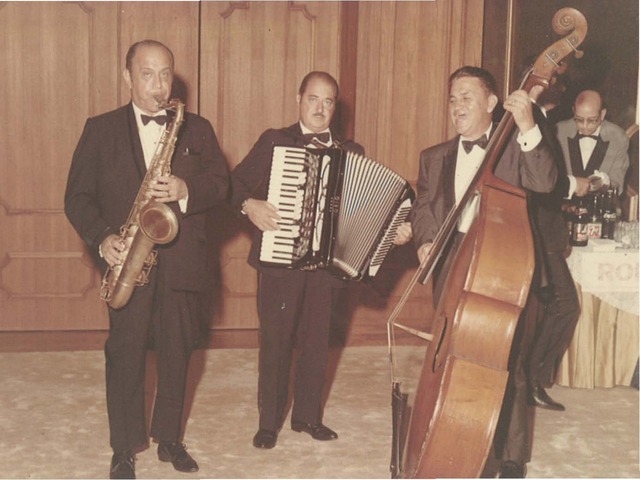
This story is actually about my parents, Josie and Lou Adler. My mom and dad really made an impact in Miami musically. In the pictures, you will see a photo of my dad at the Deauville Hotel on Miami Beach where he was the head of the Lou Adler Orchestra. He also played the bass fiddle at the Delano, Saxony, and the Americana, to name a few. Those were great days.

We lived on Northeast 50th Street and Second Avenue, now the Design District. My dad’s orchestra was playing on Miami Beach and all the rehearsals were at my house. I was the most popular kid on the block. He and my mother, who was the organist at Temple Israel for more than 30 years, played for many weddings and bar mitzvahs over the years.

We loved to eat at the Boulevard Cafeteria and at Edith & Fritz, for lobster. We went to the Olympia and the Boulevard theaters for movies and went shopping at Richards and Lerner’s on Flagler Street. After Sunday school, my mother and I would go downtown to Burdines to the cafe inside and have the Snow Princess dessert. This was a beautiful doll with an ice cream skirt with silver sprinkles all around the skirt.

My brother, father and I joined the Jim Dooley fishing club and went fishing often. We took lessons on a big boat at the port, which is now the Port of Miami.

I went to Shadowlawn Elementary school, Edison Junior High and Edison High. The pep rallies rocked the school. All the kids would go to the Red Diamond Inn for pizza and to The Big Wheel drive-in. I became a “Debs” girl and attended many dances and had a great time at Temple Beth David on Coral Way.

I love to dance. My friend Sherna Simonhoff and I took dancing lessons with Hildegard, and my mother played for the dancers. Sherna and I danced around in her beautiful house in Morningside in our ballet pink. She and I loved to take the bus downtown; it was10 cents. To this day, when I’m here in the winter, Sherna, now Sherna Brody, and I still hang out.

I finished my last two years at Miami High in the concert orchestra playing the viola. Southwest Miami was a new world to me. I was introduced to “Little Jerusalem,” and L.J., as it was known, was loaded with kids from that part of town. I remember a Dick Clark’s American Bandstand broadcast and we danced like crazy. The only way my parents could find me in the crowd was to look for the lilacs in my hair.

I went to the University of Miami and became a teacher. I was at Treasure Island Elementary School for more than 30 years. I met my wonderful husband Norman and we have two beautiful children, Gregg and Jennifer. Those were the good old days. Miami is a wonderful, diverse place to live and the best is yet to come.

My great-grandfather, Joseph Rapisardo, Sr., was a farmer in Chester, New York, with my grandfather, Leo Nicotra. As the cold and nasty winters arrived every year making crop growing a challenge, they decided to move to sunny Florida in 1950.

After arriving in Florida my great grandfather and grandfather built a home in Homestead, Florida on the corner of NW 8 Street and 6 Avenue. On the adjoining property they decided to plant onions. The crops grew well in the South Florida’s sunny winters. In 1950 the area was rural and Homestead only contained 4,573 residents.

After being so cold in the winter, South Florida was a piece of heaven and that is why for more than 50 years the family has continued to live in South Florida. At first my great-grandfather and grandfather tried to settle in Naples, Florida, but did not care for the area or the soil. They both agreed to move to the small town south of Miami known today as Homestead. It was a perfect fit for raising a family and starting a farming business.

After the elder Rapisardo and Nicotra were deceased, the children and grandchildren continued the family tradition. My father, Gaetano Talarico married my mother in 1962 in New York and in 1967 he also moved to Homestead, Florida. After falling in love with the area he started F&T; Farms, which is now over 40 years old.

I, too, went to school here in the winter and also in New York for the summer to continue the planting of the onion seeds. My uncle, Joseph Nicotra, continued the tradition that his father, Leo Nicotra, and grandfather, Joseph Rapisardo, started back in 1950.

The seeds were planted in December and the plants were pulled in April. Joseph and Leo made the long trip back by truck to Chester, New York, where they were planted again only to be re-harvested in July.

In 1953 the Homestead Air Force Base opened and grew the community to 9,152 residents and became a national center of attention since it contained the closest jet fighter facility to Cuba. With the new growth in Homestead, it still remained a part of an agriculture spot as it is today.

The property to date, now on the corner of NW 8 Street and 6 Avenue, houses duplexes that are still owned by the family. I have now lived in Homestead for nearly 46 years and was so proud to be a part of the Nicotra-Rapisardo family and learning the history of the planting seasons.

I was born in 1932 at Jackson Memorial Hospital in Miami. After my first three years at Grandma Rose Fields’ hotel, across from the prestigious DuPont Building, we moved to Miami Beach.

My recollections of those first three years was of me pretending to direct traffic from the arms of a kindly policeman at the corner of Northeast First Street and First Avenue, watching uniformed-dressed, Gesu-parish schoolgirls playing on the cement schoolyard on Second Street, occasional trips up the Miami River to a Seminole village, and watching Pan Am clipper ships land at their seaplane base in Coconut Grove.

As a young teenager, I returned to the hotel to be an assistant desk clerk and telephone operator. It was my habit to treat myself to a two-inch thick bologna sandwich with yellow mustard on rye bread at Albert Deli. It was next to Wilson’s garage, directly across the street from the hotel. Sometimes I walked a block to Royal Castle and had two or three burgers and a birch beer.

Surely some sensory experiences are never forgotten. I can recall the smell of the grilled onions and pickle on those soft tasty buns that sandwiched tiny RC burgers. In 1948, when I was 16, my parents Larry and Sophie Gilbert opened the Town Restaurant on part of the footprint of the New Pioneer Hotel.

“The Town” was to many professional and business people the place to go for breakfast, lunch or dinner. Many of its customers never had to decide what to order. The staff of waitresses knew most customers’ favorite dish for each day and the customers enjoyed being habitually recognized. It was the habit of many families to meet and eat at the Town before going to the Olympia theater for an evening of entertainment.

Miami Beach was the heart of my life. I went from kindergarten through sixth grade at Central Beach Elementary. Officer Bob Loveland worked the traffic light at 14th Street and Washington Avenue to safely cross us kids. The stanchion-pipe housing that held the electrical elements of that device remained standing for decades on the northwest corner of that busy intersection. As the years passed, it was my habit to drive by it and point it out when I took my children and grandchildren on my patented “heritage” tour of the city of my youth.

At Central Beach, Principal Katie Dean set the stage for us to understand the value of being considerate and compliant. Then came WWII. I was 9. We all did what we could to help in the domestic war activities. Shared efforts included air-raid drills and using coupons to buy rationed butter, meat, sugar and eggs.

We collected metallic objects to make munitions. From 1939 until the war started in December of 1941, my family operated the 14th Street Beach Cafeteria next to Sol Goldstrom’s Washington Avenue bakery. The government commandeered it for a military mess hall along with Hoffman’s Cafeteria on Española Way and Dubrow’s Cafeteria on Lincoln Road.

During the war years, my family operated a drugstore and lunch counter on Collins Avenue. Essentially all the customers were recruits. They were housed at hotels along the beach. When I saw them at that time I thought they were so manly; as I think about them now, they were little more than young boys.

As kids on the beaches, we watched blimps patrol the coast for Nazi submarines. We gathered cans of provisions washed ashore from U-Boat actions not far out. We developed unqualified patriotism that has remained my generation’s credo.

Scouting became a central interest to many friends and me when we turned 12. Troop No. 35 met at the American Legion Hall on 18th Street and Alton Road. Overnight hikes to what is now known as Watson Island were memorable events. So were the weekend camp outs at Greynolds Park. Scouting events took us to the old Deauville hotel and Venetian pools for swim competitions.

Life was made full with school programs at Ida Fisher Junior High and Miami Beach High school, semi-organized sports at Flamingo Park, and socializing at 14th Street Beach. Our Flamingo Park teams traveled to Shenandoah Park and to Little River to play.

My four years at Miami Beach High School was the most joyous time of my span of 25 formal educational years. Academically, it prepared me well for higher education. But it was with our teammates in interscholastic sport competition against the five other public high schools in Miami, and many others in the state, that proved to be the glue that bound us closely and from which we remain friends in our later years.

Beach High opened in 1926 on 14th Street and Drexel Avenue. I was a Beach High “Typhoon.” Our colors were black and gold. That school remained there for 34 years until 1960. It was then moved to its current location; its teams became known as the “Hi Tides.” From its opening in 1960 until now, 53 years later, people refer to the present school as the “new” MBHS (Hi Tides) with colors of silver and scarlet. Those same people refer to its predecessor as the “old school.” I think I know why. It’s just a habit.

Translate »