fbpx Skip to content
Named Best Museum 2022 by Miami New Times

Miami will always occupy a special place in my heart. My beloved grandmother spent such a great portion of her life here that the two are now synonymous in my mind. She had impeccable taste, which means Miami is the second-greatest city in the world; of course, our native Petionville, Haiti, comes in first.

My grandmother passed away April 2, 2012. I know she is in a better place now. The nationalist in her wanted to reach eternity via Haiti. Since that was not meant to be, Miami opened its arms – as always. It is where her remains are interred.

With a smile brighter than all the lights on Ocean Drive, my grandmother was the city personified. She wrapped her head in colorful scarves, reminiscent of Miami’s golden age, pulsing with the roar of turquoise and chrome convertibles. She loved the Fontainebleau for its Old World glamor and once-upon-a-time elegance.

My grandmother’s Miami was quite similar to our native country. Many friends gathered on her porch on Sunday afternoons to enjoy lodyans – a form of storytelling drenched in humor.They reminisced and laughed about old times back home. Most of her friends spoke only Creole, even if they had lived in the States for decades.

Her front door stayed open all day – as it did in long-ago Haiti. Restaurants that sold food cooked like back home, if not better, were just around the corner from her house. The grocery stores’ shelves were stocked with the ingredients she used to buy in Haiti’s open-air markets. Miami was her second Haiti. When back home was not accessible – because of various coups d’état and other inconveniences, Miami was her sanctuary.

My grandmother’s last visit to Haiti was in late 2009. She was thrilled to see the house in which she planned to spend what remained of her life. She had spent years sending money for builders to make her house just so. She was ready to move in the fall of 2009.

When she flew home to begin the rest of her life, friends and neighbors received her as though she had never left. Just as they did in Miami, everyone gathered at her house for marathon conversations and tasty food.

But the longer my grandmother stayed in Haiti, the more she pined for “home” – meaning Miami.

Three months after arriving in Haiti, she decided she had lived so long in Miami that perhaps she could not live anywhere else, including her birth country. She flew back to Miami on Jan. 10, 2010.

Two days later, a devastating earthquake struck Haiti, killing hundreds of thousands. She sobbed for the lost lives. I sobbed with her, but took comfort in the fact that she had returned just in time; she might have been among the still-unaccounted-for victims. That would have destroyed me.

As stories poured in about the quake’s aftermath, the utter destruction, the chaotic medical situation, my grandmother wept in silence. Her South Beach smile dimmed. Not even Miami could console her.

She mourned the fact that she could no longer return to her other, sometime home. She mourned the loss of long-ago Haiti – the Haiti that pulsed with turquoise and chrome convertibles, the lush and Miami-green Haiti, the Haiti she knew as a child. She was secretly grateful that her adopted city’s arms were always ready to envelop her. Miami had become her own private Haiti.

Five months before my grandmother passed away, she was admitted to University of Miami hospital. With each passing day, she became more and more frustrated about having to be in a hospital bed. She was accustomed to living life standing up. She detested the hospital gown, and wanted instead to wear her colorful wardrobe that reminded me of the sea, sunshine and coral reefs.

She told the doctors to send her home. By “home” she meant both Miami and Haiti. The intensive care unit was drab. It lacked vibrancy. It lacked life.

My grandmother has been gone two years now. I will always owe Miami a debt of gratitude for opening its arms to welcome my grandmother for as long as she wanted to be here. Whenever I come to the city, I sense her presence in the air. Everything she loved about the city is still here: the Fontainebleau, the banyan trees, the blue-blue water that hems the coast.

And just as my grandmother did when she was alive, I go to stores where only my native language is spoken. I eat Haitian food morning, noon and night. (I’ll admit I love Cuban cuisine just as much.) I visit Libreri Mapou and chat with the friendly owner and customers who cannot get enough of Haitian literature. Each visit makes it clear to me why my grandmother loved Miami so.

Perhaps one day, the city will claim me, too.

Living in Detroit’s bustling Lebanese community in the 1940s was very predictable -unless you were Joe and Mary Thomas, two of Miami’s pioneers from our nation’s largest Lebanese population.

The top priority then was doing everything to help our war effort. Two of Mary’s brothers went overseas, and the youngest died seven months later on the Pacific island of Morotai as part of Gen. MacArthur’s island-hopping campaign toward an attack on Japan.

To this day, I carry a dog-eared article about my uncle George from the “War Page” of the Nov. 20, 1944, Detroit News as a reminder of his ultimate sacrifice for our freedoms.

He was also the person who introduced my mother to my father. Joe’s tool-and-die job at the Hudson auto plant was converted to armament production. He won a glowing commendation from the Navy Department for developing a system to recycle damaged artillery from the field, which enabled him to get needed weapons back on the front much quicker.

After the war, Mary and Joe were married and began raising a family. Mary grew up on the second floor of her father’s grocery store and helped Joe open their own store. Unlike their parents, both from Lebanon, they decided they did not want their children working in the auto plants or the family store.

Upon hearing great things about Miami from their close family friend John Yunis, they headed south in 1955 and first lived in an apartment house he owned across from the Orange Bowl.

They later bought a house nearby on Northwest Third Street. Their oldest children attended Citrus Grove Elementary and Junior High, and ultimately Miami High. Mary’s father had refused to let her take a scholarship to a local college, despite being at the top of her high school class in Detroit. His old-country attitude was that education was a waste of time, especially for women, who should work in the family business.

This great disappointment shaped Mary’s No. 1 life goal: Do everything possible to give her children the maximum possible education. Joe, who briefly attended the University of Detroit but could not afford to continue, agreed.

As a result, one of their greatest accomplishments was that all five of their boys became doctors: two college professors with Ph.D.s, two orthodontists and one optometrist. The total of 16 different undergrad and graduate degrees for their five boys made up for the two college degrees they were not allowed or could not afford to pursue.

Besides raising and educating her five boys, Mary’s second life was dedicated to helping found and develop in 1973 Our Lady of Lebanon Church, which was established in the old Food Fair market on Coral Way. Joe converted the check-out counter to an altar so the first Mass could be held on Dec. 30, 1975.

When the church was struggling to generate income to pay off its mortgage, Mary suggested a weekend festival, as they had in their Detroit church. With their grocer backgrounds, Mary and Joe went to the farmers market to get fresh fruits and vegetables. She then organized a group of women who worked nonstop for a week to make homemade Lebanese food and treats. She was able to convince many local business people and others to make contributions for the fair, including live music.

The first festival in 1978 was a great success, and since then it has expanded to include arts and crafts, folkloric dances, and other fun activities. The 36th annual Lebanese Festival will be held Jan. 25-27, 2013, and it is the top moneymaker for the church. Approximately 5,000 Miamians and visitors enjoy it each year, but few know who the brainchild was behind it.

Mary was also the founder and first president of the Ladies’ Guild at the church in 1974. She continued her work at the church for decades until her health deteriorated.

Among the many accolades she received from the church and the national Maronite Church was the Silver Massabki Award in 1976. It is given to members of the parish “who have contributed extraordinarily of their time, talent and treasure” by the National Apostolate of Maronites.

In March 2011, she was able to attend a special Mass at the church honoring her and other founders.

Meanwhile, Joe became a general contractor and achieved his dream of building the family home on a two-acre mango farm in Pinecrest where Mary, now 91, lives. Joe died a happy man in 1998 on his 84th birthday in his dream house with his five boys and Mary at his side.

If you were to ask him or Mary about their greatest accomplishment, their answer would be very simple: “Five boys, five doctors!”

I grew up in Miami Shores beginning in the mid-1940s, a beautiful place to live where you can still view Biscayne Bay today, as you could then. I went to Miami Shores Elementary School and have fond memories of the teachers and my friends, some lifelong friends. I remember our teachers who were special, such as my first-grade teacher, Mrs. Gonzales, and the Easter Parade for our class. My fourth-grade teacher, Mrs. Dees, played classical music for us during rest time after lunch. We sometimes drew pictures to interpret the music.

I took ballet, tap, and toe dance lessons in a home studio where many young people took lessons. We had our dance recitals on the stage of the Shores Theater. We went to the movies there every Saturday morning.

I learned to swim at the Miami Shores Country Club. There was an Olympic-size pool with a high-dive and low-dive boards. It took great courage just to jump off the high dive! Miami Shores did have one real Olympic swimmer, Shirley Stobs. Her swimming specialty was the butterfly stroke. The pool has since been removed to expand parking and a water park has been built on the north side of the main clubhouse.

It wasn’t necessary to swim when I had a water adventure around the third or fourth grade. My friend had a grandmother who lived in a house on Biscayne Bay, just south of Miami Shores. They had a small boat dock. Toni and I tried a little fishing off the dock. After a while, I got a nibble on my line that kept getting stronger and stronger. I pulled and wound and finally landed the fish on the dock. It was a baby sand shark! It was thrown back into the water.

Brockway Memorial Library opened in Miami Shores in 1949, made possible through funds donated by industrialist George A. Brockway. I often felt like I had read my way through all the books in the children’s section and can remember checking out stacks of books during the summer months. A couple of years ago the library requested donations of Miami Shores historical items so I donated my Miami Shores Troop 39 Girl Scout badge sash with earned badges. Troop 39 members started with the Brownies in the first grade, continuing with the Girl Scouts into junior high school. In scouting our troop visited places in Miami such as Greynolds Park, Camp Mahachee, Parrot Jungle and Matheson Hammock. Our last farewell to Troop 39 was a weekend hotel stay on Miami Beach.

We had our meetings after school at the Miami Shores Community Church, the longest established church in the community and near the school. Many of us rode our bicycles to and from school. I rode my bicycle to school starting in the first grade. Miami Shores Elementary was a little over a mile from my house. I continued to ride my bicycle to Horace Mann Junior High School in the first year or two.

In 1948 I participated in a pet and doll show at the Miami Shores Community House. I didn’t win any prizes but someone took a photo that was published in a newspaper. It was spotted by Mrs. Carnegie Cline who later taught me modeling and drama. She was also involved with the Miami Daily News Youth Roundup of Dade County. I got to know the youth editor of the paper and was involved with many of the Roundup activities. I had the opportunity to model in fashion shows at the Burdine’s Tea Room and The Surf Club, ride floats in the Orange Bowl parades and meet famous people like Olympic champion Pete Desjardins at the Deauville, movie star Preston Foster and some of “the little people” who starred in The Wizard of Oz.

The Cuban revolution was taking place while I was at Miami Edison Senior High School. I remember hearing the news announcement on the radio that “Batista has left the island of Cuba.”

After graduating, I went off to college, and then moved to Atlanta, Georgia, but made visits home for brief periods. In recent years I’ve been to Miami for extended periods. When I referred to the Miami News building in downtown Miami, no one knew what I was talking about. It wasn’t until I went to an Art Basel 2012 exhibit in the Freedom Tower that I learned the Miami News building had become the Freedom Tower. Miami-Dade College unveiled the adjacent Pedro Pan sculpture to mark the 50th anniversary of Operation Peter Pan, which resulted in over 14,000 unaccompanied children sent from Cuba to the United States.

I’ve enjoyed subsequent visits to the tower for special exhibits. I learned that a year after this Spanish renaissance revival tower was built it was damaged during Miami’s1926 killer hurricane and was rebuilt twice. It was donated to Miami Dade College in 2005 by a local developer. It’s a tribute that Miami has saved this U.S. National Historic Landmark that stands tall as a reflection of the city’s history while new development grows around it by leaps and bounds.

Suddenly there is fire in the treetops along the turnpike. The sidewalk is carpeted with orange petals and the Poinciana preens itself above the jacaranda’s demure lavender feathers and the frangipani’s pink and yellow pastels. The calendar doesn’t tell us it is time for our yearly Poinciana Walk, but the world does. While we go for the sake of the trees, the homes in the Gables that they guard and grace have become characters in a never-ending story.

On one of our earliest peeking-through-the-Rangoon Creeper days in the French Village, we stumbled onto the storybook house at the southwest end of the block of chateaus. Double garage doors and peeling white paint abutted the perfectly restored wall and manicured yard we had been admiring. A diminutive arch with a black iron gate opened out diagonally to the corner of the street from a postage-stamp herb garden. Above and below, casement windows hinged inward, screens offering only the filmiest filter. The wavy glass panels of the butler’s pantry cabinets were clearly discernible from where we stood outside. Farther down the walk, a vase of fresh flowers bloomed in the window, and next to it a gray top-knotted head was turned toward the flickering screen across the room. We were mystified and mesmerized by the house, a vestige of the neighborhood’s 1920s legacy. We ached to get inside.

Then, one afternoon, we rounded the corner to hear the sounds of pans scraping through the kitchen’s casement window. Pungent garlic and onions sizzled on an unseen stove top, and plates clattered on an imagined table. Two shadowy figures floated in the lampless kitchen, one seated and one busy in the evening light lingering along the freckled street, while a gray head watched at her post, as always, next to the flowers in the living room window.

Months later, as we paced back and forth along the length of the house, by now the object of fantasy and imagination, two wiry little ladies appeared in the open door and looked out at their stalkers. The tiniest one, with delicate bird fingers, pushed open the wrought iron, screen-covered door and smiled at us. Her face was encircled with a white cottony halo and the parchment skin on her face creased into smile lines from her eyes to her chin. The woman behind her seemed younger, more serious and stern, or just responsible and justifiably wary. “Hello ladies,” The snowy one spoke. “Are you enjoying your walk?”

We were nearly speechless. For all our wishing, we weren’t prepared for this sprite to actually speak to us.

“Oh, yes. This is our favorite street. Yours is our favorite house.”

“We think it is pretty special, this house. That’s why we have stayed here all these years. Of course, the Realtors won’t give us any peace. They come by here nearly every day.”

“You aren’t going to sell it are you?” Our simultaneous question belied fears of contractors and realtors circling like vultures.

A little giggle slipped into the pixie’s voice. “Would you sell paradise?”

The taller woman reached out for the handle of the iron door and began drawing it toward her and closing the little doll lady inside. “Enjoy your walk.” She gave a tiny wave, her open palm nearly as papery as her face. A walk in paradise.

Today, perhaps because we had already walked on many streets, we drove to Cotorro Avenue, turning in from the northern end of the French Village block. Maybe if we had been on foot, the awareness would have come gradually. Instead, we were shocked to find the Garlic Sisters’ house standing naked on the sidewalk. The grizzled hedge, ripped from the ground, exposed ancient pipes and spigots that had quenched its thirst for perhaps as many years as we were old. The Florida honeysuckle vine that circled and wound and draped luxuriously over the garden wall was now twisted dry and gnarled in the side yard under piles of debris, boards and nails and chunks of plaster.

Tears blurred our vision, but we scarcely hesitated to duck through the arch and tiptoe gingerly around the rubble that had once been a garden, to French doors, standing open in the back. We stepped through onto original tile floors, terra cotta cool, and looked up to a black, wrought iron chandelier dangling above. Straight ahead, the wood paneled front door, directed a turn into the living room where a TV antenna wire dangled onto the floor.

Off the front hall, a door stood open to the kitchen where black and white tiles checkered the floor. In the empty butler’s pantry, wooden drain boards, grooved and stained, sloped down to an old porcelain sink with iron faucet and knobs still intact. On the drain board stood a vase of flowers, once fresh cut carnations, daisies, and spider pompoms, now drooping with curled and wilted petals. Not the stuff of potpourri, but of memories.

A simple ribbon circled the vase, its color indistinguishable. A florist card stuck out from a stiff plastic stem. The envelope was addressed to Virginia O’Dowd, 1032 Cotorro Avenue, Coral Gables, Florida. Dreading to see what the message would say, fearing a get well wish or sincerest sympathy, my hands shook as I turned over the card. The typed letters read: Happy Birthday, with Love.

Outside, a child’s riding toy rumbled by, a stroller wheel complained and young women’s voices drifted up through the pantry casement. Neighbors. Maybe they would think we had no right to be there, to find the flowers, to sniff for garlic, to walk over dining room tiles the sisters’ feet had crossed and re-crossed until they wore a pattern in the stone, to listen for the echo of a little birdlike chirp. “Enjoy.” So we left the French door just as we had found it, passed through the garden wall, and whispered an apology to Virginia for not somehow leaving her flowers in the open window.

I was born at St. Francis Hospital in March 1947.

My parents both came to Miami Beach for work, my mother in 1936 and my father in 1939. They met while working together at a deli, owned by my great aunt and uncle (Mary and Dave Alper).

We lived on 15th Street, near Washington Avenue and the old Miss Ehrman’s dance studio. We were one of the first families to move to the very new Morton Towers. A lot of my family moved to Miami Beach soon afterward.

My grandmother Fannie Malschick, already retired, lived in one of those apartment/hotels on South Beach that now host the rich and famous. She played cards with her cronies, did group exercises on 15th Street and safely walked everywhere.

My uncle, Gilbert Malschick, worked at the Eden Roc as a bartender from the 1950s to the 1970s. My cousin, Allen Malschick, was a well-known Miami Beach photographer who took pictures of many celebrities who entertained at the hotels on Collins Avenue.

My father eventually opened his own deli with partner Phil Seldin (Raphil’s Deli on 41st Street). His customers included the famous and infamous. Before that, my dad owned The Little Inn restaurant in Miami, a popular hangout for soldiers and friends during World War II.

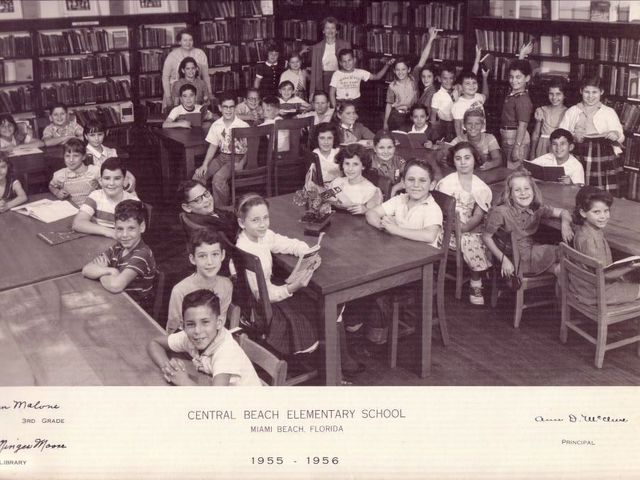
I attended Flamingo Park preschool, Central Beach Elementary, Fisher Jr. High and Miami Beach High School. Many of my friendships, born during those years, have stood the test of time and I am in touch and close to many of those “kids” today.

In 1960, the first wave of Cubans came to Miami Beach. All of a sudden a new culture was introduced, and we had tons of new friends. We spent the sweet years, as I now refer to my childhood, at Saturday afternoon matinees, shopping on Lincoln Road, and eating at Liggett’s or Wolfie’s. Friday night was dedicated to dancing at the 10th Street auditorium, and on Sunday, many beach parties were held at 14th Street and Ocean.

As we began to drive farther from the Beach, we hung at Fun Fair and the bowling alley across the street, Corky’s and Marcella’s Italian Restaurant, known for the amazing garlic rolls. We ventured even farther to the Coconut Grove coffee houses and playhouse.

I left Miami Beach after high school graduation in 1965, but my heart remains in the memories of those wonderful years. Our lives are richer for the experience and we have grown both up and together these many years later.

The year was 1942. My father, Don Terry, was in the Navy stationed at the Everglades Hotel in downtown Miami. During World War II, the hotel was used as a Navy barracks. He swept every floor of that building.

One Sunday evening, he went to Central Baptist Church where he met my mother, Margaret. Instead of marrying right away, he left and served in the South Pacific theater for the remainder of the war.

My parents wrote letters back and forth and each letter was numbered. Not ONE letter was lost over a period of three years. Today I enjoy reading parts of those letters. One day, I hope to write a book about their experience.

In March 1945, they were married and they honeymooned at the Leslie Hotel on South Beach. I was born a year later.

After his honorable discharge from the Navy, Dad returned to Miami and worked awhile at Eastcoast Fisheries along the Miami River. Having taught school in Texas, he applied to teach here in Miami. He taught speech, drama and band at Hialeah Jr. High., Robert E. Lee Junior and West Miami Junior until his retirement in 1975. Sen. Bob Graham is one of his former students. He passed away right after Hurricane Andrew in 1992.

Mother, a native Miamian, was a graduate of Miami Senior High, class of 1935. She worked at the downtown Burdines store and then at Florida Glass & Mirror. She also worked several years as registrar at Kinloch Park Junior High and retired from the payroll department of transportation to enjoy watching her only grandchild.

Also a native Miamian, I attended Miami Senior High, (class of 1964), then went on to Miami-Dade Junior College, Barry College and University of Miami. I taught in Dade County Public Schools for 32 years — at Kinloch Park Elementary, Gloria Floyd and South Miami Heights Elementary, from which I retired from in 2001.

I now co-own and manage Bijoux Dance Center, 4150 SW 70th Ct., where I teach ballroom dancing. I have so many memories of Miami over the past 60-plus years and how it has changed. The skyline, demographics and spoken languages now reflect the cosmopolitan nature of my hometown.

The Orange Bowl is gone, the parade, the old zoo on Key Biscayne, the amusement rides on the roof of Burdines at Christmas, pony rides on Northwest 36th Street, the Coliseum in Coral Gables, drive-in movies, IHOP on U.S. 1, the amusement rides on Northwest 79th Street and 27th Avenue.

But the Venetian Pool and Biltmore Hotel are still are part of the scenery.

“My kind of town, Miami is.”

A child of the Florida sun, I lived in soft T-shirts and sandals. But here I was, walking with my mother to Van E. Blanton Elementary School, attired in a plaid dress and stiff Oxford shoes. September 1959 was a more innocent time; the terms “crack,” “pusher,” “grass,” or “weed,” surely would have conjured images of children playing on steaming sidewalks where brown summer grass and wildflowers pushed hopefully upward.

At registration, we were told by the principal that first graders’ hours were 8:30 to 12:00 noon for the first three months, and after that the school day ended at 2:00. She added that 6-year-olds should walk unaccompanied to school, as it built self-reliance. First graders were served a carton of Home Milk decorated to look like a house and picket fence, and home-baked cookies in the school “cafetorium” for $1.00 every two weeks.

Walking to school in second grade, I discovered dozens of buttons which read “John F. Kennedy.” Who was he? My teacher explained he was running for president on a platform of equal opportunities in housing, school and jobs for all. A wonderful idea, and it was exciting to follow my first election on TV!

In fourth grade, we had many new classmates from “Operation Peter Pan,” in which Cuban children settled in the United States, often not knowing if they would ever see their families again. I vividly remember the first two arrivals. One, “Angela,” was very shy. She wore the same outfit every day and only responded quietly if Spanish-speaking adults talked first, but she always worked hard on her studies.

Then there was “Maria.” We girls would marvel at her vast supply of rustling silk dresses and gold jewelry. She bubbled over with fluent English that her “Abuela” (Grandma) had gone on a shopping spree at Jordan Marsh in anticipation of her arrival, adding, “Abuela is taking me to New York and has arranged for me to have ham on the plane,” smacking her lips. I was insanely jealous!

There was a game we played every Friday called “7-up.” Seven students would randomly tap seven blindfolded students, then we’d guess which person tapped us by asking seven questions about hobbies and interests. Maria tapped me. I guessed correctly with one question about an upcoming trip. The normally happy, bubbly child burst into cries: “Cheater! You looked to see who tapped you.” I sobbed, “I did not, I recognized the swishing silky sound of your dress.” My teacher mediated: “I want you two to talk privately with each other and smooth things over.” We calmly conferred; Maria acknowledged, “I believe you didn’t cheat; my dress DOES swish.” I responded “Why do you keep bragging about clothes and jewelry and trips? You’re making the kids jealous.” She replied, “I’m envious of you all. You have lived here your whole life and I had to leave my home and might never see my relatives again.” I lovingly hugged and reassured her: “This is your new home and I’ll be your new best friend.” Our teacher then had us sit side by side for the rest of the year. We exchanged gifts of crayons and bubble bath. Maria exclaimed, “Together, we can color and draw beautiful pictures of the beaches in Miami and Cuba.”

In October 1962, we had to confront possible mortality. President Kennedy announced Cuban missiles were pointed towards the United States. A tense standoff lasted three weeks. There were simulated air-raids and we would dive under desks for cover; thankfully it was soon over. My teacher told us that, ironically, the brief crisis actually helped thaw some of the relations between nations, apparently for a mutual desire to preserve mankind. Meanwhile, I wrote poems about annihilation which I submitted unsuccessfully to the Blanton Bugle: “Mother is baking an apple pie, soon we all will die.”

November 22, 1963 dawned as an exciting day for me; I had no idea the day would end so tragically. All summer, I had practiced for a jump-rope competition, with Maria timing. Practice paid off, I won the prize jump rope! But sadly, just as school ended, someone shouted, “President Kennedy is dead. He was shot.” We all froze! Teachers admonished, “Go straight home. This is a national tragedy.” School was closed the following Monday. For one month, school flags were flown at half-staff with black ribbons. President Lyndon Johnson announced that he would carry on President Kennedy’s legacy with the 1964 Civil Rights Act. We all learned a lesson that could never be taught in a classroom: that one’s life can be tragically cut short, but grief and sadness can be channeled into helping their memory live on, by carrying on their good works.

Our school years at Blanton were finally coming to an end. Sixth graders were treated to a barbecue and swimming at Morningside Park and pool, equipped with a high-dive. I was afraid to dive but it was now or never! Slicing through cold, clear blue water, my young life passed before me. I had learned so much: reading, writing, math, elections, death and friendship. How you can make things happen; words can make an enormous impact. Crayons and paper can be transformed into beautiful pictures. Gasping when reaching the water’s surface, I heard my teacher exclaim: “Karin, hurry up. It’s time to go. But first, let’s have a rousing rendition of our school song.”

As onlookers gaped, we sang, “We’re loyal to our school, it’s here we learn and live, knowledge strength and beauty too, these to us we give, our teachers show the way to make our dreams come true, Van E. Blanton, Van E. Blanton, we all stand for you.”

Our first family visit to the Miami Public Library (as it was called then) was back in 1958. I was 5 years old, my sister Victoria was 8, and my brother Matthew was 10. We visited a crowded shopping destination, “Little River.”

After going to Woolworth’s, Arno Shoes, Beauty Fair and Larry’s Restaurant, my mother Mildred “Fritzie” Stahl spotted the Little River Library and exclaimed, “I’ve been meaning to get a library card. Let’s go there!” My sister Vickie picked out Lad: A Dog, I got Blueberries for Sal and my father Edmund checked out a large, illustrated Don Quixote and Sancho Panza and read it to us that same night, which my brother especially enjoyed.

Fritzie loved the library so much she quit working at Burdines in 1959 to work at Little River Library full-time. Although her official position was “Clerk Typist I,” with her educational background at American University, and with my father’sbackground as a member of the Art Students League, they embarked on professional endeavors there.

My mother participated in the children’s summer reading club, which my sister and I eagerly joined. Here’s how it worked: during the summer of 1963, a bulletin board was placed at each library branch entrance. For each child, a colorful fishing pole was placed on the board, identifying the reader. Whenever a child finished a book, a fish was added, showing which book the child had “caught” (read).

My sister’s fishing pole was heavily sagging with such “catches,” including Herman Wouk, Ernest Hemingway and Margaret Mitchell. My pole was heavily laden with Beverly Cleary and Mark Twain selections. At the end of the summer, 15 children from the Little River library boarded a Coast Cities Coaches bus downtown to receive a certificate of achievement. A total of 725 children, each of whom had read a minimum of eight books, attended from libraries throughout the county.

My parents also presented many puppet shows at the library. One memorable show was Treasure Island, by Robert Louis Stevenson. My father designed cloth puppets and painted scenery, and my mother wrote a script based on the book. After the show was over, my mother was delighted because several children asked, “Where can I get a copy of Treasure Island?” A “classic,” which might otherwise be just sitting on the shelf was being noticed!

I remember one librarian who worked with my mother in Little River, Miss Grace Rayfuse. Fritzie knew the library so well she would just look up a book if children asked for one, but Miss Rayfuse suggested, “Always say, ‘let’s look in our card catalogue,’ if it is a child asking for a book.” That became a catch-phrase in the library.

It has now been more than a half-century since our family’s first visit to the Little River library. My brother, mother and father died many years ago. My sister and I still live about three miles away from the library (we are currently zoned to use the North Miami library). We still love books. Our living room resembles a library itself with floor-to-ceiling bookshelves filled to capacity.

I decided to take a sentimental trip back to the Little River library recently. The exterior looks much the same with its slanted pillars and double-glass doors. Inside, it was much different. Children had replaced pencil and notebook paper with laptop computers. Instead of “[our] card catalogue,” children now expertly skim a computer mouse to search for books.

Sadly, there doesn’t seem to be nearly as many books available as when I visited the library in the 1950s and 1960s. The entire shelf near the checkout desk was gone. In its place was a display of videos, compact discs and DVDs. Everything seems so different. And yet the library director informed me the county still offers the summer reading club. Despite all the new technology, there are still thousands of books available for checkout. I checked and yes, Treasure Island is still available.

I was born in 1946 in Greenwich, Conn. Every winter we would take the train to Miami and stay at the Gulfstream Hotel in Miami Beach.

One could look down the beach and not see another hotel nearby. There were a lot of “snowbirds” (although that term had not been coined yet) who stayed there, among them some of the rich and famous, as well as the infamous.

I had my picture taken with J. Edgar Hoover when I was 4. Sorry to say I lost the newspaper clipping of that photo in my many moves. I had no idea who this pudgy man was or why the photographer was making a fuss over us. There were other children around my age. There was Sherman Billingsley, whose father owned the famous Stork Club in New York. There were the Kresge children, Cary and Kitty. Their family owned Kresge’s 5 & 10 cent stores. The name may not sound familiar now but the K in Kmart stands for Kresge.

My family eventually bought a home in Miami Beach and we moved there full time when I was 6. Growing up in Miami Beach in the 1950s and ’60s was wonderful. I don’t think we realized then what a paradise we lived in. There was the dog track at the end of South Beach. The Art Deco hotels were filled with vacationers from New York and New Jersey. There were the Orthodox Jewish diamond dealers who would come in the long heavy black coats, even in the heat. There were the retired people in their orthopedic shoes schlepping their lounge chairs. Frank Sinatra was singing in the Poodle Room of the Fontainebleau, and once I passed Sammy Davis Jr. on Arthur Godfrey Road. He was this tiny man with two enormous bodyguards.

I went to St. Patrick’s School and then to Carrollton in Coconut Grove. Many of our classmates had fled from Cuba. They taught us the meaning of freedom and added spice to our city. I remember driving to school during the Cuban Missile Crisis, never realizing that we were in such danger. We were just excited to see all the cute sailors and soldiers all over Miami.

I have returned to Miami Beach a few times over the past years. It is not the place I grew up. The small motels vibrate with the beat of Latin music and “the beautiful people” come from all over to lie on the beach. If it weren’t for Joe’s Stone Crabs, I would think I was in the wrong place. I am glad this amazing city has been revitalized. In the 1970s, the hotels showed their age. The shops on Lincoln Road were all closing and parts of it looked like a ghost town.

The people who walk the beach and sidewalks now don’t know what the Stork Club was or that there were such things as 5 & 10 cent stores way before the dollar stores came into vogue. The young ones won’t know who Hoover was, nor will they have heard of Sinatra or Sammy Davis Jr., except through old black-and-white photos or a song they hear in an elevator. I don’t know if 41st Street is still called Arthur Godfrey Road or if people remember that Jackie Gleason did his TV variety show from the Miami Beach Convention Hall.

I do know that I was blessed to have grown up in paradise. I hope those who reside there know how lucky they are and make wonderful memories that will come back to them when they are old and living in New Jersey.

My father, David R. Balogh, is a Miami Beach legend. Most Beach people knew him and many, many shopped at his Balogh jewelry store.

Today, wherever I go, whether Miami, New York City or even Sun Valley, Idaho, I meet people who proudly show off their long-ago-purchased Balogh treasure.

My dad’s story is in many ways typical of the tales of those designated by Tom Brokaw as “the greatest generation,” those men and women who helped us defeat Nazism in World War II and then returned home to create the most prosperous and free nation, not even fathomed by our founding fathers.

I do believe, however, that my dad has some very distinguishing qualities, especially his unusual embodiment of both an ambitious drive coupled with romantic warmth and charm. He was the Navy vet who sent home every paycheck to his loyal wife Sallie. And when he returned from the war, they drove their old station wagon from New York City to subtropical, undeveloped Miami Beach to begin their family life with infant daughter Joan. What drove him to Miami, in addition to his run-down jalopy, was his conviction that Miami Beach was nirvana with its consistently sunny weather, the ocean and the palm trees. This was the venue to start a business and a life.

My parents rented a very small store on Arthur Godfrey Road, as they certainly could not afford Lincoln Road. They began a “mom and pop” antique business. My dad’s optimism led to his conviction that his customers would invest in and celebrate a new, good life with lovely items both to wear and to adorn their homes. He believed both in Miami Beach and in America. He was spot on about his customers, Miami Beach and America.

In addition to his foresight and optimism, he had skills. He had an uncanny business savvy, sensing where and how to buy, and he had a charismatic ability to sell. He loved beauty and believed in investing in real, tangible items. This mom and pop business grew just as he had envisioned; it was enlightening to witness the business morph from a two-person, seven-day-a-week operation into an internationally renowned jewelry store. He opened stores in Coral Gables, Hallandale, the Diplomat Hotel and much later on Madison Avenue in New York City. But the basis of his business and his heart remained in Miami Beach.

As my father’s business grew, so did Arthur Godfrey Road. It was symbiosis; David Balogh and Arthur Godfrey Road fed off each other and grew together. He purchased real estate on the street and involved himself in leadership roles, such as establishing the parking facilities to help all the small businesses and restaurants in the area. He was active in the Miami Beach Chamber of Commerce and many local and national philanthropies, such as Mount Sinai Hospital, juvenile diabetes and the University of Miami. He became imbedded in the fabric of Miami Beach life. My dad retired at age 92, but he still puts on his suit and tie every day and enjoys riding around looking at his properties.

My dad’s dedication and focus went considerably beyond his jewelry and real estate businesses. He was an accomplished musician — a pianist and flutist. He actually met my mom in Astoria, New York, through his music; he was her piano teacher. He played first flute in the Miami Beach Symphony and I remember feeling special to be called up on stage to conduct when the symphony came to my North Beach elementary school. He was so proud that he was able to play under the maestro Arturo Toscanini. My dad’s special motto, still displayed in his closet shelf, is “you never fail until you stop trying,” and this definitely permeated the inner structure of his businesses and his family. Fortunately, I was able to incorporate some of my parents’ strong work ethic and very ambitious, yet measured, approach to life.

I grew up in a very close family and was indoctrinated with family-first values. As with his business life, my dad also fulfilled his familial goals. My younger brother, Bobby, a “chip off the old block,” has built his life in the Miami area. After Yale undergraduate school and then law school, Bobby has taken our father’s real estate interests beyond even David’s expectations. He and his wife, Cara, have molded two talented children, Andrew and Alex, both Yale undergraduates.

I am a practicing psychoanalyst in New York. My husband, Marty, guided by my father, opened his own jewelry business in New York almost four decades ago. We have two wonderful and accomplished daughters. Cara is a Ph.D. and professor of American literature, while her sister, Anna, another “chip off the old block,” is in the real estate business. Clearly, all this was the result of the example he set, the drive he had and the quality and quantity of time he and my mom spent with us.

The Greek hero Achilles was given the choice by his goddess mother Thetis to live either the adventurous, but short life or the long, undistinguished one. My dad, now 94, my hero, never had to make this choice. He has lived both.

Translate »